

This is the shocking story of how for sixteen years Ealing Labour councillors talked rubbish about having to make “difficult choices” to cut services to save money, ignoring thousands of residents' protests, and in doing so created a massive mess that a decade later still costs millions to clean up every year and leaves children’s and disabled people’s lives unnecessarily poorer.
It’s a story about an ambitious New Labour leader - politically aligned with Tony Blair and his campaign director in 1997, the three times disgraced ex-Lord Peter Mandelson - who makes bad choices that harm the very people (and their children) who elected him to represent them in Southall Green, one of the poorest council wards in Ealing.
Not only do his bad choices harm vulnerable people who deserve better, Ealing Labour’s “solution” to the problem they created is to blame and punish their victims - with fewer frontline services they need the most, more authoritarian and privacy-violating surveillance, and harsher financial punishments for and criminalisation of often unfortunate individuals who can’t afford to pay huge fines, while allowing actual criminal fly-tippers to carry-on and get away scot-free.
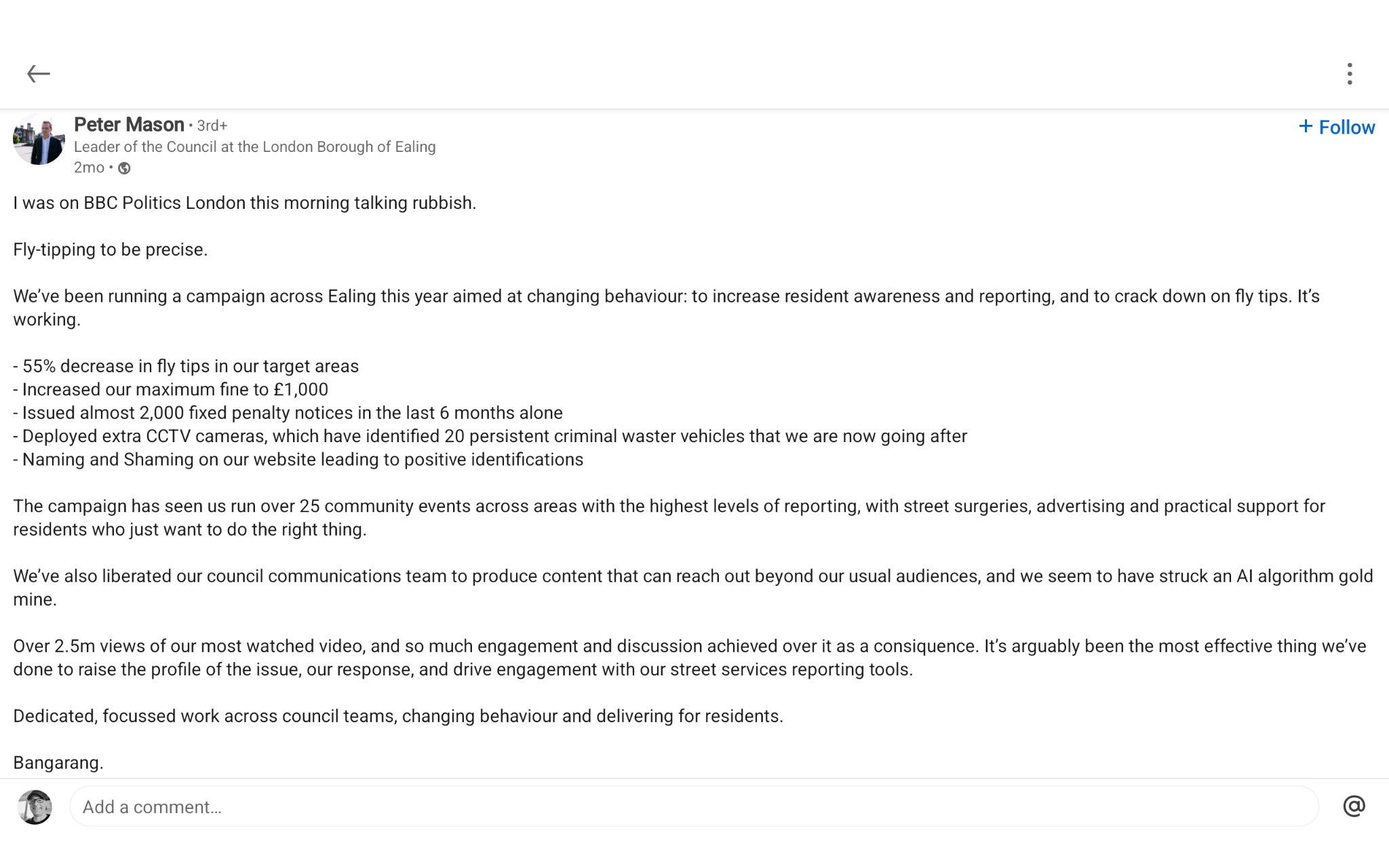
Seemingly oblivious (or maybe not) to the chaos and disorder caused, he celebrates spending millions more than he saved on enforcement by trumpeting his “listening to residents” and his enforcement “achievements” on TV and LinkedIn, signing off with a Boris Johnson-esque “Bangarang”.
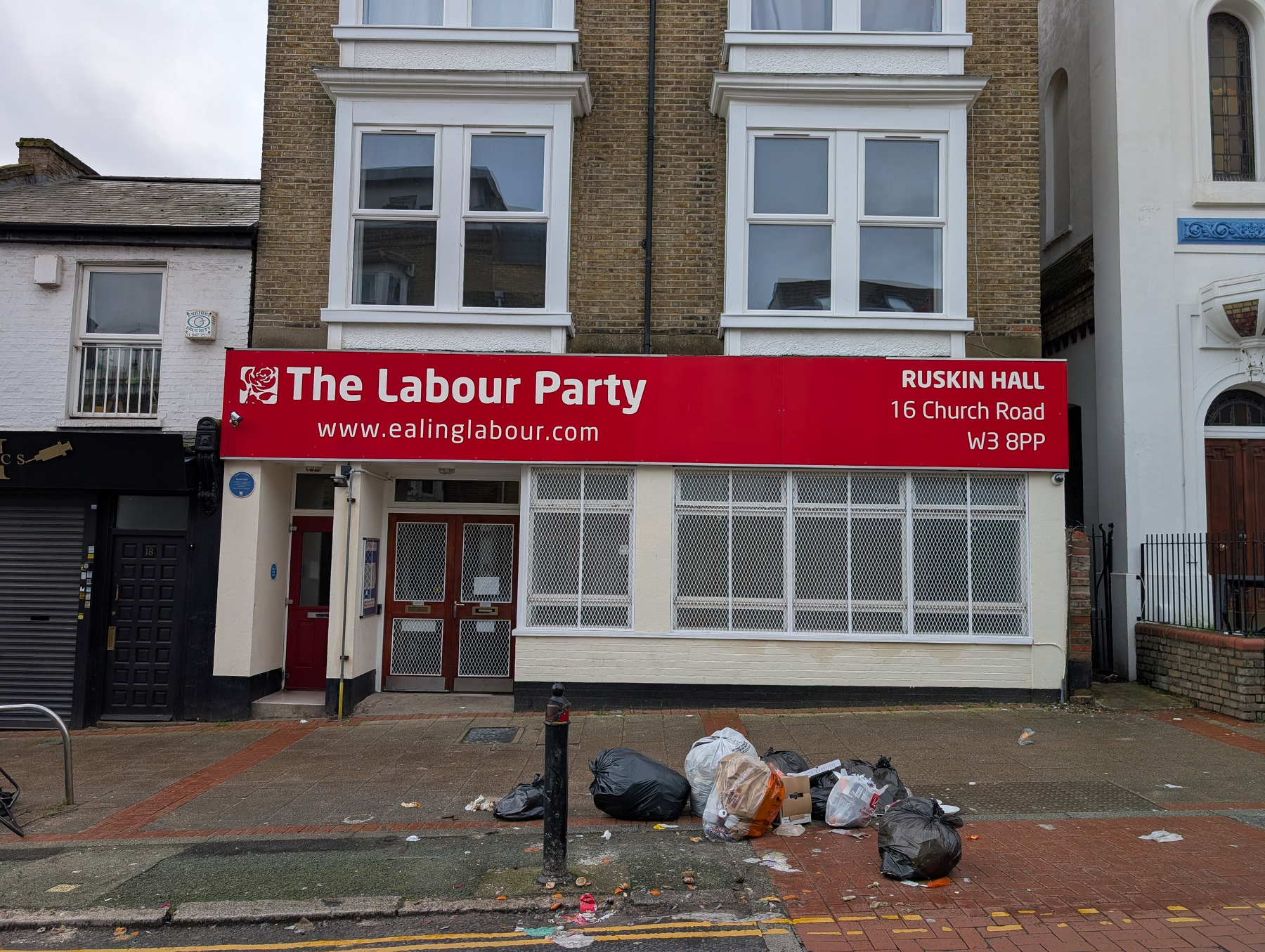
Bangarang Pete
Ealing Council last week announced their draft budget for the coming financial year 2026-27. Coming just three months before local council elections in May, it is full of what many voters will see as nothing more than simple electoral bribes.
Ealing Labour Leader Peter Mason hailed it as the first council budget in sixteen years that doesn’t cut frontline services such as social care, schools, housing and planning and waste collection.
That’s quite an admission.
Sixteen years of Ealing Labour cutting frontline services as if they were Tories.
Of course, Ealing Labour always blamed the national Tory government cuts to local government funding. They had no choice to make the “difficult choices” that were effectively imposed upon them by a hard-right Tory central government.
What else could they do?
At least they did it in a more professional and grown-up way than Ealing Conservatives would have done!
And let’s just pretend that Peter Mason didn’t spend much of his time between 2015 and 2019 in cahoots with “the Dark Lord” Peter Mandelson - the disgraced best friend of convicted paedophile financier Jeffrey Epstein - in trying to undermine Jeremy Corbyn every single day.
Corbyn isn’t perfect, but a Corbyn-led Labour government in 2019 would certainly have provided increased funding to local authorities.
Instead, self-identifying “left-wing” Mason made the “difficult choice” to withdraw support and effectively hand the election to known anti-Semite, all-round racist, liar and “killer clown” Boris Johnson. Never on your side.
After Corbyn’s successor as Labour Leader Keir Starmer won a landslide General Election last year against a Tory Party reeling after five years of chaos and confusion under Johnson, Truss and Sunak, Mason was clearly delighted to announce additional central government funding.
But with Starmer generating his own chaos by supporting war crimes by Israel and embroiled in a scandal of his own making with his appointment of Peter Mandelson as the British Ambassador to the US despite knowing of Mandelson’s continued friendship with the convicted paedophile Epstein, national Labour’s stock is at an all-time low.
Similar to by-elections, local elections are often a convenient opportunity for the general public to voice their frustration with, and opposition to, national government policies and failures with a protest vote against the ruling party.
Ealing Labour councillors must be very concerned that many of them will lose their massively increased allowances in May, thanks to the actions of Starmer’s national Labour Party.
In the lead-up to the elections, therefore, their leader Peter Mason has seized the opportunity to take back the local initiative with a financial package of “improved” frontline services, including action on fly-tipping.
One of the big local (and national) issues now in Ealing, and especially Southall, is fly-tipping, with the perception across the borough that the problem, while not new, has got significantly worse in recent years.
A quick recap of how we got here
In 2003, “Filthy streets, dirty parks, a growing drug problem and overcrowding mark Southall as suffering ‘inner-city deprivation’”, then London Mayor Ken Livingstone admitted.
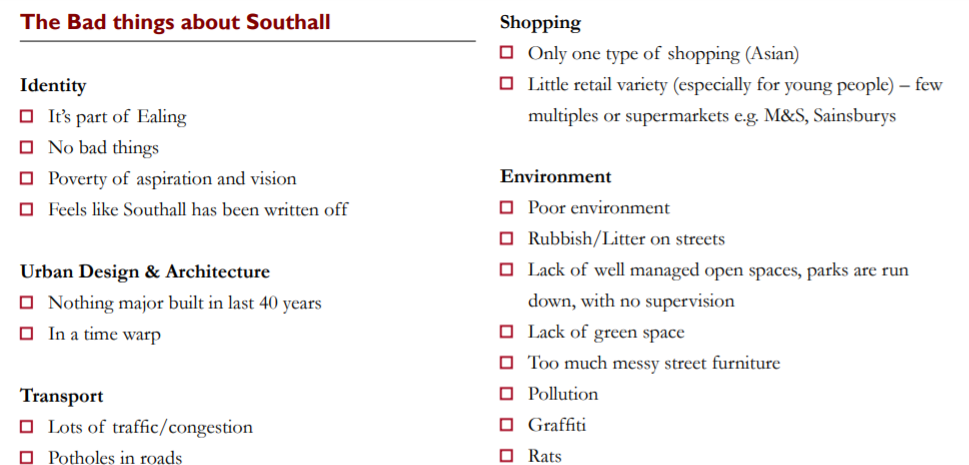
Around the same time, Southallians complained about rubbish and litter on our streets in response to a consultation on the possible development of the old Southall Gasworks site.
 —
—
In 2010, soon after Peter Mason arrived in the borough, he was complaining about his new neighbours on Facebook, who - quite possibly - were rooting through his trash in the night:
“How many times must i be woken up by their squeaking?”
Rather than set an example and report a noise nuisance via the council website like a normal person, Mason proposed a callous, ruthless and deadly violent solution:
“will somebody please shoot these fucking foxes in Acton!”

It was after Mason’s arrival that Ealing Labour under then leader Julian Bell made the “difficult choice” to freeze council tax every year while the national Tory government cut their funding by 60%.
Of course, they wanted to protect the majority of people suffering under Tory and LibDem imposed national austerity from having to pay more council tax. But in doing so they reduced further still the amount of money available to sustain local services.
Cynics might point out that Bell was afraid that raising council tax would be vote loser. Instead, in order to retain power, he made the “difficult choices” to raise funds and save money by selling off Ealing’s public assets and cutting frontline services - including adult social care services in Southall, and a 50% reduction in waste collection across the borough.
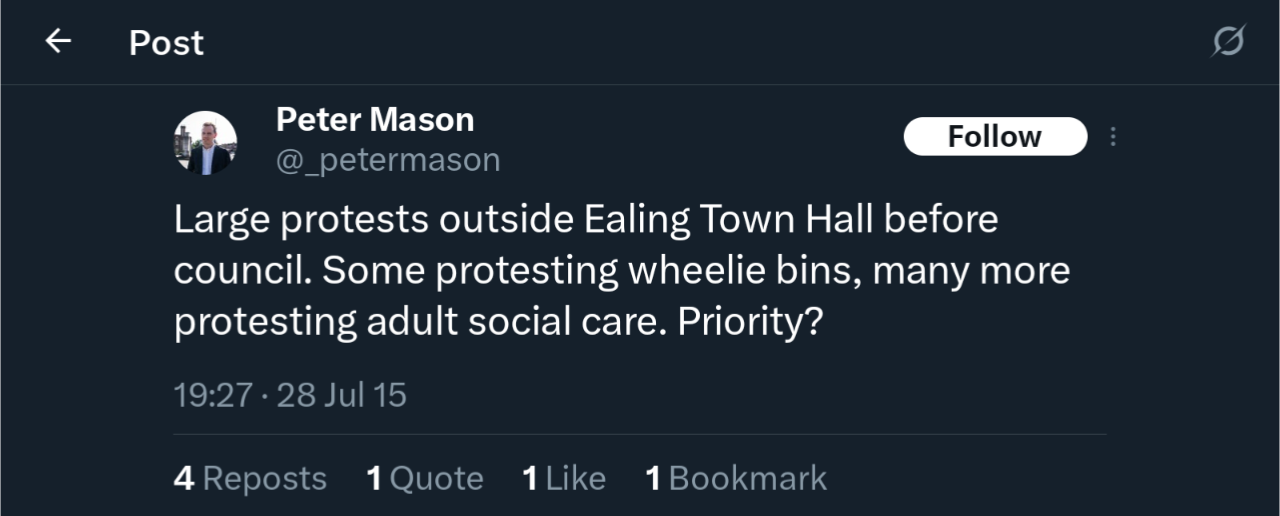
In 2015, residents protested against these cuts outside Ealing Town Hall. Peter Mason, always ready put put his spin on it, tweeted:
“Some protesting wheelie bins, many more protesting adult social care [sic]. Priority?”
When Ealing Council switched from weekly black rubbish bag collections to fortnightly wheelie bin collections in 2016, Cabinet Member Bassam Mahfouz promised a change that would please Peter Mason and “keep our streets cleaner by cutting down on the number of black bags ripped open by foxes.”
Peter Mason, never shy about telling residents why he’s right and they’re wrong, tweeted that rolling out wheelie bins was “unavoidable” and that cutting collections by half would save £3 million.
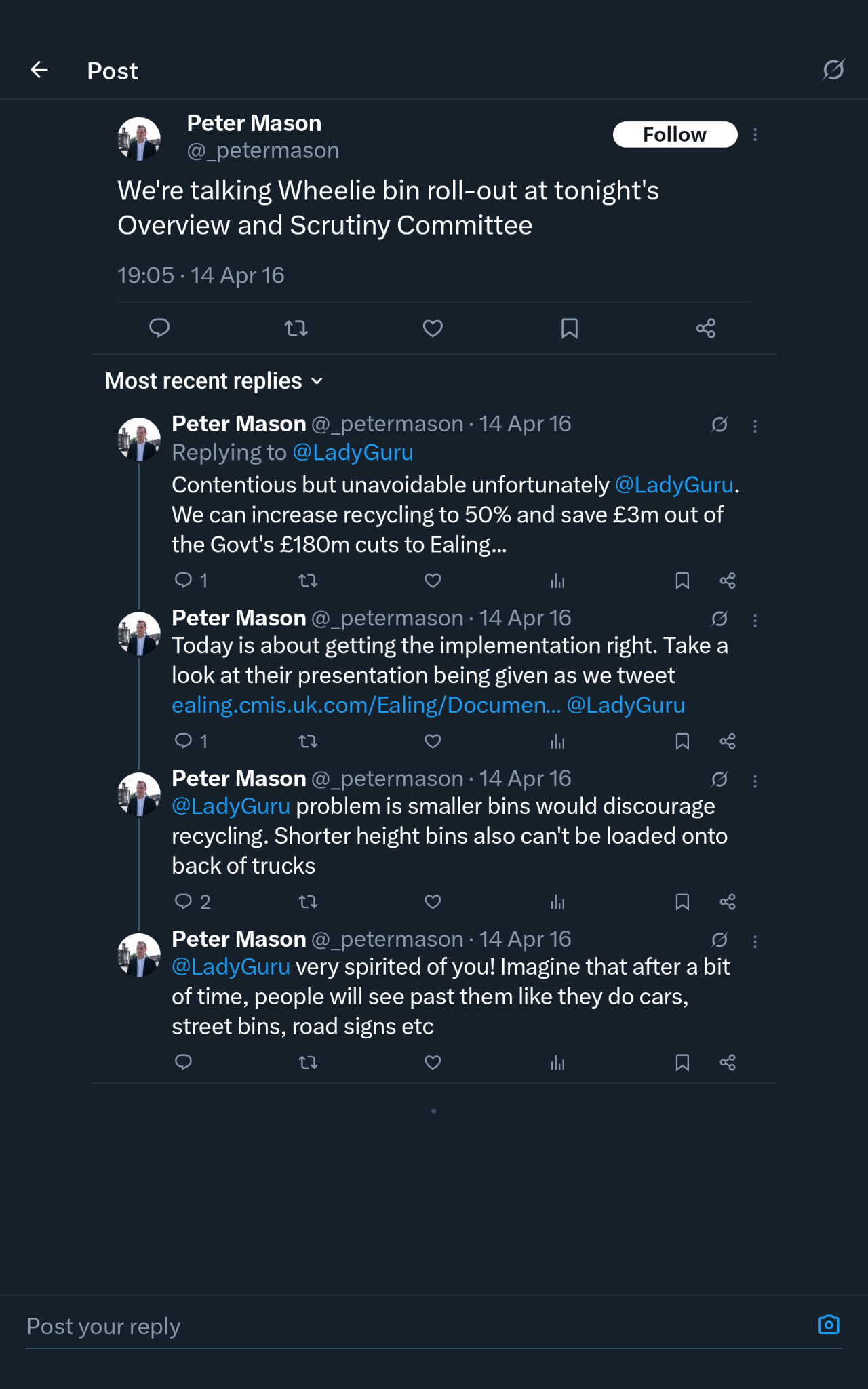
Despite more than 7,000 Ealing residents formally opposing this drastic reduction in general waste collection frequency, the “ever-listening” Labour council pressed on regardless.
The question now is what was the cost?
Residents called it immediately
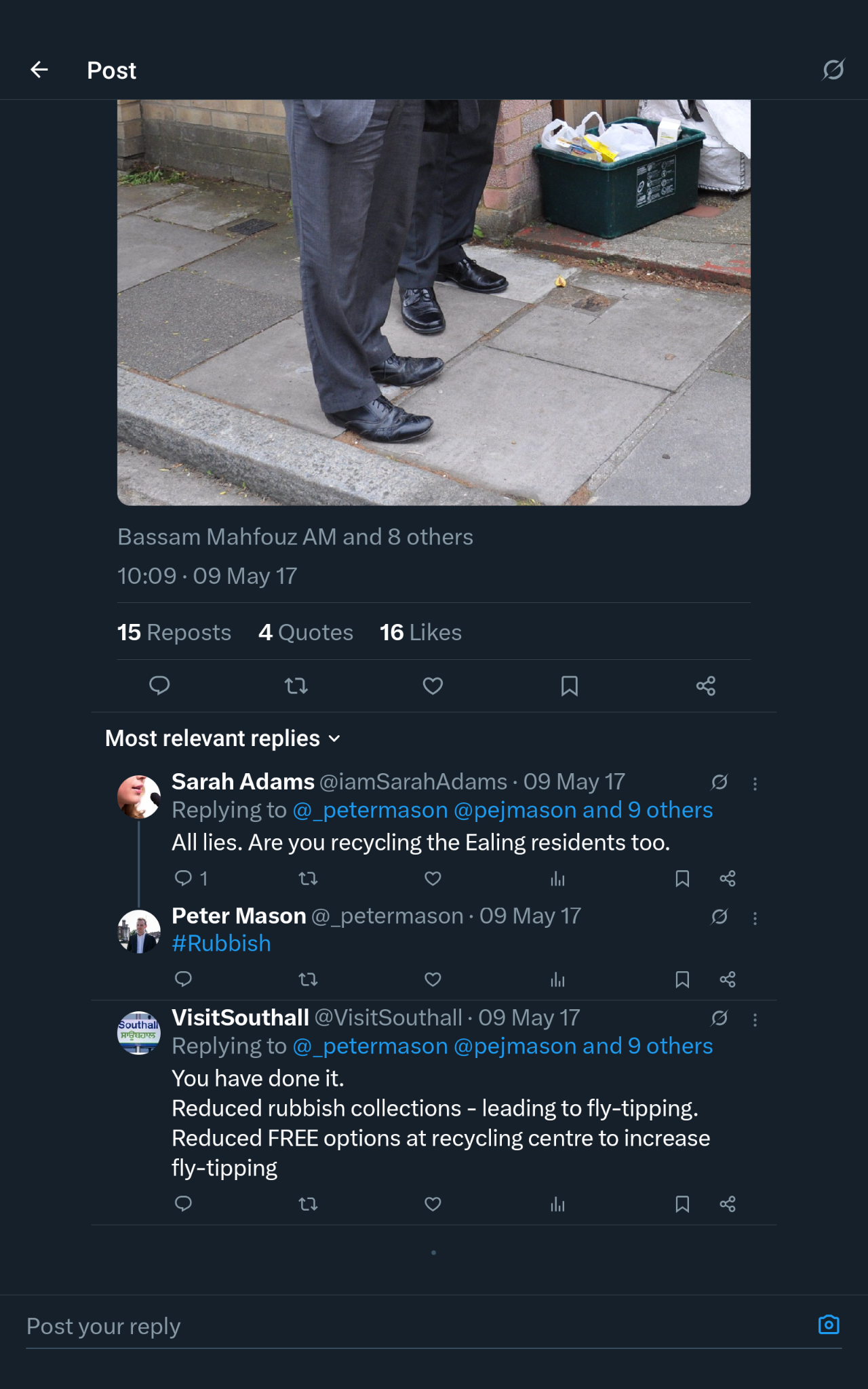
On social media in May 2017, barely a year after the policy change, residents directly challenged then-Cabinet Member Peter Mason about the obvious connection.
Sarah Adams wrote: “All lies. Are you recycling the Ealing residents too.”
VisitSouthall responded: “You have done it. Reduced rubbish collections - leading to fly-tipping.”
By November 2018, at the Southall Green / Broadway Ward Forum, Peter Mason was still talking rubbish about tackling fly-tipping, claiming “packed house, passionate people and ideas a plenty.”
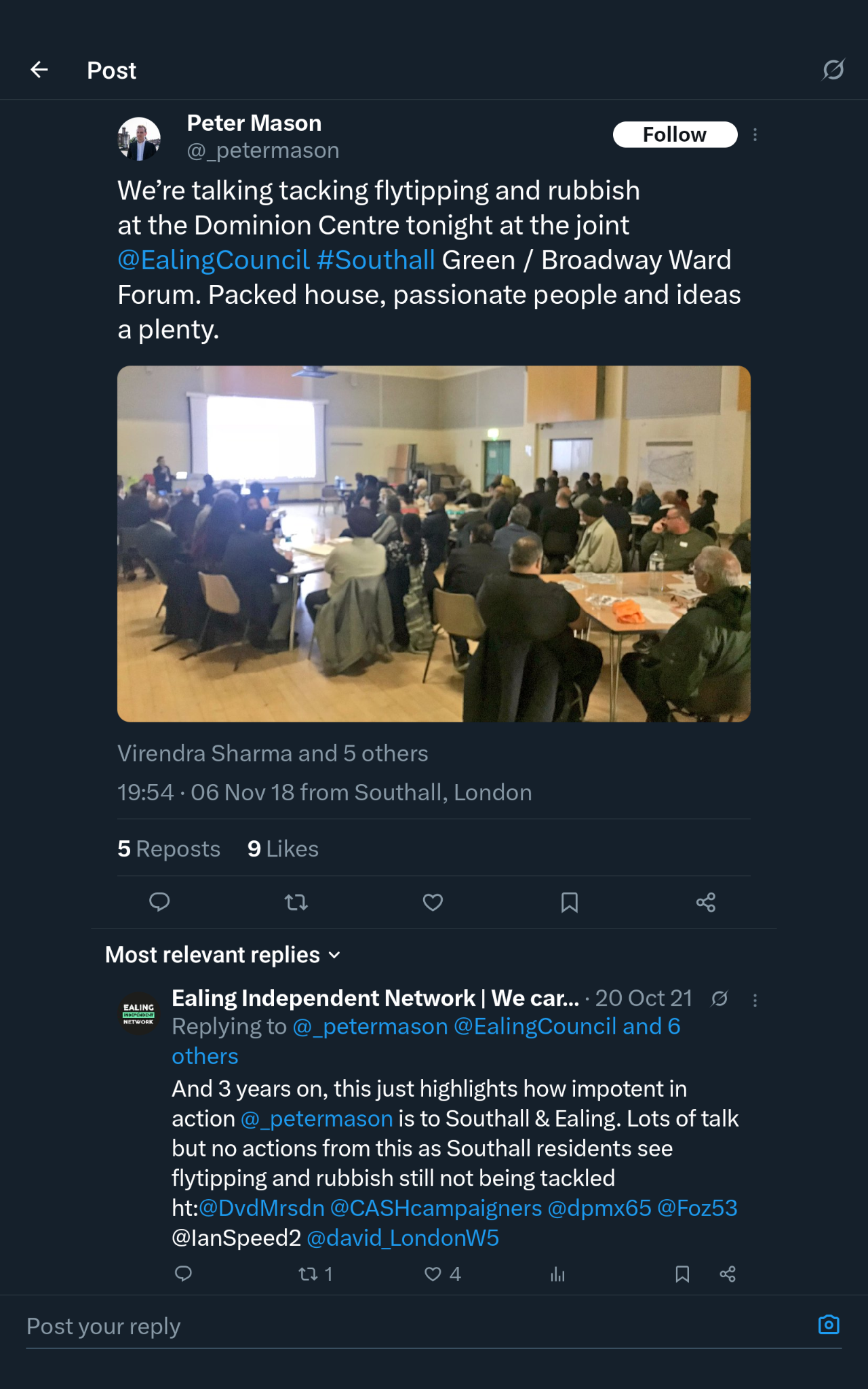
Three years later, in October 2021, Ealing Independent Network commented on the same post: “And 3 years on, this just highlights how impotent in action @_petermason is to Southall & Ealing. Lots of talk but no actions from this as Southall residents see flytipping and rubbish still not being tackled.”
In 2022, I stood as an independent candidate in the local elections against Labour in the ward where I live in Southall Green. My then seven year old son Zion went out leafleting with me and documented what it’s like as a child growing up in the area Peter Mason represents.
“This part of Southall is disgusting”
This part of Southall is right around the corner from where we live. I feel so ashamed as a parent that I am raising my children in a place they know as home and that they find disgusting because of the state it’s in.
[Many thanks again to the incredible LAGERcan volunteers who cleaned up this particular fly-tip the following year.]
Later that year, the Young Ealing Foundation published a report aiming to help tackle youth violence in Southall.
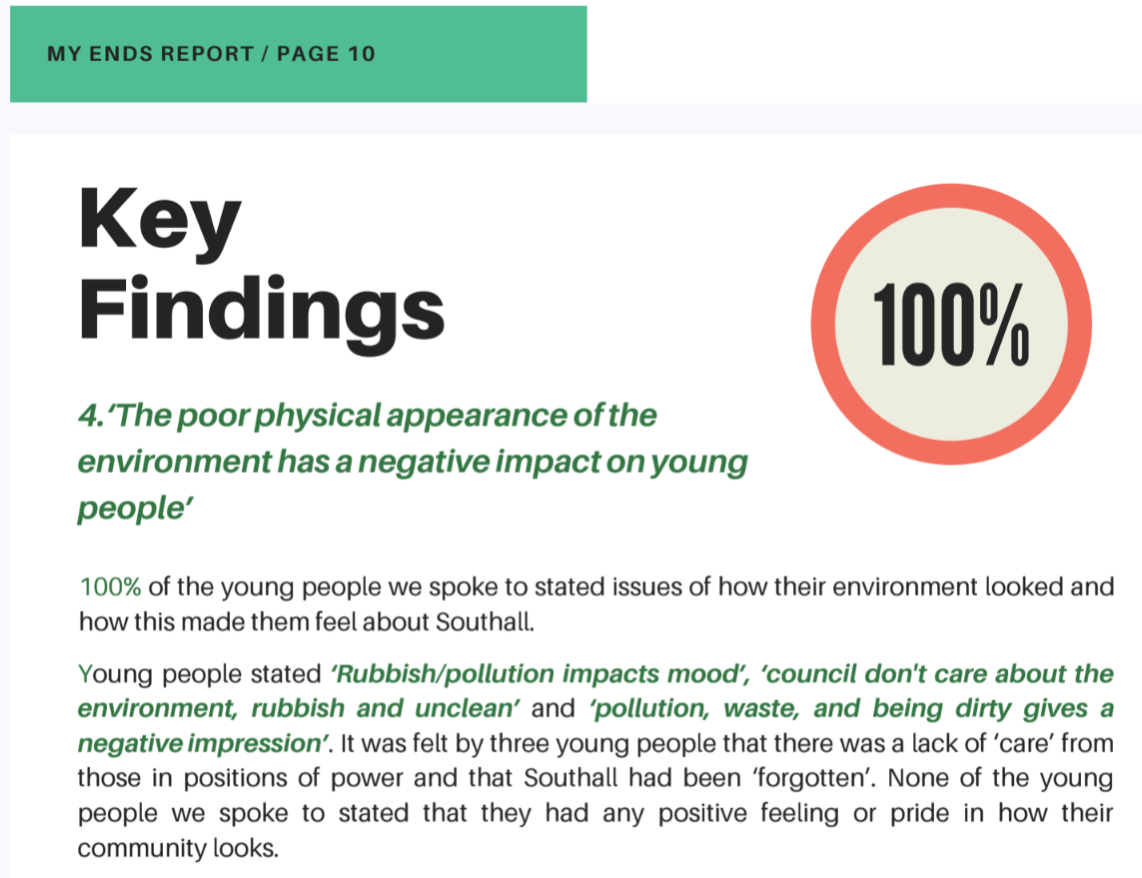
Young people stated ‘Rubbish/pollution impacts mood’, ‘council don’t care about the environment, rubbish and unclean’ and ‘pollution, waste, and being dirty gives a negative impression.'
The report stated that the poor physical appearance of the environment has a negative impact on young people.
In 2025, a disabled Southall Green neighbour, Arti, described how her life is curtailed by fly-tipping
Her mother is often forced to push her wheelchair into the road to get past due to pavements being frequently blocked by rubbish, leaving Arti exposed to speeding traffic.
[Arti] said: “It makes me anxious going out, and I’ve slowly, slowly cut down on going out due to this issue.
“It makes me really mentally unstable, and I feel trapped, because I can’t do anything about it. I’m trying my very best.”
It’s a not uncommon sight here to see disabled people forced to risk their lives by walking with their mobility aids in the road because the pavements are impassable due to rubbish bags, mattresses, fridges, broken glass, illegally parked cars, and broken pavements.
Also last year, my brilliant community pharmacist, Rahul Puri, explained the serious public health harms arising directly as a result of the dramatic rise of fly-tipping in Southall, an area already extremely vulnerable to health problems and stressors.
Fly-tipping doubled when weekly rubbish collections ended in 2016
Official government data shows the number of fly-tipping incidents doubled after 2016 and the introduction of fortnightly wheelie bin collections. Ealing Council’s own numbers show it costs millions. And the solution they won’t consider would save £1-1.6 million per year.
What actually happened is recorded in the government’s own statistics: fly-tipping in Ealing doubled overnight and has cost council taxpayers millions every year since.
Three months after weekly collections ended, the council was already announcing a fly-tipping crackdown.
In November 2016, it reported that new taskforce crews had visited 763 streets and traced dumped waste back to 1,124 addresses in just three months. The message from cabinet member Bassam Mahfouz was simple: “We will find you and we will fine you.”
The enforcement narrative was in place almost immediately after the service change - just as the official data shows fly-tipping doubling across the borough.
It’s hard to escape the impression that the council knew the service change would create a problem and prepared to police the consequences rather than reconsider the policy itself.
Some might argue the rise could simply reflect better reporting rather than more fly-tipping. But the data shows a different pattern. Incidents were stable for years, then almost exactly doubled in the same year weekly collections ended - and have remained at that higher level ever since.
Reporting changes usually produce short-term spikes or gradual trends. What Ealing’s figures show is a sudden, permanent step-change, which strongly suggests a real increase in dumping rather than just better record-keeping.
Ealing Council now spends £3 million annually clearing fly-tipping whilst claiming the problem is down to residents' behaviour.
Now Ealing Southall’s MP and formerly Peter Mason’s deputy leader of the council, Deirdre Costigan visited Southall Green in March 2022 to launch yet another ineffective authoritarian pre-election crackdown on fly-tipping.
Costigan said, “I’m here in Southall today with our fly-tip enforcement and clearing team to talk about our new zero tolerance approach to illegal dumping. Ealing is a brilliant place to live but a small minority of people spoil things for the rest of us by fly tipping in our borough.”
She claimed that this small minority of people in Southall “don’t play by the rules” and that their actions are “disgusting, irresponsible and illegal.” She also states that the council’s CCTV surveillance and enforcement mechanisms are inadequate.
But the government data tells a different story: Ealing Council created the problem, spent ten years managing the symptoms, and refuses to consider the solution because it would mean admitting the original policy was a catastrophic mistake.
What the official data shows
The table below uses Defra’s national fly-tipping dataset, with population-adjusted rates per 1,000 residents to control for population growth.
| Year | Total Incidents | Population | Incidents per 1,000 residents |
|---|---|---|---|
| 2012–13 | 6,352 | 336,900 | 18.9 |
| 2013–14 | 5,765 | 338,000 | 17.1 |
| 2014–15 | 7,257 | 339,000 | 21.4 |
| 2015–16 | 7,032 | 339,700 | 20.7 |
| 2016–17 | 14,270 | 340,000 | 42.0 |
| 2017–18 | 13,610 | 340,500 | 40.0 |
| 2019–20 | 13,115 | 341,806 | 38.4 |
| 2020–21 | 13,090 | 340,341 | 38.5 |
| 2021–22 | 12,303 | 366,762 | 33.5 |
| 2022–23 | 12,922 | 369,937 | 34.9 |
| 2023–24 | 16,828 | 375,340 | 44.8 |
The pattern is undeniable:
- Four years of stability (2012–16): Fly-tipping averaged 17–21 incidents per 1,000 residents
- One year of catastrophe (2016–17): Jumped to 42 incidents per 1,000 residents
- Eight years of plateau (2017–24): Remained at 33–45 incidents per 1,000 residents
That’s a 137% increase per person from 2012–13 to 2023–24.
This isn’t explained by population growth. Even after adjusting for population, fly-tipping has more than doubled per resident.
The structural break
For data analysts, this is what a “structural break” looks like — a sudden, permanent shift in the underlying pattern that points to a specific policy change rather than gradual social trends.
Year-on-year changes show the exact moment:
- 2012–13 → 2013–14: -587 incidents (-9.2%)
- 2013–14 → 2014–15: +1,492 incidents (+25.9%)
- 2014–15 → 2015–16: -225 incidents (-3.1%)
Then wheelie bins and fortnightly collections were introduced in June 2016:
- 2015–16 → 2016–17: +7,238 incidents (+102.9%)
Followed by stabilisation at the new, much higher level:
- 2016–17 → 2017–18: -660 incidents (-4.6%)
- 2017–18 → 2019–20: -495 incidents (-3.6%)
- 2019–20 → 2020–21: -25 incidents (-0.2%)
- 2020–21 → 2021–22: -787 incidents (-6.0%)
- 2021–22 → 2022–23: +619 incidents (+5.0%)
- 2022–23 → 2023–24: +3,906 incidents (+30.2%)
What the council promised
In March 2016, Cabinet Member Bassam Mahfouz announced the switch to fortnightly collections and wheelie bins:
“Wheelie bins will make it easier for people to recycle more meaning less waste will be sent to landfill, and they will also keep our streets cleaner by cutting down on the number of black bags ripped open by foxes.”
The council claimed the changes would:
- Save around £1.7 million per year
- Increase recycling rates
- Reduce street mess
- Improve cleanliness
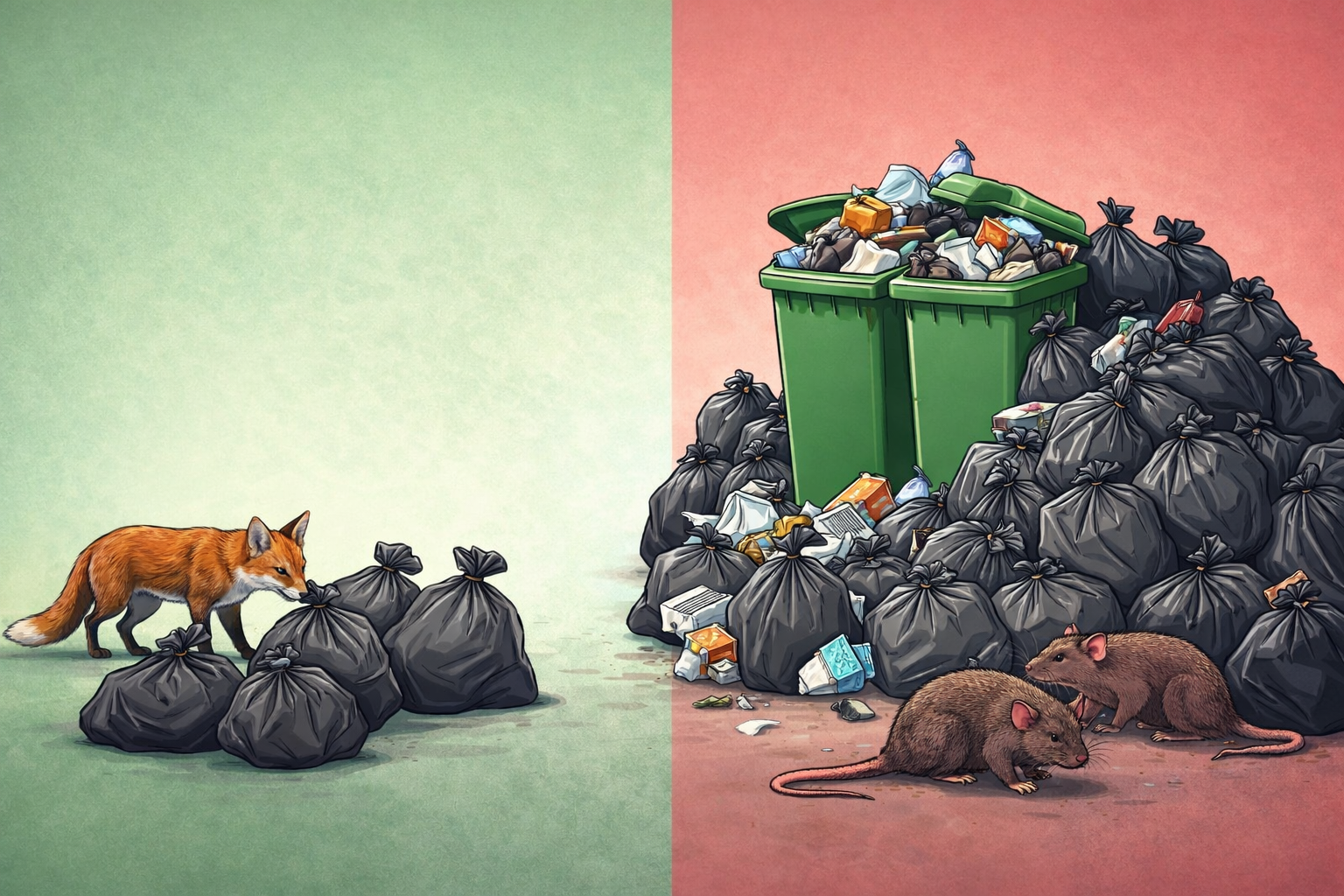
What actually happened
Fly-tipping per resident almost exactly doubled in the year after the policy was introduced.
Streets got objectively dirtier — by every measurable metric.
The rate has never returned to pre-2016 levels — eight years later, fly-tipping remains approximately double what it was.
In 2023–24, the rate hit 44.8 per 1,000 — the highest on record, more than double the pre-2016 average.
The residents who predicted the disaster have been proven right by eight years of data.
The council that promised cleaner streets has delivered the opposite.
If only the council actually listened to the residents!
The timing problem for other explanations
Some might blame the rise in fly-tipping on demographic change, population growth, or changing social attitudes.
But the data demolishes these explanations:
Demographic change happens gradually. It doesn’t produce a one-year doubling across an entire borough.
Population growth is accounted for. These figures are per 1,000 residents — they already control for population increases.
Social trends develop slowly. They don’t create structural breaks where behaviour doubles in twelve months.
The data shows:
- Stable pattern for years
- Sudden doubling in the exact year the waste collection system changed
- Permanent plateau at the new level
That’s the signature of a policy shock, not a social trend.
The borough-wide collection frequency change is the only factor that aligns precisely with the timing and scale of the increase.
The false economy
The council claimed fortnightly collections would save £1.7 million per year, rising to £2.3 million.
But fly-tipping isn’t free.
The current annual cost
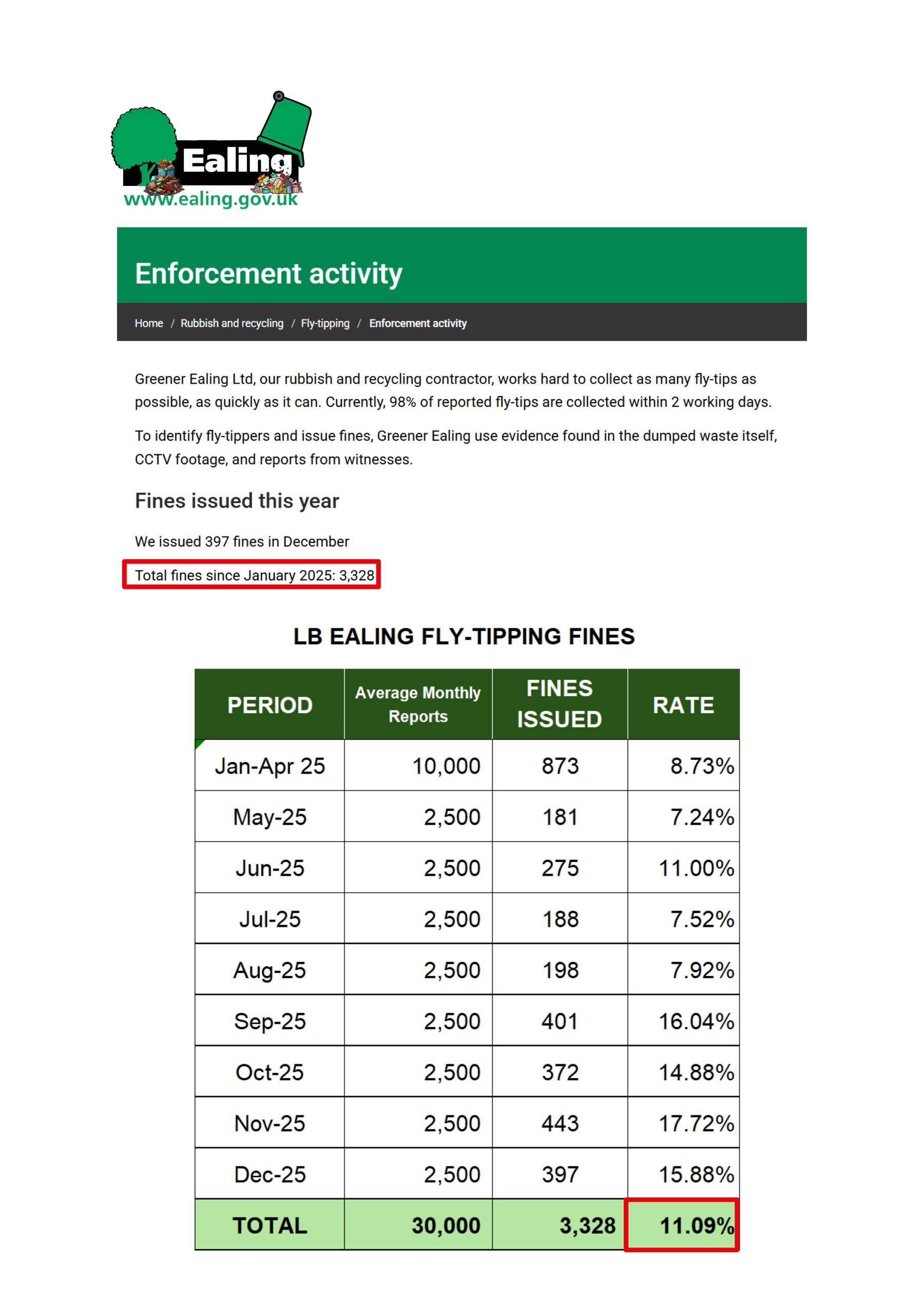
In June 2025, Ealing Council admitted that illegal dumping costs the borough £3 million a year.
The council’s own 2025 enforcement data shows:
- 30,000 fly-tip reports
- 3,328 fines issued
- 11.09% enforcement rate
Fine income vs clearance costs
The council issues fines of up to £1,000 for fly-tipping, but most enforcement uses Fixed Penalty Notices typically ranging from £400–£1,000.
Conservative estimate (£400 average fine):
- 3,328 fines × £400 = £1.33 million income
Mid-range estimate (£600 average fine):
- 3,328 fines × £600 = £2.0 million income
Net taxpayer cost:
| Category | Amount |
|---|---|
| Annual clearance costs | £3.0 million |
| Fine income (low estimate) | £1.33 million |
| Fine income (mid estimate) | £2.0 million |
| Net public cost | £1.0–£1.7 million per year |
Cost per incident
With 16,828 incidents (2023–24) and £3 million annual cost:
£3,000,000 ÷ 16,828 = £178 per incident
This covers collection labour, vehicles, disposal fees, investigation, enforcement, administration, and legal costs.
The 13-year comparison
Before wheelie bins (2012–16 average):
- Clearance costs: ~£430,000 annually
- Fine income: ~£149,000 annually
- Net cost: ~£281,000 annually
After wheelie bins (2025):
- Clearance costs: £3,000,000 annually
- Fine income: £1,330,000–£2,000,000 annually
- Net cost: £1,000,000–£1,700,000 annually
The increase:
- Clearance costs: +£2.57 million annually (+597%)
- Net taxpayer cost: +£719,000–£1,420,000 annually (+256–505%)
The cumulative damage
From 2016–17 to 2023–24, Ealing recorded 108,015 total fly-tipping incidents.
From 2012–13 to 2015–16, Ealing recorded 26,406 total incidents.
That’s 81,609 additional incidents over eight years compared to pre-wheelie bin rates.
Even at the conservative clearance cost of £178 per incident, that’s £14.5 million in additional fly-tipping costs since the policy change.
The claimed £1.7 million annual savings?
Wiped out more than eight times over.
The enforcement paradox
You might argue that enforcement has improved, so comparing to pre-2016 isn’t fair.
The data proves this defence is worthless:
2012–16 average:
- Fine recovery rate: ~34% of clearance costs
2025:
- Fine recovery rate: ~44–67% of clearance costs
So yes, enforcement has significantly improved.
But the total volume has increased so much that even with better recovery rates, taxpayers now pay £1–1.7 million annually vs £281,000 pre-2016.
Better enforcement of a much worse problem still costs far more than preventing the problem in the first place.
Ealing Labour’s rubbish collection scheme doubled fly-tipping and cost eight times more to clean up the mess they created than they saved by stopping weekly waste removal
The perverse incentive
Here’s where it gets darkly absurd.
If the council actually collected the maximum £1,000 fine for all 3,328 enforcement actions:
Fine income: £3,328,000
Clearance costs: £3,000,000
Net profit: £328,000
The council would be making money from fly-tipping.
Now, they’re not actually collecting £1,000 per fine — most are Fixed Penalty Notices at lower amounts, and many go unpaid. But the theoretical possibility exists.
And that creates a perverse incentive:
The more fly-tipping occurs, the more enforcement opportunities exist, the more fine income potentially flows in.
It’s like something out of Catch-22.
Milo Minderbinder would be proud: create a problem through policy change, establish an enforcement regime, generate revenue from the problem you created, claim you’re “tackling” the issue whilst financially benefiting from its continuation.
Everyone in the syndicate gets richer — except the residents whose streets are covered in rubbish and who are paying for enforcement through their council tax.
The children’s centres connection
In 2023–24, Ealing Council began consulting on closing 10 of the borough’s 25 children’s centres, claiming budget pressures.
The projected savings? Around £1 million annually.
Meanwhile, the council:
- Spends £3 million clearing fly-tipping (a problem they created)
- Spends £1.9 million on enforcement
- Could save £1–1.6 million by returning to weekly collections
- But won’t, because it would mean admitting the 2016 policy failed
So let’s get this straight:
Can’t afford: £1 million to keep children’s centres open for vulnerable families
Can afford: £3 million clearing fly-tipping + £1.9 million enforcement, both addressing a problem the council created and refuses to fix
Could save: £1–1.6 million annually by reversing the policy that caused the problem
But won’t: Because political pride is apparently worth more than children’s services
All while justifying massive pay rises for ineffective and wasteful councillors that cost over a million pounds in four years. That’s enough to pay for all the children’s centres.
The Milo Minderbinder business model
If you’re not familiar with Catch-22, Milo Minderbinder is the mess officer who runs a syndicate that profits from the war by trading with both sides, eventually bombing his own base because the Germans paid him to do it. Everyone is a member of the syndicate, so everyone benefits. Some more than others.
Ealing’s version:
- Create the problem: Switch to fortnightly collections (save £1.7m)
- Problem doubles: Fly-tipping increases 100%
- Monetise the problem: Enforcement regime generates fine income
- Claim success: “55% reduction in target areas! We’re cracking down!”
- Never fix the root cause: Because the enforcement regime is now part of the budget model
- Close children’s centres: Can’t afford services, must “manage budget pressures”
- Everyone in the syndicate benefits: Except residents living with the rubbish and paying council tax for both the clearance and the enforcement
We just need to dump enough rubbish to earn enough money to keep the children’s centres open!
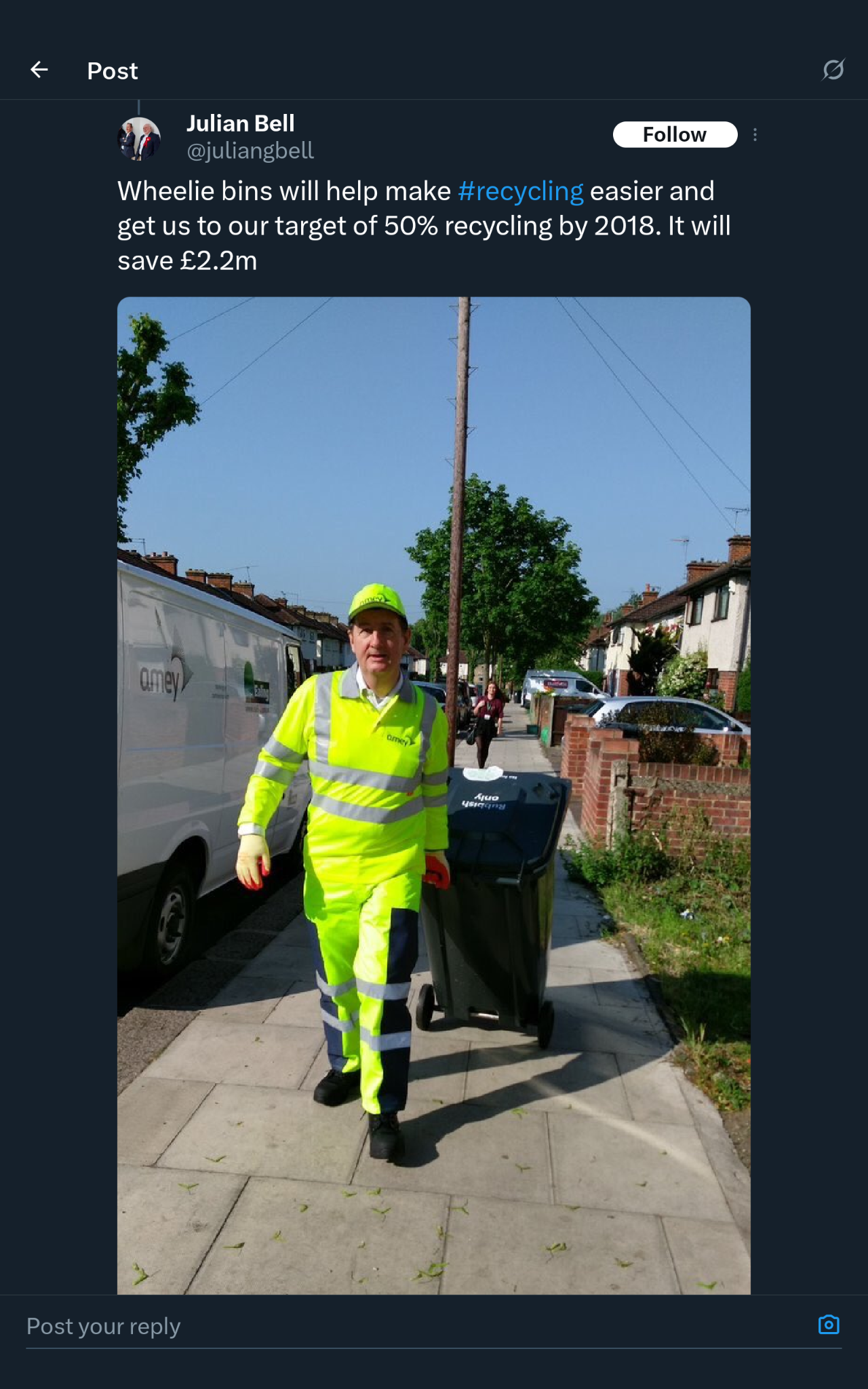 Former Ealing Council leader Julian Bell in brand new spotlessly clean high-visibility clothing is pulling a wheelie bin full of cash?
Milo would absolutely pitch this:
“See, it’s really quite simple. We save money by collecting rubbish less frequently. This creates more fly-tipping. We then fine people for fly-tipping. The fines pay for enforcement. The enforcement creates more fines. Eventually, if we get enough rubbish on the streets, we’ll be making a profit! Then we can afford frontline services again. Everyone benefits from the syndicate.”
The only flaw in the plan: You have to live in a borough covered in fly-tipped rubbish whilst paying council tax for both the clearance and enforcement of a problem your council created and profits from.
But hey, bangarang, Pete. The syndicate thanks you for your service..
The solution they won’t consider
In January 2026, Council Leader Peter Mason appeared on BBC Politics London to discuss the council’s fly-tipping enforcement campaign.
“We’ve been running a campaign across Ealing this year aimed at changing behaviour: to increase resident awareness and reporting, and to crack down on fly tips. It’s working.
- 55% decrease in fly tips in our target areas
- Increased our maximum fine to £1,000
- Issued almost 2,000 fixed penalty notices in the last 6 months alone
- Deployed extra CCTV cameras, which have identified 20 persistent criminal waster vehicles that we are now going after
- Naming and Shaming on our website leading to positive identifications”
He concluded: “Bangarang."
Bangarang indeed.
Here’s the obvious question Peter Mason won’t answer:
If enforcement campaigns can achieve 55% reduction in target areas at a cost of £1.9 million, why not reverse the policy that caused the 100% increase everywhere?
The economic comparison
Current approach (2026 budget):
| Category | Annual Cost |
|---|---|
| Enforcement budget | £1,910,000 |
| Clearance costs | £3,000,000 |
| Fine income | -£1,330,000 to -£2,000,000 |
| Net cost to taxpayers | £2,910,000–£3,580,000 |
Achievement: 55% reduction in target areas only (not borough-wide)
Cost per prevented incident: ~£868
Return to weekly collections (estimated):
| Category | Annual Cost |
|---|---|
| Additional collection cost vs fortnightly | £1,700,000 |
| Clearance (at 2012–16 levels) | £430,000 |
| Fine income (at 2012–16 levels) | -£149,000 |
| Net cost to taxpayers | £1,981,000 |
Expected result: Return to pre-2016 baseline (~7,000 incidents vs current ~16,000)
Cost per prevented incident: ~£189
Annual saving from weekly collections: £929,000–£1,599,000
Service improvement is 4.6 times more cost-effective than enforcement.
The full comparison
| Metric | Pre-2016 (Weekly) | 2025–26 (Fortnightly + Enforcement) | Return to Weekly (Estimated) |
|---|---|---|---|
| Collection frequency | Weekly | Fortnightly | Weekly |
| Annual incidents | ~7,000 | ~16,000 | ~7,000 |
| Incidents per 1,000 | ~21 | ~40–45 | ~21 |
| Clearance cost | ~£430k | £3,000k | ~£430k |
| Enforcement cost | Minimal | £1,910k | Minimal |
| Fine income | ~-£149k | -£1,330k to -£2,000k | ~-£149k |
| Net taxpayer cost | ~£281k | £2,910k–£3,580k | ~£1,981k |
| Cost per prevented incident | N/A (baseline) | £868 (target areas) | £189 (borough-wide) |
| Annual saving vs current | N/A | N/A | £929k–£1,599k |
Preventing the problem vs managing the symptoms
Weekly collections:
- Cost: £1.7 million more than fortnightly
- Benefit: Prevents ~9,000 fly-tipping incidents
- Net effect: Saves £0.9–1.6 million annually vs current approach
- Addresses: Root cause
Current enforcement:
- Cost: £1.9 million in enforcement alone
- Benefit: 55% reduction in target areas only
- Net effect: Costs £0.9–1.6 million more annually than prevention
- Addresses: Symptoms whilst cause continues
Put simply:
Preventing the problem would cost £1–1.6 million less per year than managing it.
But that would require admitting the 2016 policy was a mistake.
And apparently, protecting political face is worth £1–1.6 million of taxpayers' money annually.
The pattern
This fits Ealing Council’s broader modus operandi:
1. Policy imposed without genuine consultation
Over 7,000 residents signed a petition against wheelie bins. The council ignored them and implemented the policy anyway.
2. Environmental rhetoric masking cost-cutting
Promised “cleaner streets” whilst implementing cost-saving measures that created the opposite outcome.
3. Costs externalised onto residents
Fortnightly collections create storage problems in terraced housing, HMOs and all the new tower blocks (Southall’s predominant housing types). Residents bear the burden whilst council claims savings.
4. Claims contradicted by measurable outcomes
Promised streets would be “cleaner.” Data shows fly-tipping doubled and remained at that level for ten years.
5. Blame shifted to residents
When policy causes problem, council blames “behaviour” and “awareness” rather than examining whether the policy itself failed.
6. Expensive symptom management instead of admitting failure
Spend £1.9 million on enforcement rather than £1.7 million on service improvement, because the latter would require admitting the original policy was wrong.
7. No outcomes evaluation
Report activity statistics (investigations, fines, warnings) without ever asking: “Did the policy we implemented in 2016 cause the doubling? Should we reverse it?”
What this proves
1. The data is undeniable
Fly-tipping per resident almost exactly doubled in the year after fortnightly collections were introduced. No other borough-wide change explains the timing or scale.
2. The cost is substantial
£14.5 million in additional clearance costs over eight years, plus £1.9 million annual enforcement spending, far exceeds the claimed £1.7 million annual savings.
3. The solution is obvious
Return to weekly collections. It would be cheaper, more effective, and address the root cause rather than managing symptoms.
4. The political calculation is clear
The council prioritises avoiding admission of policy failure over fiscal responsibility and effectiveness.
5. Residents were right all along
The 7,000+ people who opposed wheelie bins, the residents who predicted fly-tipping would increase, the community members who’ve complained for ten years — they were all correct.
6. The council’s approach to evidence
When data contradicts promises, ignore the data, blame residents, and spend millions managing the problem you created rather than reversing the policy that caused it.
Where are we now?
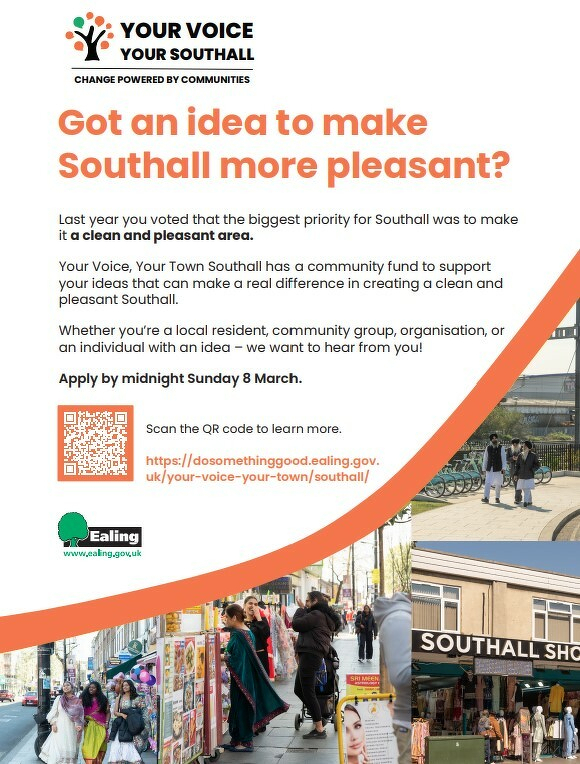
Now, if anyone has any bright ideas about how to make Southall cleaner and more pleasant, the mega rich developers building more than ten thousand new homes in tens of new tower blocks have kindly given us £120,000 from their profits to make the place more marketable for their sales teams.
Please get your thinking caps on and submit your applications to the Southall Town Team led by Jags Sanghera… oh, wait, I feel another story coming on!
Methodology note
All data sourced from:
- Defra Fly-tipping Statistics 2012–13 to 2023–24 (official government dataset)
- ONS Mid-Year Population Estimates for Ealing (2012–2018)
- Population estimates for 2019–2024 included in Defra dataset
- Ealing Council enforcement data (2025, published on council website)
- Ealing Council statements (2016 cabinet announcements, 2025 media coverage)
- Per capita calculations use ONS mid-year population estimates for each year to control for population growth.
Caveats:
- Data crunched with the help of AI. I checked the headline data, but if you see any mistakes, human or otherwise, please let me know.
- There could be other causes of the increase in fly-tipping. The data clearly shows a doubling of fly-tipping incidents immediately after weekly refuse collections were replaced with fortnightly general waste collections.
- As a friend said to me, we need more bins, more collections, free disposal of bulky waste and recycling items, targeting of illegal dumping by organised rogue waste disposal and clearance companies and unscrupulous HMO landlords, and more education and support about what’s acceptable waste disposal and what isn’t.
- Enfield Council switched from weekly to fortnightly bin collections in 2019. The data from Enfield doesn’t show the same dramatic shift as it does in Ealing, but residents there are complaining of increased fly-tipping and asking for a return of weekly collections.