

This is a follow-up to Bangarang! Pirate Pete and the Lost Bin Collections of Southall and Boomerang! Ten Years Sorting Out Fly-Tipping, which documented how fly-tipping in Ealing doubled the year weekly black bag collections were scrapped in 2016 — and remained at that high level ever since.
After those two articles, a commenter on a separate Facebook post promoting the launch of the “What Happened to Southall?” report questioned the focus on bin collections, among other things.
MW Gurney made several points worth taking seriously: that fly-tipping has risen nationally, that other factors like bulky waste charges and enforcement levels matter, that Ealing’s recycling rates compare well with London, and — most directly — that if collection frequency were the main driver, “every borough on fortnightly collections would look the same.”
Now, to be fair, right at the bottom of my first “Bangarang” article, I did say:
“There could be other causes of the increase in fly-tipping. The data clearly shows a doubling of fly-tipping incidents immediately after weekly refuse collections were replaced with fortnightly general waste collections.
As a friend said to me, we need more bins, more collections, free disposal of bulky waste and recycling items, targeting of illegal dumping by organised rogue waste disposal and clearance companies and unscrupulous HMO landlords, and more education and support about what’s acceptable waste disposal and what isn’t.”
In my follow-up “Boomerang” story, I explicitly stated some of the other factors involved:
The 2022–23 cost-of-living shock likely increased the baseline pressure on waste systems nationally.
In Southall, these are likely to include housing density, overcrowding, higher private sector rents, as well as collection policy, enforcement and recording practices, and over-development minus any major infrastructure mitigations that magnify national economic stress.
None of this suggests that collection frequency is the only factor. But it is one of two variables that changed suddenly — and the one that aligns most closely with the timing of the spike in 2016.
What Happened to Brent?
The best way to test whether fortnightly collections cause fly-tipping spikes is to find boroughs that made the same switch — and look at what happened.
We do not have to look far.
Brent switched to alternate weekly general waste collections around 2013-14.
The decision followed an August 2010 Executive report promising “long term efficiency savings in excess of £1 million each year” and a step change in recycling rates towards 60%. The report also introduced a “no side waste” policy: only waste that fits inside the bin will be collected.
Residents predicted exactly what would happen.
Brent’s Own Overview and Scrutiny Committee called in the decision, citing concerns including the “implications of fortnightly refuse collections on housing estates and properties in multiple occupation.”
The call-in papers from November 2010 make grim reading in retrospect.
By November 2012 — before the full fortnightly switch was even complete — a Wembley Matters report on a council scrutiny committee revealed that Brent’s own officers explicitly linked the rise in fly-tipping to the new collection system, which had “led to residents dumping excess/uncollected waste on footpaths and near litter bins in some areas.”
The campaigners who predicted it, the report noted, had been right.
Then the full fortnightly switch landed.
In 2014-15, fly-tipping in Brent surged by 84% in a single year — the largest year-on-year increase of any local authority in England.
A Freedom of Information request by the Press Association confirmed the figures; a December 2015 industry report recorded them independently. The Kilburn Times reported that Brent Council spent £531,178 clearing illegally dumped waste that year, recouping just £11,670 in fines.
What Happened to Hounslow?
Hounslow announced its switch to fortnightly wheelie bin collections in September 2015, implementing it from April 2016 — just weeks before Ealing made the same change in June 2016.
Residents in Chiswick and Brentford immediately petitioned against it, warning that terraced streets with “tiny front gardens” were “totally unsuitable to house a wheelie bin of any type.”
The council pressed on regardless, promising cleaner streets, higher recycling rates, and cost savings of £1.3 million per year. Sounds familiar?
Within weeks of the July 2016 launch, residents were sending angry emails to the council. MyLondon reported residents' complaints of dirty and littered streets:
“We have new bins but no idea when they will be emptied,” wrote one Feltham resident.
A fellow resident did the arithmetic:
“They have given us 6 wheelie bins for 22 properties containing 46 residents. That is one third of a bin per property for two weeks, one sixth of a bin per week.”
Streets in the TW3 postcode were described as “dirty” with “recycling boxes bursting at the seams.” The council’s response — “wash and squash plastics and cans as much as possible” — was not equal to the scale of the problem it had created.
A resident petition to restore weekly collections warned explicitly that “councils who move to fortnightly collections see overflowing bins, more litter and more fly-tipping.”
The Hounslow data tells the rest of the story.
What Happened to Harrow?
Gurney argued that if collection frequency were the driver, every fortnightly borough would show the same pattern.
The Defra fly-tipping dataset shows they do — at the moment of their respective policy changes.
| Year | Ealing | Brent | Hounslow | Harrow |
|---|---|---|---|---|
| 2012–13 | 6,352 | 6,911 | 13,934 | 6,228 |
| 2013–14 | 5,765 | 7,001 | 15,864 | 8,429 |
| 2014–15 | 7,257 | 12,912 (+84%) | 16,282 | 7,072 |
| 2015–16 | 7,032 | 13,198 | 19,809 | 8,462 |
| 2016–17 | 14,270 (+103%) | 17,340 | 22,973 (+16%) | 6,835 (-19%) |
| 2017–18 | 13,610 | 18,609 | 17,063 | 9,626 |
| 2018–19 | 12,547 | 23,965 | 21,897 | 13,658 |
| 2019–20 | 13,115 | 34,197 | 22,480 | 11,151 |
| 2022–23 | 12,922 | 34,830 | 26,135 | 9,222 |
| 2023–24 | 16,828 | 27,023 | 27,241 | 12,609 |
Source: Defra Fly-Tipping Statistics for England, 2012-13 to 2023-24.
Brent switched first. Brent spiked first (+84%, 2014-15). Ealing switched in 2016. Ealing spiked in 2016-17 (+103%).
Hounslow switched in April 2016 and its figures climb steadily from that point. Harrow, which did not switch to fortnightly general waste collections, shows no equivalent spike. In 2016-17 — the year Ealing’s fly-tipping doubled — Harrow’s figures actually fell by 19%.
Brent and Ealing both recorded sharp increases at the moment each borough changes its collection system.
Hounslow, starting from a baseline level equal to Brent and Ealing after they switched, shows a smaller immediate increase.
Three boroughs switched; three boroughs saw an immediate increase. The one that did not switch did not.
Gurney said:
“if it were the main driver, every borough on fortnightly collections would look the same.”
Up to a point, they do.
The pattern is not that every borough looks identical. The pattern is that every borough breaks at the point the system changes.
That said, the longer-term picture is messier, and worth being honest about.
When Brent, Ealing, Harrow and Hounslow (plus Newham) are indexed against the national trend, Ealing actually turns out to be the clearest case — precisely because it is the simplest.
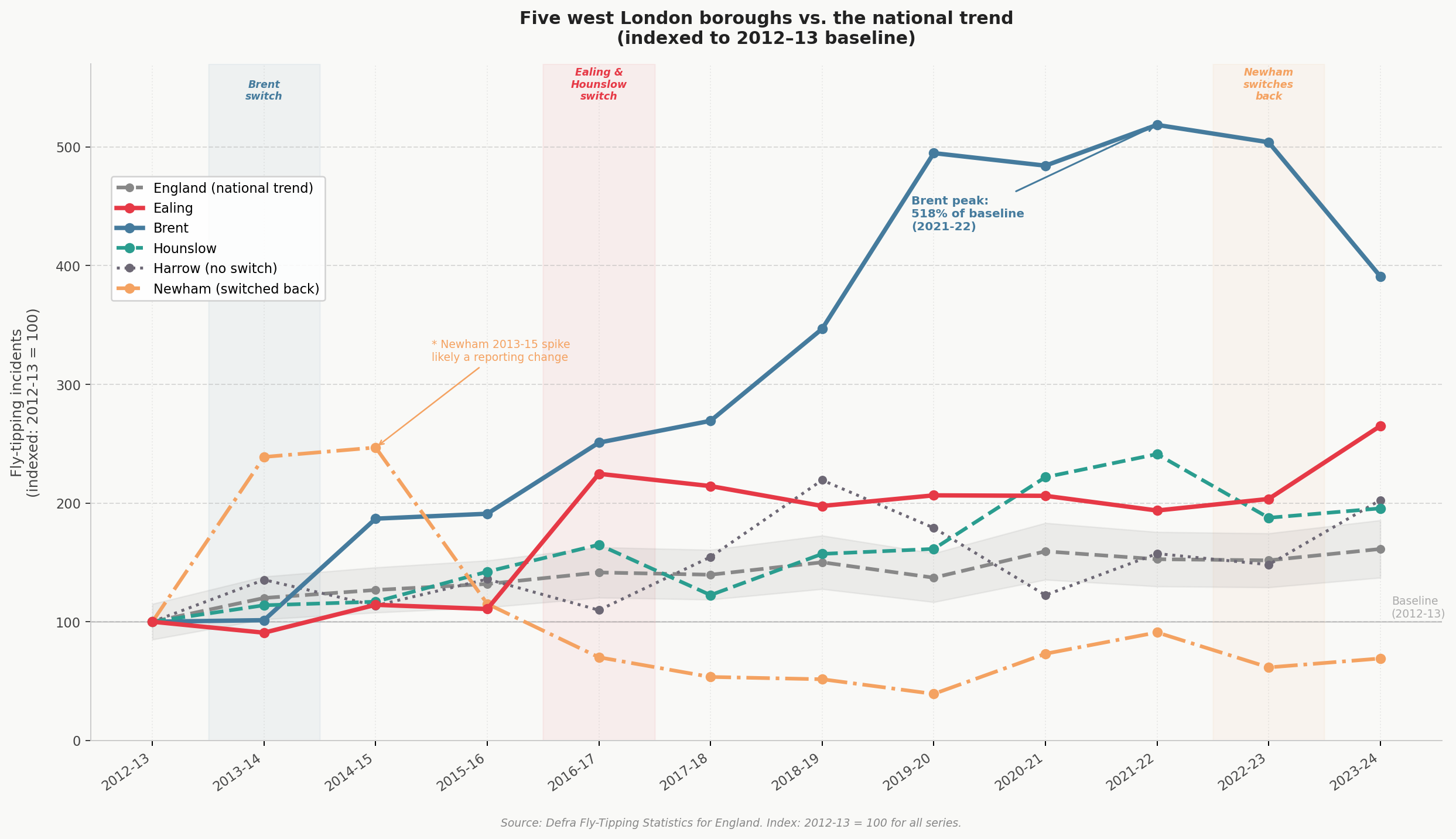
Ealing had no new reporting technology introduced in 2016, no major change in street cleansing methodology, but it did later introduce a new fly-tipping “task force” enforcement drive to tackle the 216% increase. That, and repeated “crackdowns” every four years just before local elections, probably helped maintain the flat doubled rate we see until 2023.
Ealing’s 2016-17 spike is a clean structural break from a stable baseline, diverging sharply from both the national trend and from Harrow, which tracks the national trend throughout.
Brent and Hounslow both show sustained divergence from the national trend, but with more noise — later enforcement campaigns, a twin-stream recycling change in Brent’s case, and Covid-era disruption all complicate the picture.
Ealing is not the weakest case. It is the clearest one.
The Structural Reasons
Why does this happen? The answer lies not in residents' values but council attitudes, assumptions and arithmetic.
Brent Council’s own 2005 waste strategy — produced by consultants SLR/LUC — warned that fortnightly collections “may not be feasible in many areas.”
They noted that alternate weekly collections work “in high performing areas” and where “diversion of up to 50% of the waste stream to recycling and composting means that residual waste bins are rarely full on collection day.”
That describes a leafy suburb with modest household sizes and gardens. It does not describe Brent, Hounslow or Southall.
Brent’s 2019 Inclusive Growth Strategy documented what those boroughs actually look like:
- Brent has the highest population density in outer London at 78.8 persons per hectare, against an outer London mean of 43.3.
- Overcrowding in the private rented sector more than doubled between 2001 and 2011, from 8,134 to 16,642 overcrowded households.
- Almost half the population live in flats.
- Brent has the highest number of housing benefit claimants in all outer London boroughs.
The Hounslow resident who calculated one sixth of a bin per person per week was not describing cultural differences, an absence of “British values” or documenting a need for individual behaviour change. He was describing the physics of the material structural problem with everyday reality for ordinary people.
One fortnightly wheelie bin cannot physically contain two weeks of waste from twenty-two properties sharing a building.
The most striking confirmation of the link comes from Brent itself — not from critics, but from its own officers.
In July 2014, as fly-tipping in the borough was surging towards its 84% annual spike, Brent Cabinet received a report recommending an increase in dry recycling collection frequency to weekly. Among the listed benefits of doing so:
“more frequent waste collections are also likely to reduce the amount of waste that is fly-tipped in Brent.”
That is a council officer, writing in the year of the borough’s worst-ever fly-tipping surge, officially recording the causal link between collection frequency and fly-tipping.
Ealing’s Cabinet, two years later, made the opposite decision with no equivalent analysis on record.
On Recycling
Recycling was the stated justification. It did not materialise.
Gurney is right that Ealing’s recycling rate is among the highest in London — second in 2023-24 at 48.7%.
But London as a whole languishes near the bottom of English regions at 33%, and being near the top of a poor-performing region is not the same as meeting the targets used to justify the switch.
Ealing’s recycling rate in 2015, before the switch, was 45%. Ten years later it is 49%.
Brent promised 60% recycling in 2010. Fourteen years later it is at 33%.
The recycling argument was built on a false comparison from the start.
Brent’s 2010 waste strategy cited a table of the top 20 recycling performers in England to justify fortnightly residual collections.
Every authority in that table used fortnightly collections.
But those authorities were Staffordshire Moorlands, Cotswold, East Lindsey, South Hams, South Shropshire: rural and semi-rural districts with low population density, large gardens, and modest household sizes.
The same strategy document recorded that Brent had 2.62 persons per household — the third highest in England and Wales — and the highest overcrowding rate of any outer London borough.
The evidence that fortnightly collections work for Cotswold was never evidence that they would work for Brent, or Ealing, or Southall.
What Happened to Newham?
The most telling comparison is not between boroughs that switched but between one that switched and one that switched back.
Newham is, by every measure Gurney would use to explain fly-tipping, a more challenging borough than Ealing.
A 2022 presentation by Newham’s Director of Public Realm described:
- a population of 355,000 with a 21.5% annual churn rate,
- almost 50% of residents in private rented accommodation,
- the second most diverse borough in the UK,
- and a deprivation ranking of 12th out of 317 local authorities.
Newham’s fly-tipping data requires a brief note before drawing comparisons.
The borough had a chronic, pre-existing crisis — identified by the Guardian in 2014 as the worst local authority in England per head.
A sharp spike in fly-tipping through 2013-15 coincided with the launch of a new digital in-cab reporting system in January 2014, which Newham itself acknowledged meant “reporting, and collecting of tips has increased dramatically.”
Defra’s own notes on the dataset record Newham’s explanation that “the ease of recording, combined with multiple street cleansing rounds carried out daily, seven days a week, results in a high level of fly tips recorded.”
The incidents are real — but the pre-2014 figures undercount them, making the spike look larger than the underlying change in behaviour warrants.
From 2015-16 onwards, Newham’s figures are meaningful: a gradual decline through to 2019-20, a Covid-era spike in 2020-22, and then a significant drop in 2022-23.
That drop followed a policy change. In February 2024, Newham’s Cabinet Member for Environment announced:
“We have recently launched weekly recycling collections, in place of the previous fortnightly collections, and this makes it much easier for residents to keep on top of their domestic rubbish.”
That is not an enforcement or a behavioural change intervention. It is a system or structural intervention to address material everyday reality.
The result: a 32% reduction in fly-tipping — the second largest drop in London — against a rising national trend.
A Labour cabinet member, in a borough more deprived and more densely populated than Ealing, explicitly said that weekly collections make it easier for residents to manage their waste.
And the data confirmed it.
What Enforcement Can and Cannot Do
Gurney’s strongest point is that enforcement matters. He is right. The evidence from Newham, Brent and Ealing all confirm it — targeted enforcement in specific hotspots can achieve significant localised reductions.
But enforcement and structural prevention are categorically different interventions with different cost profiles.
Brent’s experience demonstrates this most clearly.
After a decade of escalating enforcement — wanted posters, CCTV, naming and shaming, fines of up to £1,000 — Brent’s Don’t Mess With Brent campaign achieved a genuine and impressive reduction from its 35,000 peak.
Kilburn Times reported that by 2024-25, incidents had fallen by 53% year-on-year, with a 500% surge in fixed penalty notices placing Brent third in England for fines issued.
In October 2023 Brent also switched to twin-stream recycling collections, separating paper and card from other dry recyclables — a further service change that may have contributed to the reduction.
Several things changed simultaneously, and the improvement is real.
But even so, provisional figures for 2024-25 suggest around 16,338 incidents — still more than double Brent’s pre-fortnightly baseline of approximately 6,900 in 2012-13.
Enforcement reduces the peak. It does not restore the baseline.
After a decade, millions spent on enforcement, a 500% increase in fixed penalty notices, and a recycling service change, Brent has got back to roughly where Ealing was in 2024 — and neither has returned to baseline.
Newham achieved a 32% reduction by changing policy. These are not equivalent strategies.
The Unasked Question
None of this proves that collection frequency is the only factor.
Of course it is not.
Deprivation, housing density, overcrowding, enforcement capacity, bulky waste charging, the cost of living — all of these matter. My original “Bangarang” and “Boomerang” articles said so from the start.
The question that Ealing Council has never asked — and that ten years of crackdowns, campaigns and council award nominations have been designed to avoid asking — is a simple one:
Has the 2016 alternate weekly collection policy been evaluated as a material cause of the sustained doubling in fly-tipping?
The data from Brent, Harrow, Hounslow and Newham provides the answer Ealing is not looking for.
- Three boroughs made the same switch from weekly to fortnightly collections.
- All three show divergence from the national trend from the moment of the switch.
- The one that did not switch tracked the national trend throughout.
- The one that switched back saw a 32% reduction.
The pattern is not ambiguous. It is a boomerang — you throw the policy out, and the costs come back.
As Brent’s own consultants warned in 2005: fortnightly collections “may not be feasible in many areas.”
Southall is one of those areas.
The last ten years have not disproved that warning — they have confirmed it.
*All fly-tipping incident data sourced from Defra’s Fly-Tipping Statistics for England, 2012-13 to 2023-24. Data for this analysis drawn from the complete London borough dataset.
Provisional 2024-25 Brent figures from Kilburn Times / North London News reporting, pending official Defra publication.
A note on cross-borough comparisons: recording methodology varies significantly between boroughs and changes over time. Newham is a particular case — its figures from 2013-14 onwards reflect a proactive daily digital reporting system that produces higher counts than paper-based systems used previously and by other boroughs.