Peter Mason has spoken often and publicly about his childhood. Growing up in a pre-fabricated concrete panel council house. The smell of damp. Picking mould from window caulking. His family spending three months in temporary accommodation.
These are not details dragged out of private correspondence — they are things he chose to put on the public record, repeatedly, over several years, as the basis for his claim to understand what bad housing does to people.
They are also, now, the most direct measure of his record as leader of Ealing Council.
What he said
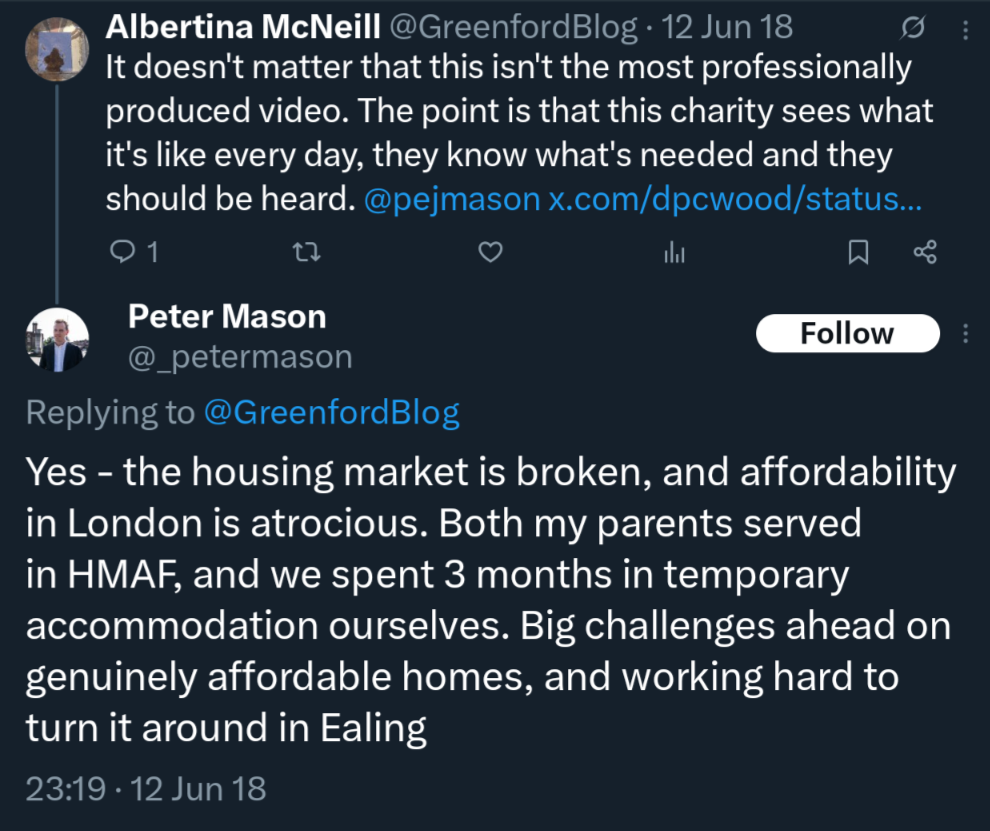
In June 2018, Mason - cabinet lead for housing - wrote:
“Both my parents served in HMAF, and we spent 3 months in temporary accommodation ourselves. Big challenges ahead on genuinely affordable homes, and working hard to turn it around in Ealing.”
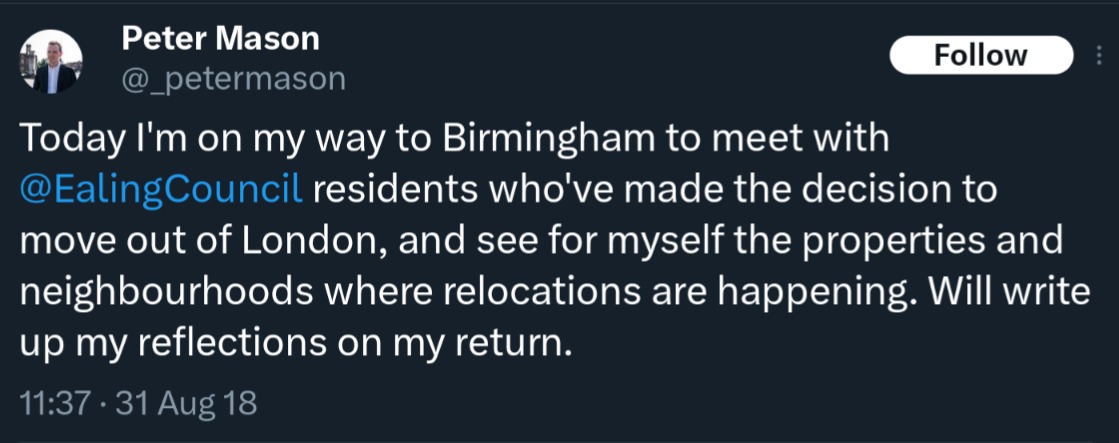
Later that summer, he travelled to Birmingham to visit Ealing residents who had, in the council’s framing, chosen to relocate there, writing:
“Today I’m on my way to Birmingham to meet with @EalingCouncil residents who’ve made the decision to move out of London, and see for myself the properties and neighbourhoods where relocations are happening. Will write up my reflections on my return.”
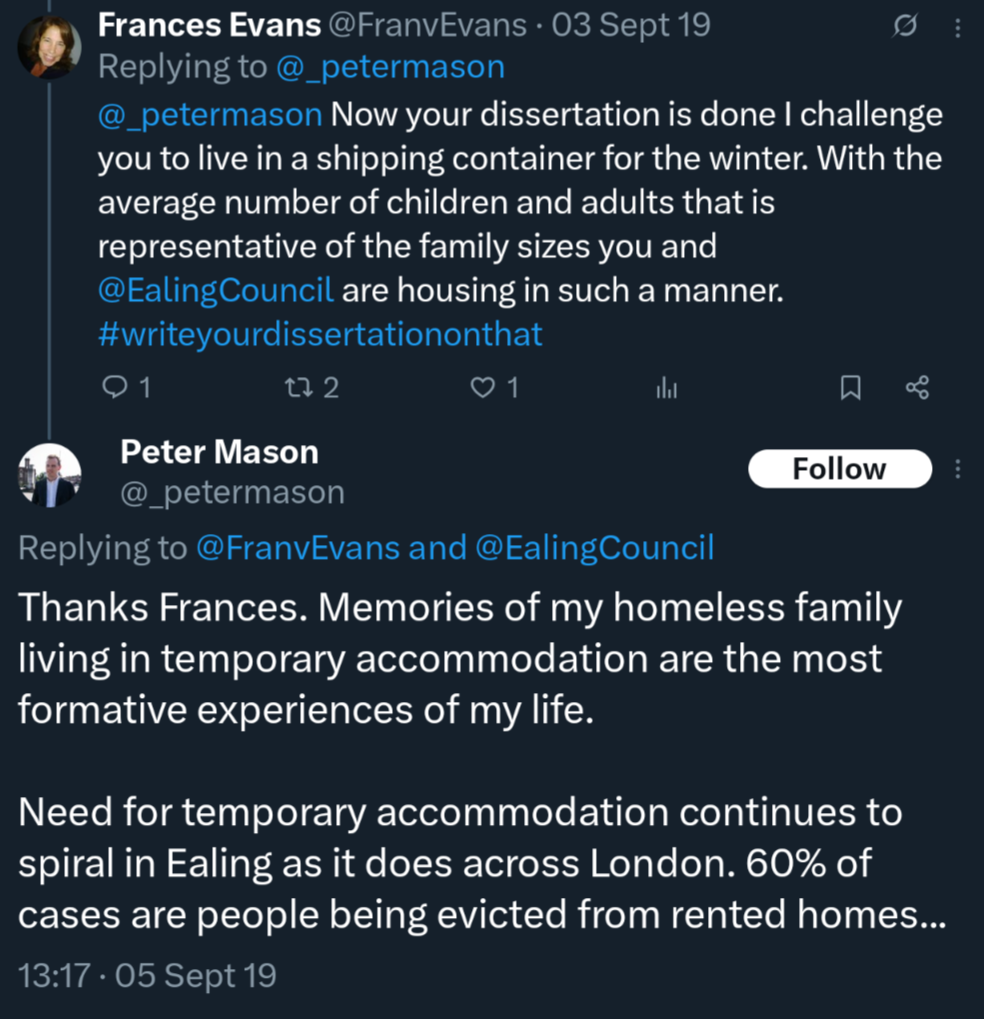
When challenged in 2019 over the council’s use of modular homes and the relocation of families out of London, he replied:
“Memories of my homeless family living in temporary accommodation are the most formative experiences of my life.”
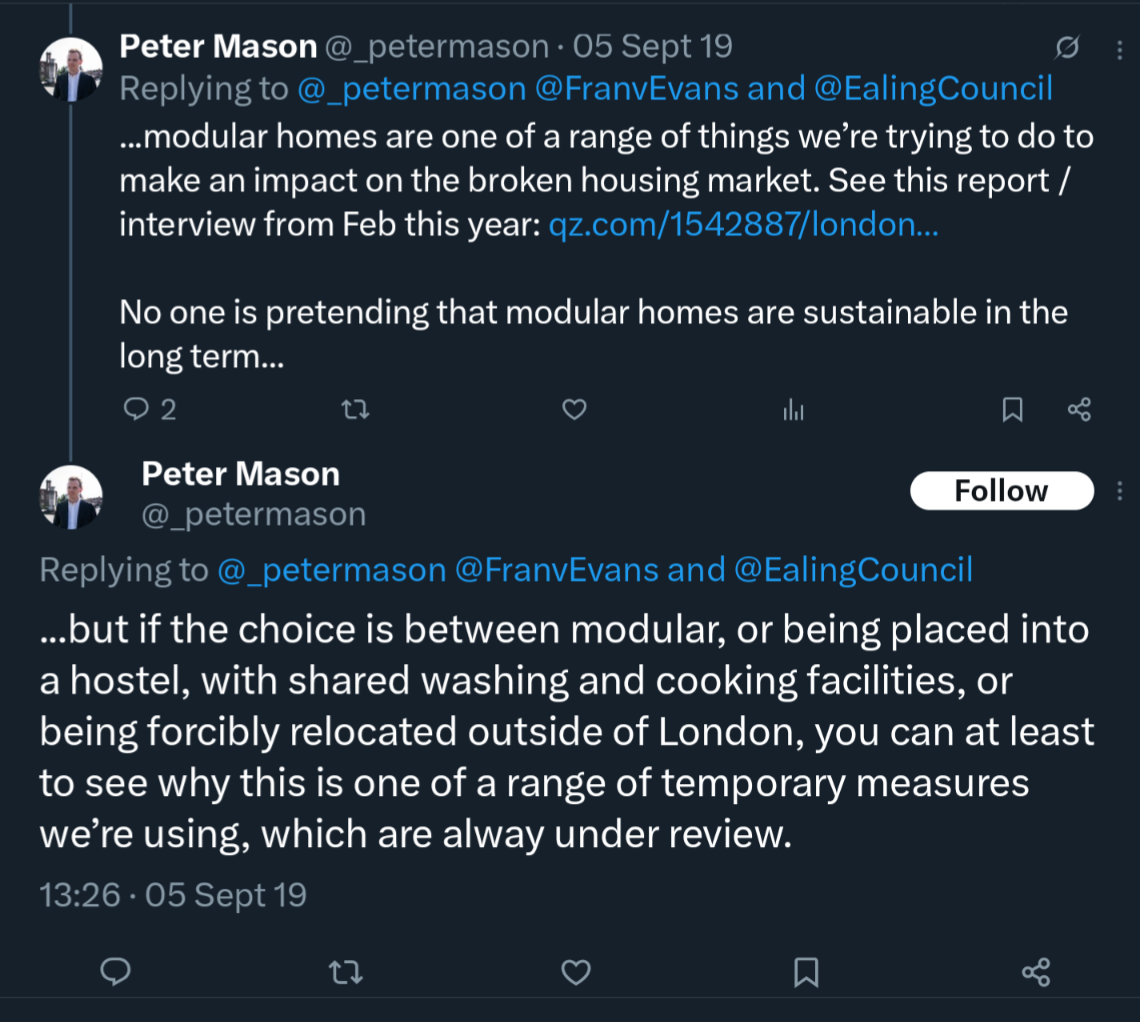
In the same exchange, he defended the use of temporary measures:
“if the choice is between modular, or being placed into a hostel, with shared washing and cooking facilities, or being forcibly relocated outside of London, you can at least see why this is one of a range of temporary measures we’re using, which are alway [sic] under review.”
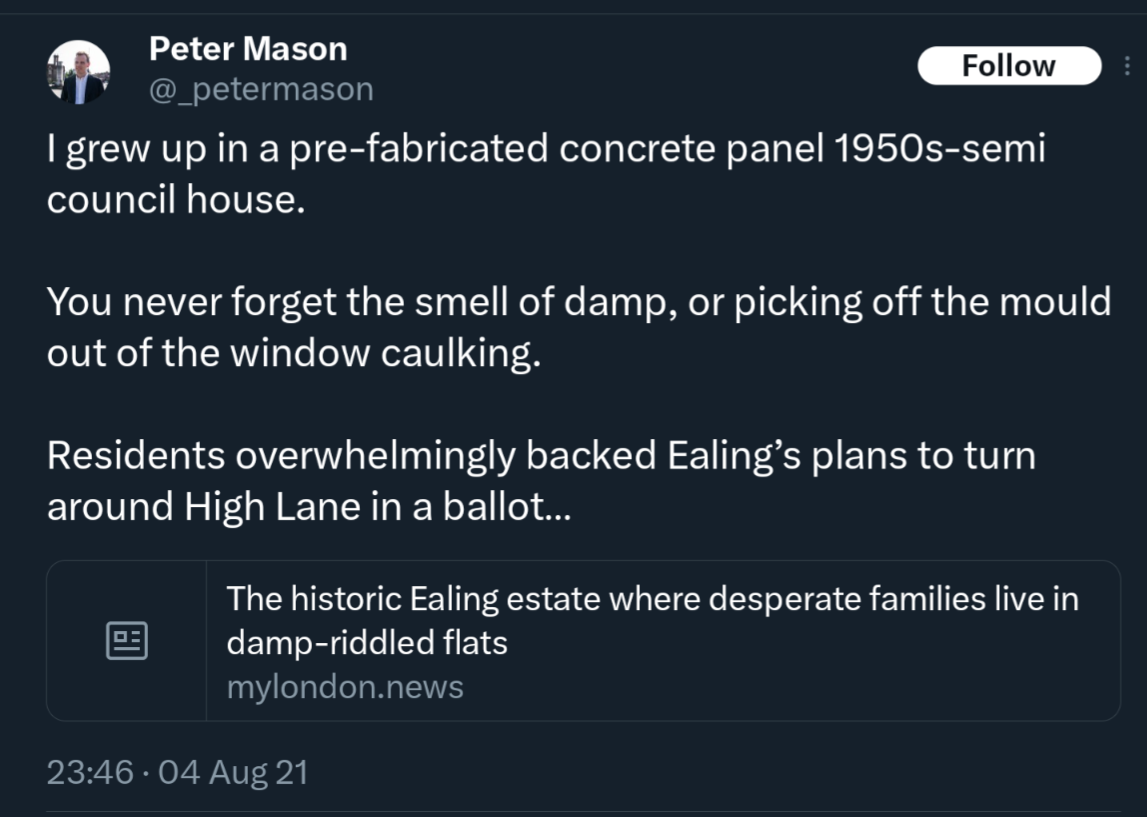
In August 2021, soon after he became council leader, Mason wrote:
“I grew up in a pre-fabricated concrete panel 1950s-semi council house. You never forget the smell of damp, or picking off the mould out of the window caulking.”
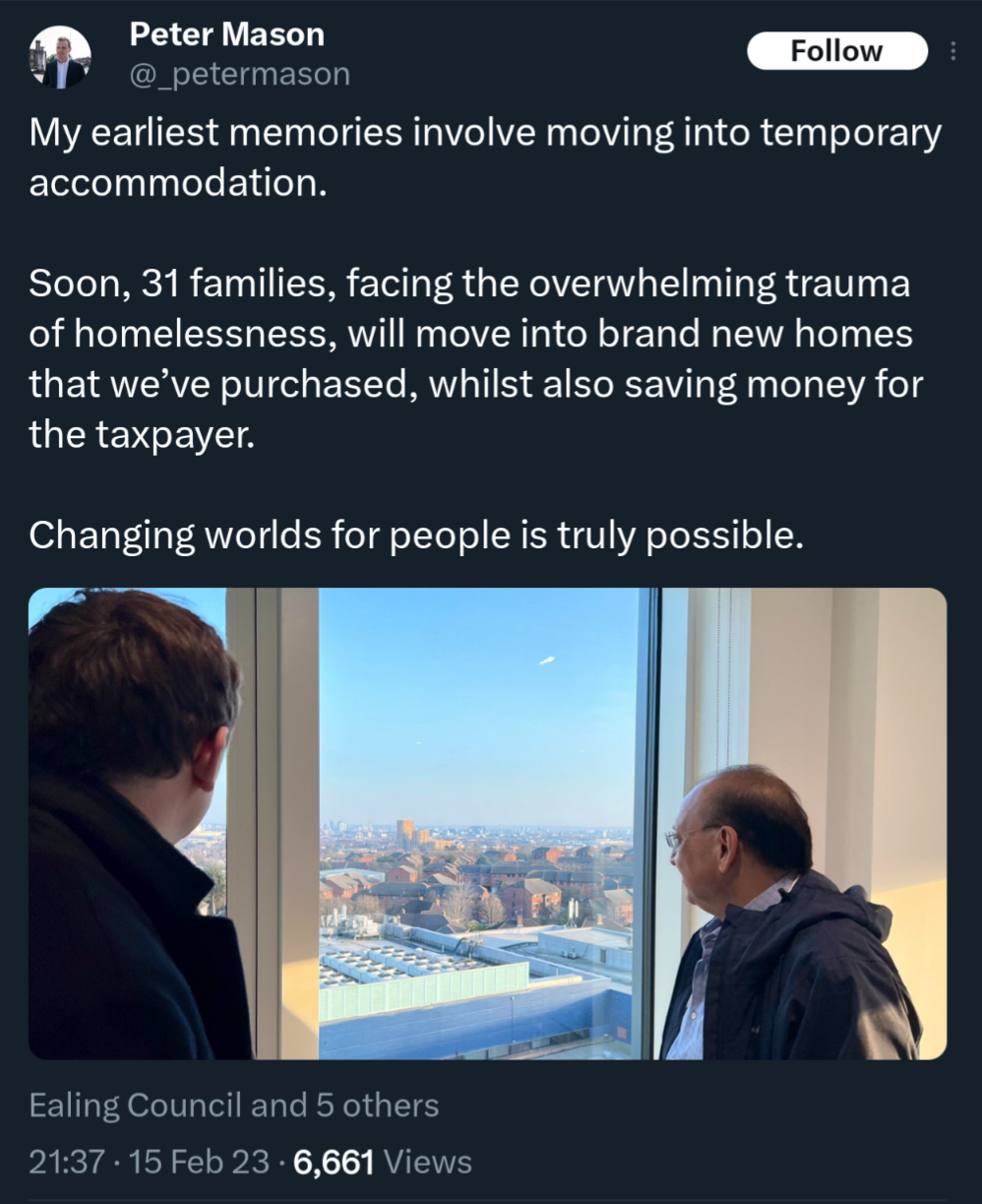
In February 2023, two years into his leadership, he returned to the theme:
“My earliest memories involve moving into temporary accommodation. Soon, 31 families, facing the overwhelming trauma of homelessness, will move into brand new homes that we’ve purchased… Changing worlds for people is truly possible.”
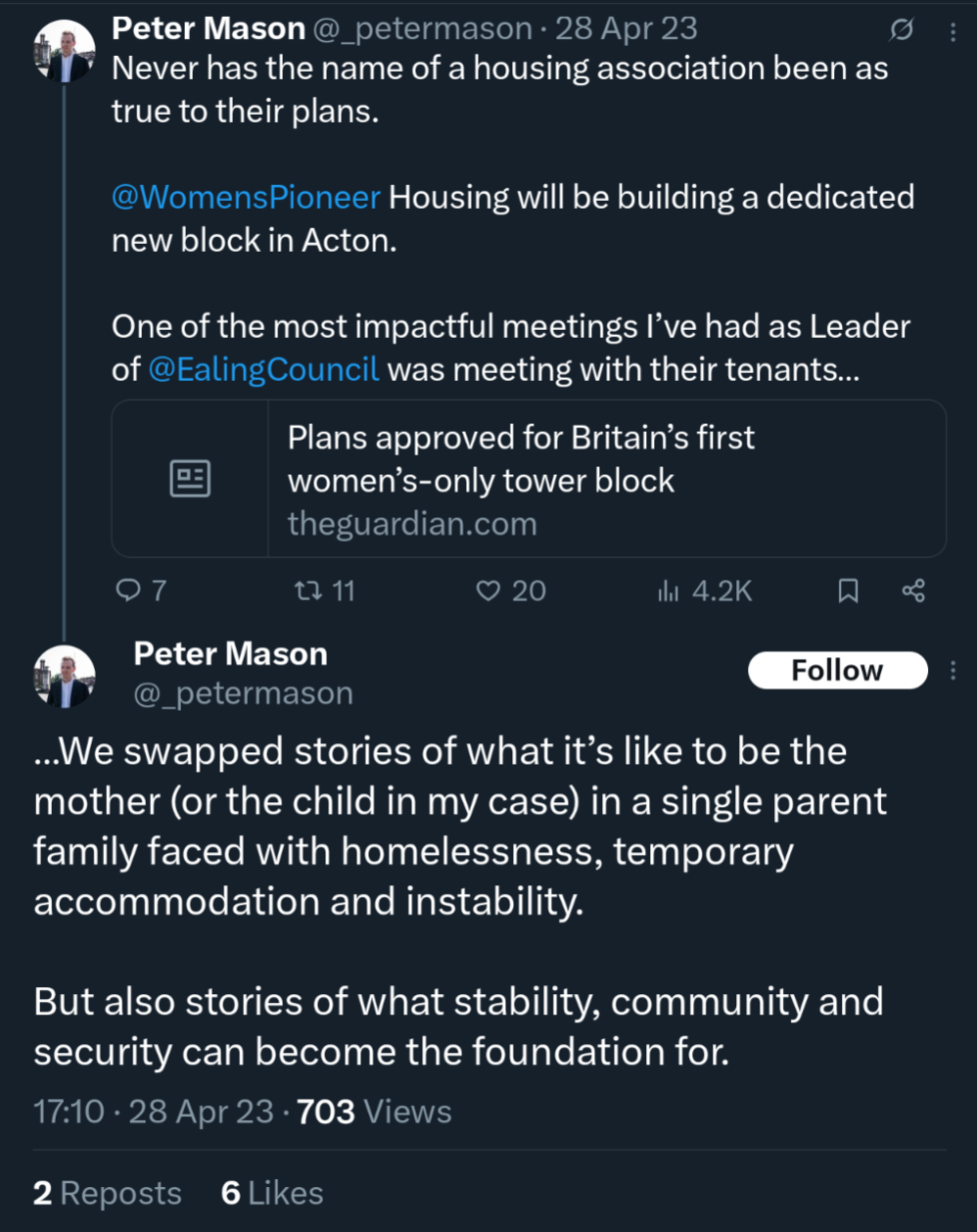
Two months later, he described meeting tenants of a women’s housing association:
“We swapped stories of what it’s like to be the mother (or the child in my case) in a single parent family faced with homelessness, temporary accommodation and instability. But also stories of what stability, community and security can become the foundation for.”
What the record shows
In May 2022, less than eighteen months into his leadership, Ealing Council self-referred to the Regulator of Social Housing over failures in housing health and safety. A regulatory notice was issued. By 2025 — three years later — the Local Government Association’s Corporate Peer Challenge found the notice remained in place and progress had been minimal.
The Housing Ombudsman issued findings of severe maladministration against the council, specifically citing failures around damp, mould and repairs. Temporary accommodation households in Ealing now stand at nearly 3,000 — among the highest in London. The relocation of families to Birmingham and beyond, which Mason was visiting and defending as a councillor from 2018, continues.
Ealing Council’s external auditors, Forvis Mazars, formally identified the unresolved housing health and safety failure as a significant weakness in the council’s governance arrangements — for the third consecutive year. Their finding, published in the audit completion report for 2024/25, was that the council had failed to adequately address recommendations made by internal audit, an externally commissioned report, and the Regulator of Social Housing in respect of housing-related health and safety risks.
The same report confirmed that Ealing’s accounts have received disclaimed audit opinions for four consecutive years — every year of Mason’s leadership.
The accounts for 2024/25 were signed by Mason on 26 February 2026. They were subsequently found to contain an incorrect figure for the chief executive’s salary, overstated by nearly £20,000, not caught before publication. The same accounts show the chief executive’s corrected salary at £222,525 — a package, including pension, of £271,750.
Mason’s own leader’s allowance has nearly doubled since he took over as leader in 2021, from £32,100 then to £62,815 now.
None of this is inference. Every finding cited above comes from published public documents: the auditor’s completion report, the peer challenge findings, the regulator’s notice, the Housing Ombudsman’s determinations, and the council’s own published accounts.
Peter Mason asked voters to judge him on his record. On housing — the issue he has most consistently used to define himself — the auditors, the regulator, and the ombudsman have already offered their assessment.
Voters in Southall Green will make their own on 7 May.