Two weeks ago, and again today, Ealing Labour attacked Grace Hunter, a Conservative candidate for Pitshanger ward, after a TikTok clip surfaced in which she said:
“The solution to our housing problem isn’t building six million more houses… it’s deporting six million people.”
This is fascist propaganda reminiscent of the policies of the National Front in the 1970s and 1980s — and of our own present-day far right, which is leading the polls and looks set to reshape the next government.
Where the “six million” came from
I’ll be honest. When I first read the reported quote, the figure stopped me cold. “Six million.” Whatever the context, whatever the intent, those words in a sentence about mass deportation carry an unmistakable echo. The deliberate murder of six million Jewish people by the Nazi regime is the defining atrocity of the twentieth century. In a borough where Jewish communities have deep roots, that resonance does not disappear because it may have been unintentional.
So I looked into where the figure came from.
It almost certainly derives from a July 2025 report by the Centre for Policy Studies — a right-leaning think tank with strong Conservative connections — which found the UK is short approximately 6.5 million homes compared to similar European countries. The CPS acknowledged migration as a contributing factor — but was explicit that even cutting net migration to zero would not solve the shortage. The bulk of the problem is decades of under-building.
Hunter appears to have taken the CPS’s housing deficit figure and inverted its argument entirely. Where the think tank said “we need to build six million more homes,” Hunter said “we need to deport six million people instead.” She used a Conservative think tank’s research to reach a conclusion that Conservative think tank specifically rejected.
That origin does not dissolve the echo. The Holocaust did not happen in the abstract. It began with the identification of a group of people as a problem to be solved — and with the language of removal. When that number appears in a sentence about deportation, the discomfort is not irrational. It is memory doing its job.
What Ealing’s own data actually shows
Ealing Council’s own figures tell a different story from Hunter’s. Over 3,000 households are currently in temporary accommodation in the borough, with 329 households with children in bed and breakfast accommodation beyond the legal six-week limit. Average rents rose by 12.4% in a single year — faster than anywhere else in London. The council’s own analysis attributes this to landlords leaving the market, a chronic shortage of new homes, and properties being converted to short-term lets such as Airbnb.
Immigration does not appear in Ealing’s own homelessness analysis as a cause. The council is run by Labour. These are their numbers.
Mass deportation is not a housing policy. It is fascism.
A very old idea
Mass deportation is not a new idea. It is not even a particularly Conservative idea in origin. It is the oldest demand of the British far right — and it has been with us, in one form or another, for sixty years.
The National Front was founded in 1967 with the expulsion of all settled non-white immigrants as a founding policy. By 1974, the compulsory deportation of all non-white immigrants and their descendants — including the white British partners in mixed-race relationships — was the cornerstone of their manifesto. They said it would take ten years. Before deportation, non-whites would be stripped of British citizenship and placed behind white Britons in access to welfare, education and housing.
The British National Party, formed in 1982, carried this forward. Under John Tyndall’s leadership it promoted compulsory removal of non-whites from the UK. In the early 1990s it produced stickers with the slogan:
“Our Final Solution: Repatriation.”
When Nick Griffin modernised the party’s image, compulsory deportation became “voluntary repatriation” — but any non-whites who refused would be stripped of their citizenship and categorised as “permanent guests.”
The language evolved. The policy did not.
Tommy Robinson — real name is Stephen Yaxley-Lennon — drew around 100,000 people to a far-right rally in London in September 2025. He has spent his public life advocating for the mass deportation of immigrants and Muslims from Britain. At that rally he told the crowd that:
“an orchestrated, organised invasion and replacement of European citizens is happening.”
And now, in April 2026, both the Conservative Party and Reform UK are standing candidates across Ealing on platforms that include mass deportation schemes targeting hundreds of thousands of people.
Reform’s plan would disapply the 1951 Refugee Convention to achieve it. The Economist described both plans as “dangerously unrealistic.”
The Overton window has not just shifted. It has been smashed. Fascist policy is mainstream.
Southall has been here before
Southall knows this history in its bones.
On 23 April 1979 — St George’s Day, 46 years ago yesterday — the National Front held an election meeting at Southall Town Hall, in the heart of a community they wanted removed from Britain. They chose Southall deliberately. It was a provocation. The community knew it.
Blair Peach was 33 years old, a teacher of children with special needs at a school in East London, and a member of the Socialist Workers Party. In the months before Southall, he had twice been attacked by NF supporters while cycling home from work. On 23 April he travelled to Southall to stand with the community against the NF meeting.
Workers went on strike. Ten thousand residents signed a petition to cancel the meeting. Thousands marched. The Tory-run Ealing Council — compelled by the Representation of the People Act — allowed the meeting to proceed despite the community’s protests.
The police sent in 2,800 officers — 94 on horseback — to protect the National Front’s right to meet. Thirty fascists attended their meeting inside. By the end of the night, 345 people had been arrested. Dozens were injured. And Blair Peach was murdered, struck on the head by a member of the Metropolitan Police’s Special Patrol Group.
No police officer was ever charged.
The internal police inquiry, suppressed for thirty years, concluded he had almost certainly been killed by one of six SPG officers who had preserved their silence.
Eight thousand people filed past Blair Peach’s body as it lay in state at the Dominion Cinema in Southall. Between five and ten thousand followed his coffin to East London Cemetery. A primary school in Southall bears his name. This April, his partner Celia Stubbs donated the full archive of materials relating to his death to the Bishopsgate Institute, where they are now publicly available.
Southall did not passively endure the far right. The community organised, and resisted.
And Labour? Surely Labour stood with Southall?
Many people will be thinking: but Labour stood with Southall back then, didn’t they? That was the difference. Labour opposed the far right.
Wrong.
It was Labour’s Home Secretary Merlyn Rees who refused to overrule the then Conservative Ealing council to ban the NF meeting. It was a Labour government whose response to Blair Peach’s death was to defend the Metropolitan Police.
The pattern goes back further. Labour abandoned its opposition to immigration control as early as 1962, when the party decided it could not afford to be seen as “soft” on the issue. By 1968 — the year of Enoch Powell’s Rivers of Blood speech — Labour had already passed its own restrictive Commonwealth Immigrants Act, creating a distinction between predominantly white British citizens and predominantly non-white Commonwealth citizens who could no longer claim to be British.
Powell was sacked from the Tory shadow cabinet for the rhetoric of his speech. The policy content was already bipartisan.
Individual Labour figures did stand with Southall. Neil Kinnock spoke at Blair Peach’s graveside. Peter Hain co-founded the Anti-Nazi League. Dozens of Labour MPs supported the anti-fascist movement.
The Labour Party as a governing institution did something different: it triangulated, accommodated, and refused to act.
The difference between then and now is not that Labour used to oppose restriction and now betrays its principles. It is that the accommodation has become the policy itself.
What the National Front demanded in 1974 — strip rights, detain, deport — is now being proposed in white papers and manifestos by national parties that between them hold almost every seat on Ealing Council.
What the national Labour government is doing right now
Ealing Labour’s attack on Grace Hunter was entirely justified in its condemnation of her remarks. But voters in Southall should know what the national Labour government has done since taking office.
It has doubled the qualifying period for permanent settlement from five to ten years.
Home Secretary Shabana Mahmood has told migrants they must “earn the right to be in the UK” — language almost identical to Conservative leader Kemi Badenoch’s framing of citizenship as “a privilege that is earned.”
This Labour government has stripped newly recognised refugees of permanent status, replacing it with temporary protection renewable every 30 months.
Labour is reviewing how UK courts apply the very European Court of Human Rights provisions that protect people from deportation to dangerous situations.
The Institute for Government is unambiguous: there is now “a race to toughen immigration controls among parties that lead the election polls.”
Only the Liberal Democrats, the Greens and Jeremy Corbyn’s and Zarah Sultana’s Your Party nationally are defending a rights-based approach.
Peter Mason, leader of Ealing Council, said that the election should not be a choice between “extreme-Left and extreme-Right.”
He is right that Grace Hunter’s remarks represent something extreme.
But his own national Labour Party, whose governing National Executive Committee he sits on, is implementing policies that the Institute for Government describes as a fundamental departure from decades of consensus.
Southall residents are not obliged to choose between a party that says fascism loudly and a party that does fascism quietly.
A different approach is possible
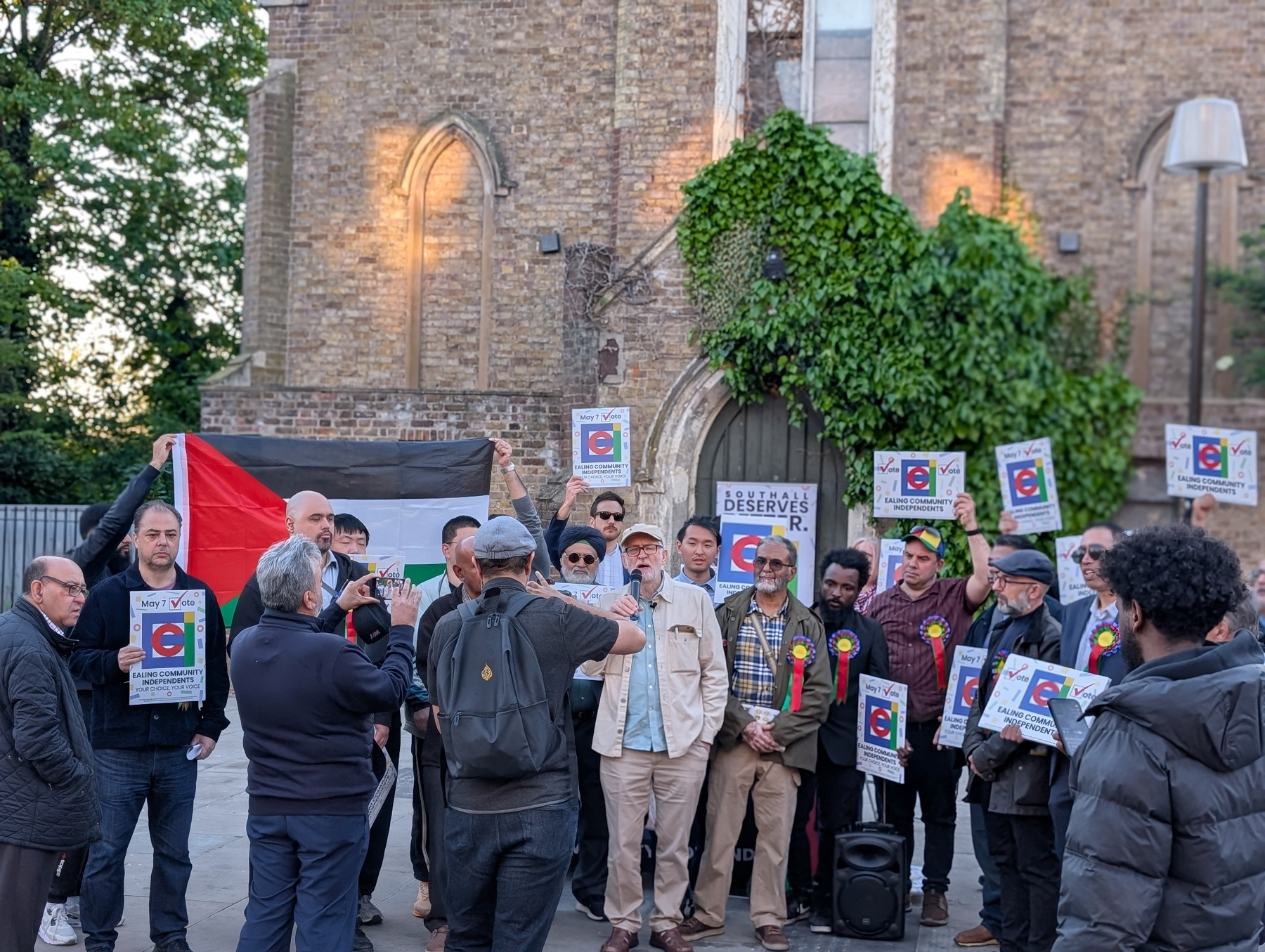
Ealing Community Independents candidates in Southall wards are standing on a platform rooted in this community — its housing, its services, its right to transparent and accountable local government — without using our neighbours as political currency. They support Ealing Friends of Palestine’s campaign for council pension divestment. They will not compete to sound toughest in a race to the bottom that Southall has seen before and refused before.
Yesterday, Jeremy Corbyn — the former Labour Party leader who Ealing Labour leader Peter Mason did so much to undermine and oppose — visited to give his support, again.
On 7 May, Ealing voters will decide whose side they are on.