I attended the West London Citizens “Accountability Assembly” at St Anselm’s Church in Southall Green on Tuesday night. I left after an hour, before any of the candidates had answered any of the preset questions.
In that hour, I listened to Peter Mason talk — yet again — about his family upbringing in damp and mouldy temporary accommodation.
[Video courtesy of another audience member.]
Three months that made him a lifelong socialist, committed to ensuring others don’t have to endure the same hardships.
Then I listened to a succession of young people describe, in harrowing terms, how they — a tiny subset of the more than 3,000 families in unsafe, insecure and unsuitable housing in Ealing — struggle in conditions far worse, for years without end.
This is Mason’s Ealing.
Shaped in his own image over more than a decade of leadership (behind the scenes and out front):
- ever-increasing housing waiting lists, thousands of demolished and half-built social homes,
- millions wasted on unscrupulous contractors,
- failed environmental schemes,
- and obscene increases in councillor allowances.
The young people who spoke last night deserved answers. They didn’t get them.
They got choreographed applause and cheers. They got pledges.
[Video courtesy of another audience member.]
What are these pledges worth?
The organisers decided no questions were permitted from the floor. The party leading the polls in Ealing was not invited. The local organisers, activists and candidates best placed to speak to their experience were refused a seat at the table.
That is not accountability. It’s political convenience.
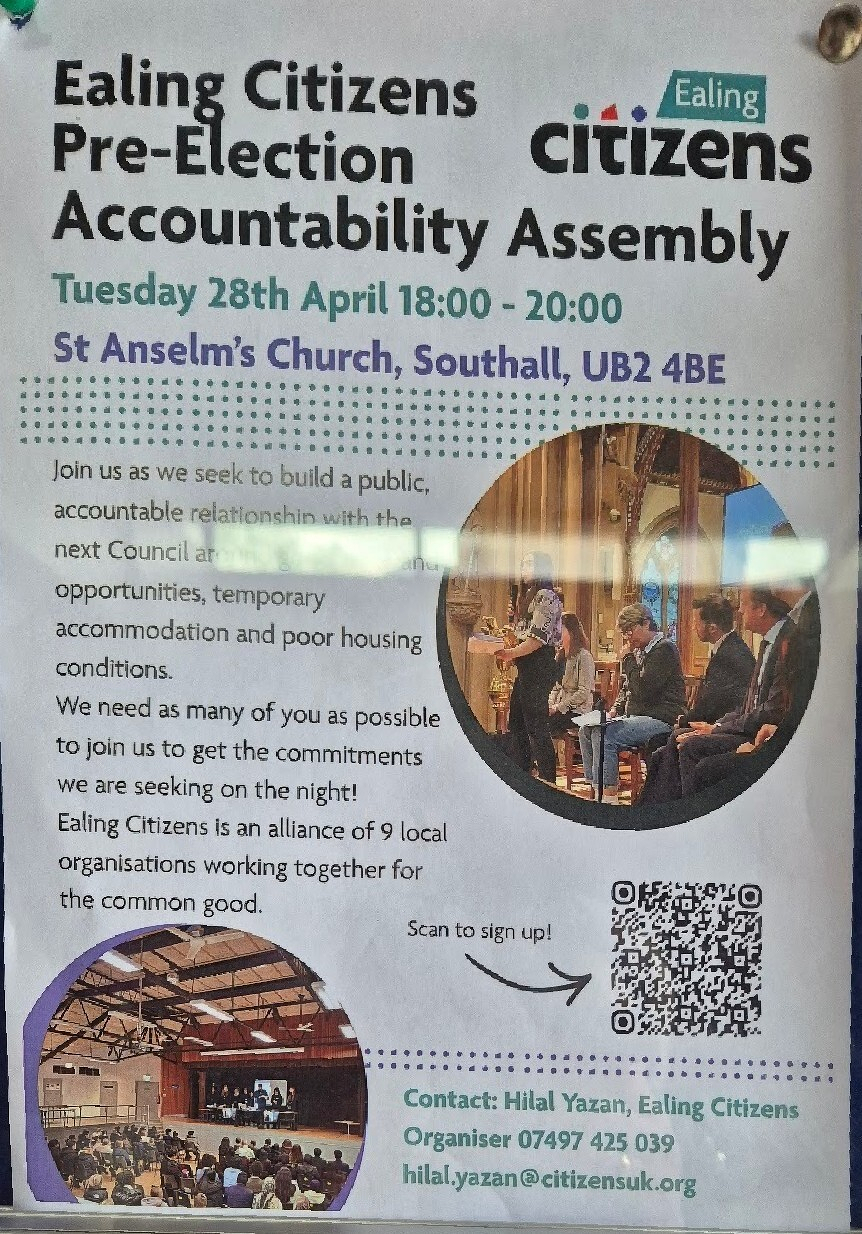
An accountability assembly that excluded Southall’s actual challengers tells us more about Ealing’s political establishment than any speech delivered from its podium.
“The party told you to reject the evidence of your eyes and ears. It was their final, most essential command.” — George Orwell, Nineteen Eighty-Four
On the evening of 28 April 2026 — nine days before Ealing residents go to the polls — West London Citizens held what it billed as a “Pre-Election Accountability Assembly” at St Anselm’s Church in Southall Green.
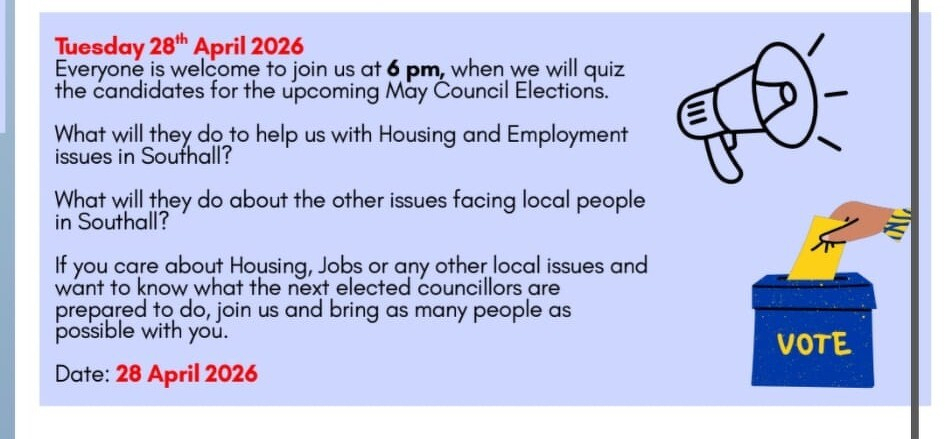
The event’s own code of conduct stated clearly: “This is not an election debate, hustings or partisan political rally. We do not support or endorse any politician or political party.”
Three candidates were invited to make opening statements and respond to the assembly’s manifesto asks: Peter Mason (Labour), Gary Malcolm (Liberal Democrats), and Julian Gallant (Conservatives).
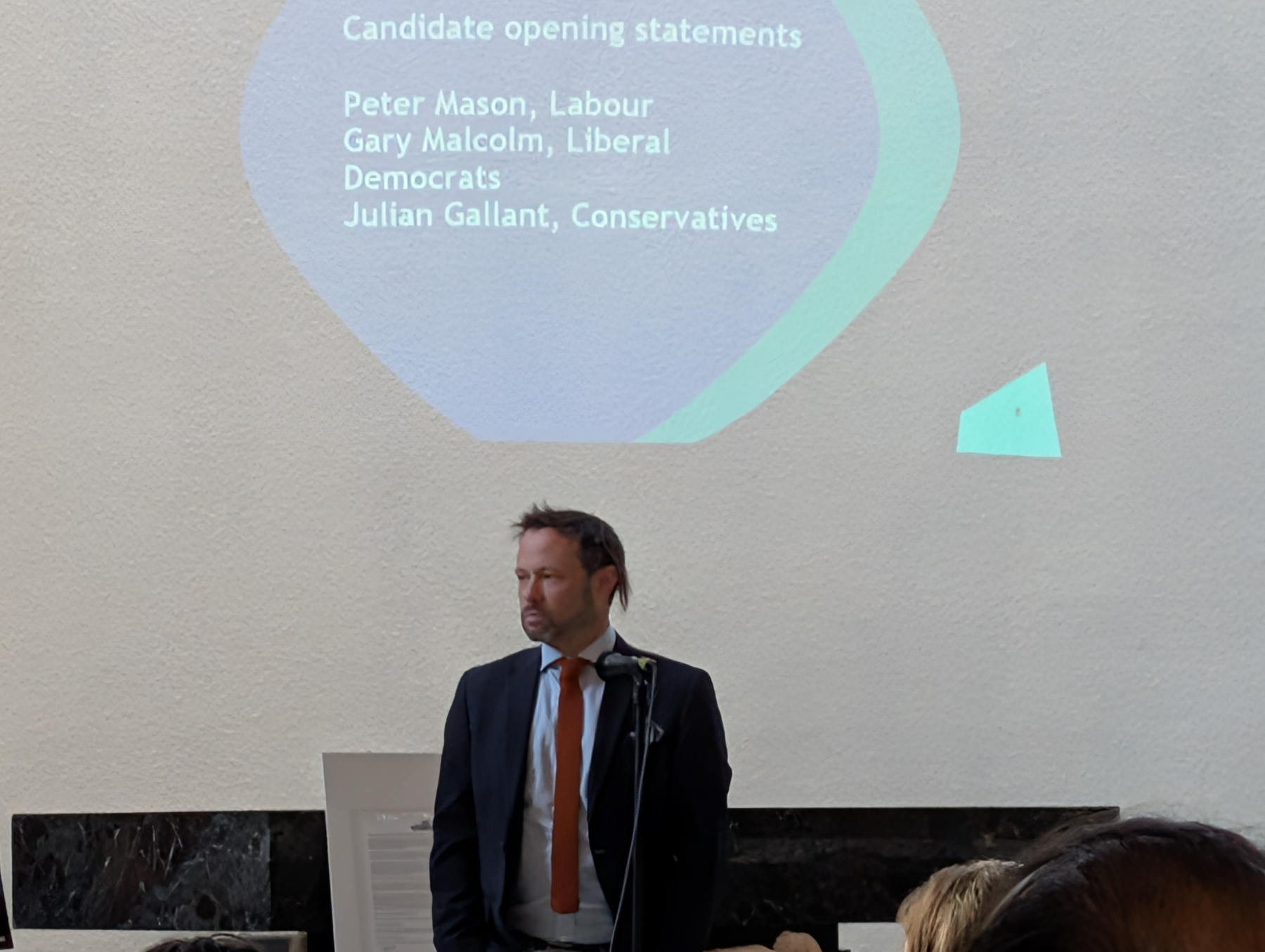
No other parties were invited.
Ealing Community Independents, standing candidates across multiple Southall wards, formally requested to attend. They received a direct written refusal.
This isn’t the first time
This is not a new arrangement. Four years ago, on 27 April 2022, Ealing Labour’s then-parliamentary candidate Bassam Mahfouz tweeted from an identical Citizens UK event, describing it plainly as a “Hustings” — with the same three parties on the stage.
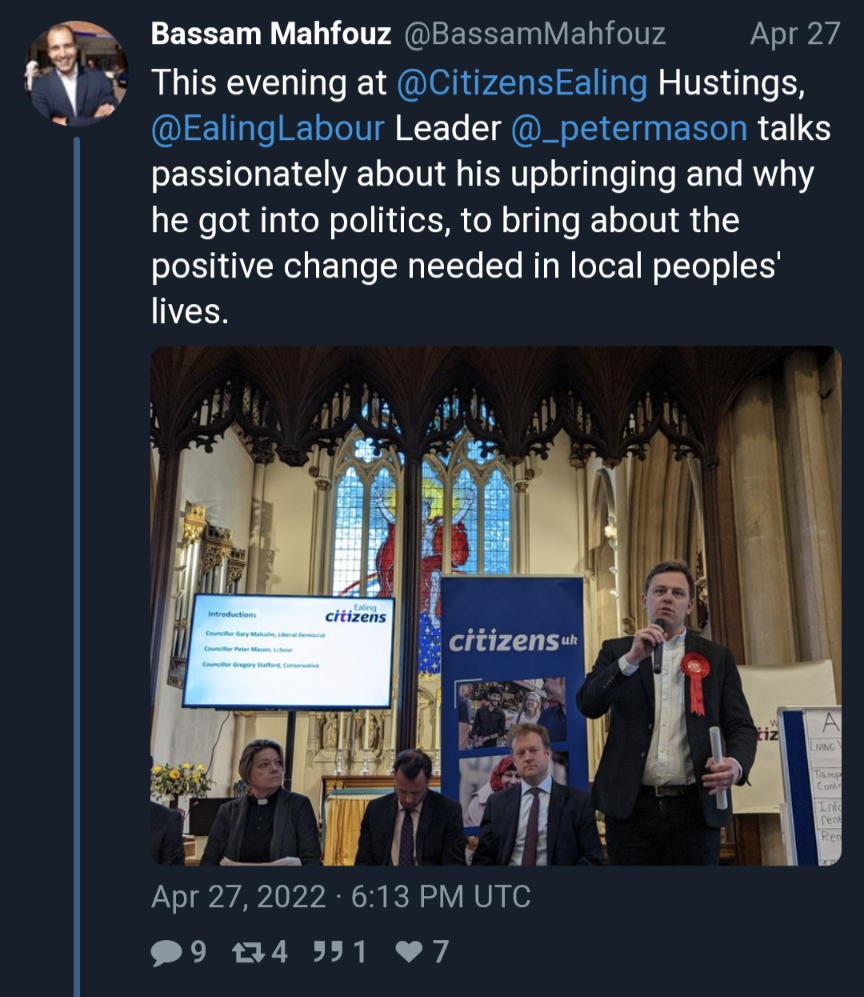
The projected slide at that event listed two of the same names: Councillor Gary Malcolm, Councillor Peter Mason, with then-Councillor Gregory Stafford representing the Conservatives.
In 2026, the event has been rebranded. It is no longer a hustings. It is an “accountability assembly.” The code of conduct now explicitly states it is “not an election debate, hustings or partisan political rally.”
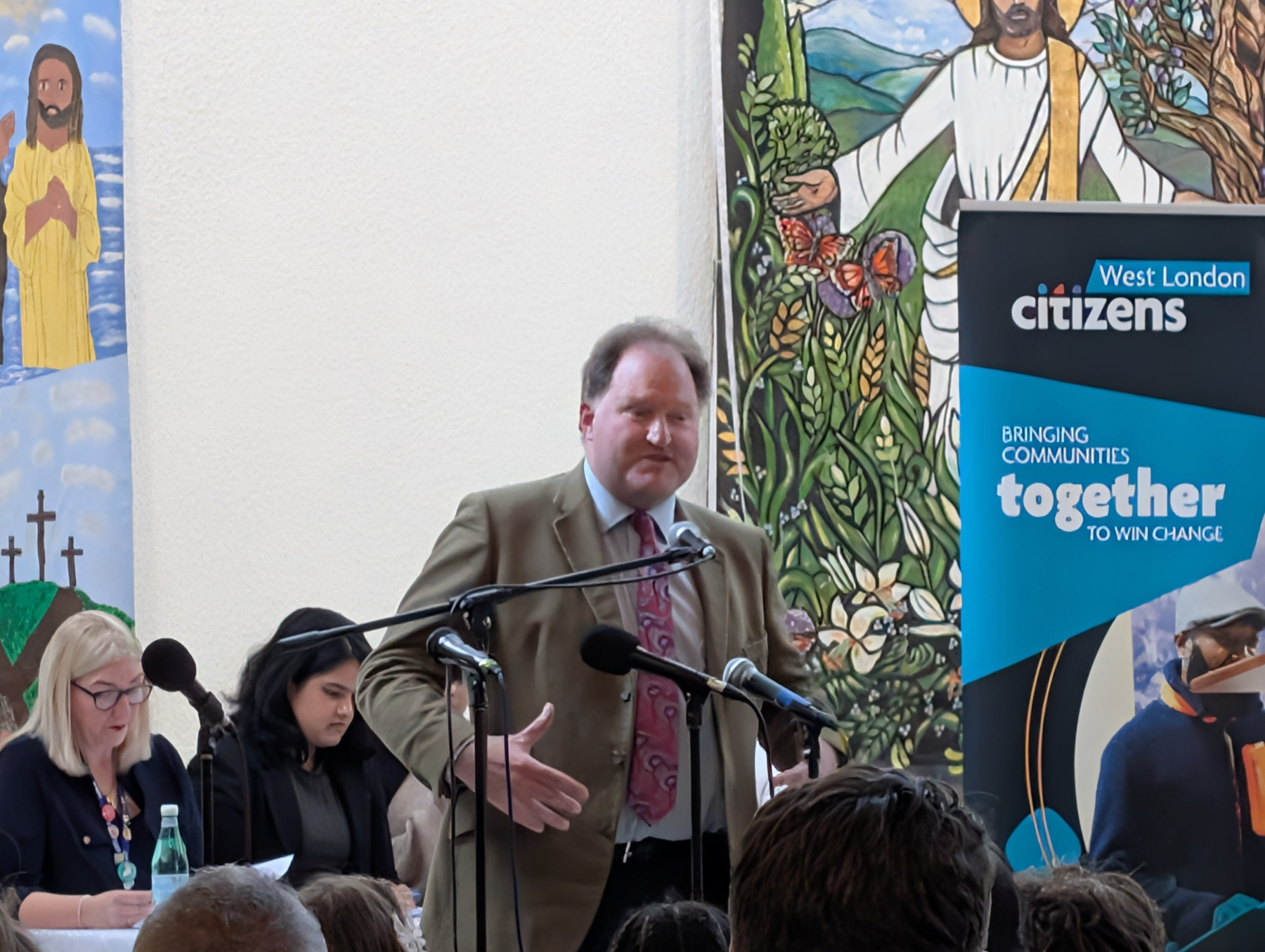
The parties on the stage are identical. The parties excluded are identical. Only the language has changed.
A controlled format
The assembly’s rules prohibited questions from the floor. The agenda had been shared with invited candidates in advance. Residents — perhaps 50 of the 700 whose voices supposedly shaped the Citizens manifesto — could listen, but not speak.
This is a legitimate format for some purposes. But calling it an accountability assembly, while excluding candidates and silencing the room, raises an obvious question: accountable to whom, exactly?
What the record actually shows
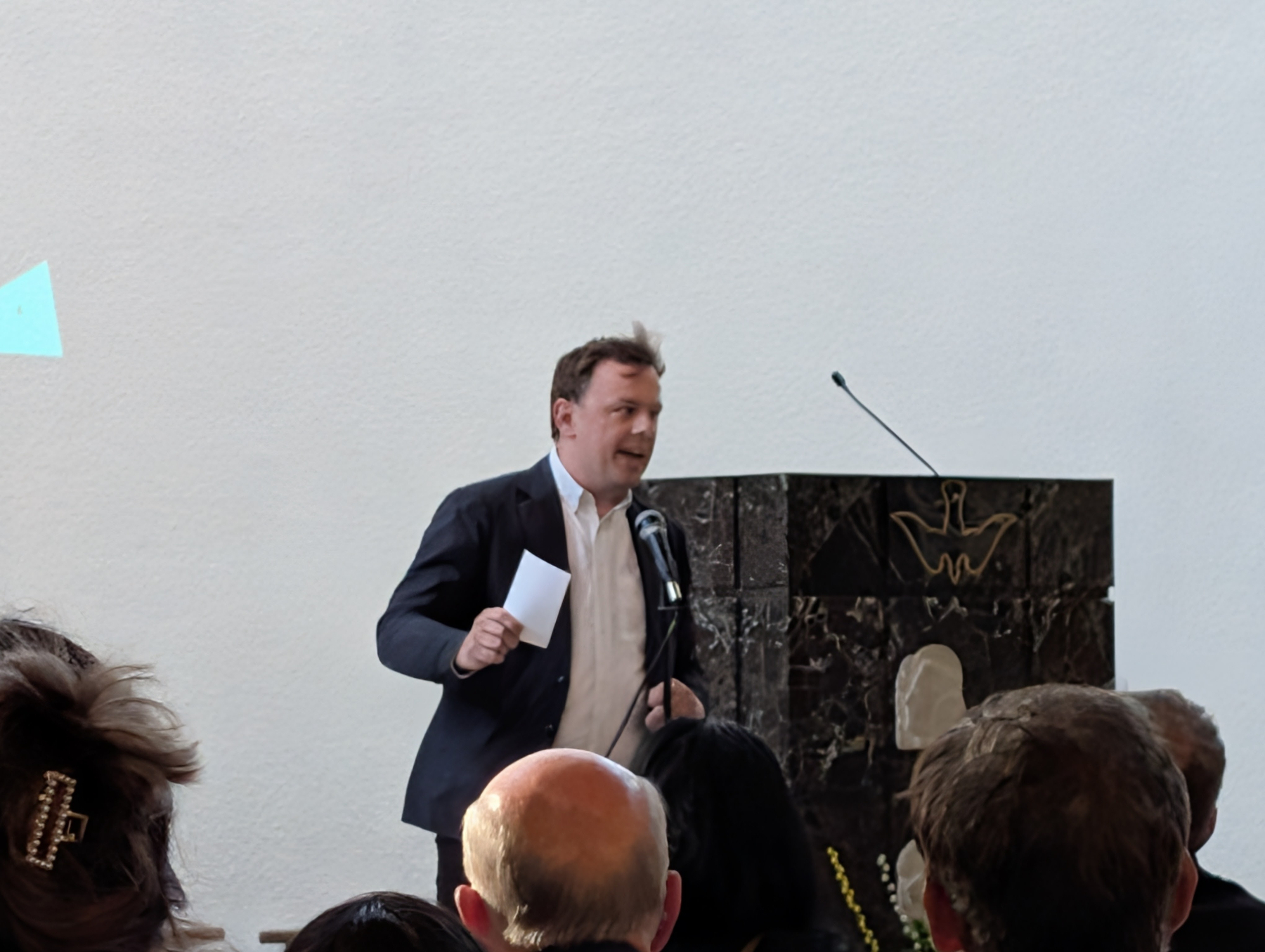
Peter Mason arrived at St Anselm’s with a confident message. Speaking to Ealing News on 25 April, he said:
“Our record speaks for itself in terms of what we’ve delivered, not just in genuinely affordable homes, but jobs for local residents and the money that we’re reinvesting back into frontline services.”
The record, examined closely, tells a different story.
In 2022, Ealing Labour promised to build 4,000 affordable homes. By 2026, the party’s own manifesto celebrated delivering 2,644 — 1,356 fewer than pledged.
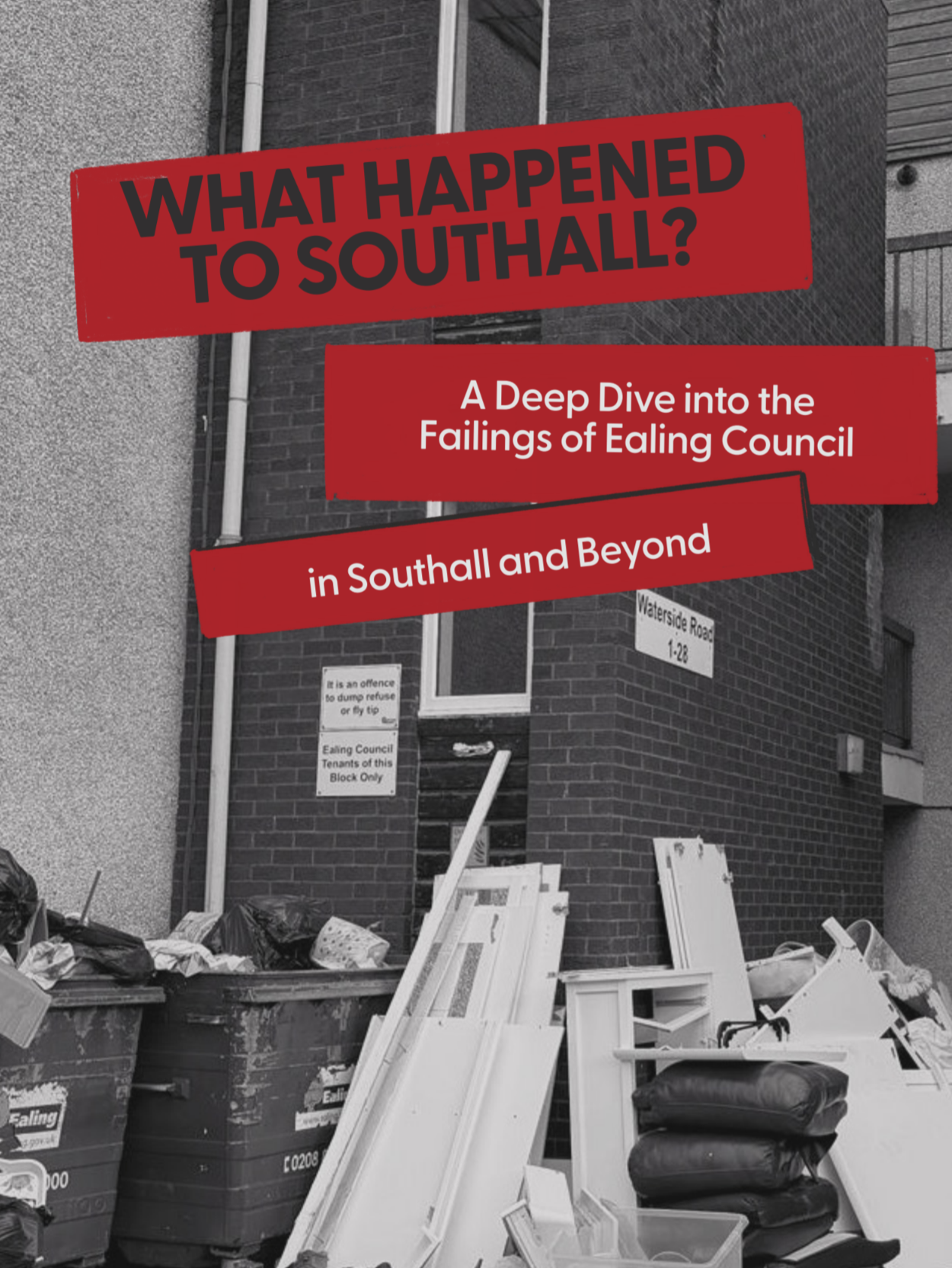
The recently published report What Happened to Southall? produced by Community Powered Reporting and collating council data, local journalism and Freedom of Information responses, gives a fuller picture. It reports Conal Urquhart’s investigation, which found that of roughly £100 million allocated to deliver more than 1,100 affordable homes, only around 180 had been completed by early 2026 — approximately 16% of the target.
Conal also broke the story of Henry Construction, who were awarded contracts to build genuinely affordable homes in Southall Green, and went bust before completion — despite having a publicly documented history of prior insolvency collapses.
This site documented some of the human cost in detail:
- Half-built homes have rotted on Norwood Road for three years.
- The McCreesh family were made homeless after Ealing failed to deliver their promised accessible new home, with council officers telling them they were “not responsible” for new-build properties.
- The Southall Market Car Park development now faces potential demolition and rebuild at enormous additional cost.
Mason attributed the shortfall to unforeseeable events: Liz Truss, Ukraine, rising interest rates.
What he did not explain was why Henry Construction — whose controllers had prior insolvency history and had extracted a £10 million dividend shortly before a previous collapse — was awarded public contracts in the first place.
That information was publicly available.
The question of who signed off on the risk has never been answered.
What Happened to Southall? documents the wider pattern.
- Fortnightly bin collections introduced in 2016 linked to fly-tipping more than doubling.
- The housing waiting list rising above 12,000.
- A sustained closure of children’s centres, youth facilities and sports provision.
Plans affecting ten children’s centres, which hit Southall hardest of any of Ealing’s seven towns, losing three of its six centres including its main Grove House hub.
Residents campaigned and raised over £5,000 to fund a [judicial review challenge (https://caselaw.nationalarchives.gov.uk/ewhc/admin/2026/886), heard in February 2026.
Mr Justice Kimblin dismissed the claim on 15 April.
The closures will proceed.
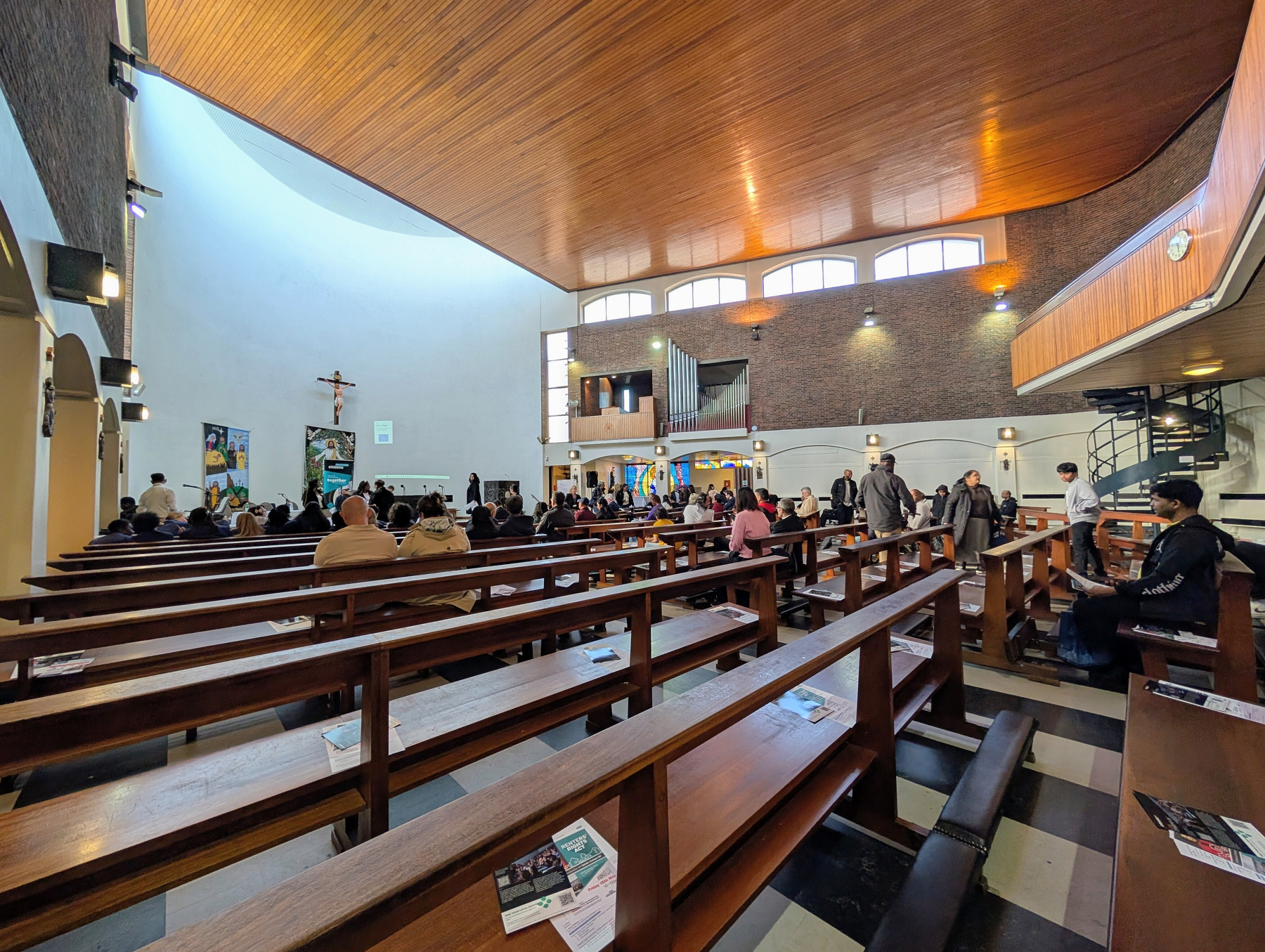
At the accountability assembly on Tuesday evening, with no questions from the floor permitted, none of this went examined.
When accountability is NOT accountability
There is a phrase that has haunted Southall for years, first documented on this site in August 2019. When residents pressed Ealing Council on when the toxic remediation of the Southall Gasworks site would finally be completed, the council’s contaminated land officer — whose post had originally been funded by Berkeley Group, the developer responsible for the pollution — provided this clarification:
“The remediation for the next nineteen years is, in a sense, NOT remediation.”
Residents had been told remediation would be complete in September 2018. Then December 2018. Then March 2019. When pressed in writing on whether these repeated assurances constituted “a rather significant error” that was “extremely misleading,” the council’s Regulatory Services Officer replied that he did not agree — defending each revised deadline as based on “the best information available at the time.”
The remediation of the contaminated land is set to complete 2038.
Meanwhile, Peter Mason and his then-leader Julian Bell were accepting all-expenses-paid trips to the MIPIM property developers’ conference in Cannes, courtesy of a consortium that included Berkeley Group — the company whose contractor was producing the poisonous air that Southall’s children were breathing in their school playgrounds.
Orwell’s observation was about totalitarianism. But the instruction it describes — reject the evidence of your eyes and ears — does not require a totalitarian state. It only requires officials who have learned that language can be made to mean its opposite, and institutions willing to let them get away with it.
Remediation that is NOT remediation.
A hustings that is NOT a hustings.
An accountability assembly that excludes the candidates with the most to say about the record being assessed.
The pattern is consistent. Only the subject changes.
The pledge that accountability forgot
The Living Wage sits at the heart of West London Citizens’ 2026 manifesto.
It is one of the asks candidates were invited to commit to at St Anselm’s on Tuesday evening.
It was also one of the asks Peter Mason committed to at the same event four years ago.
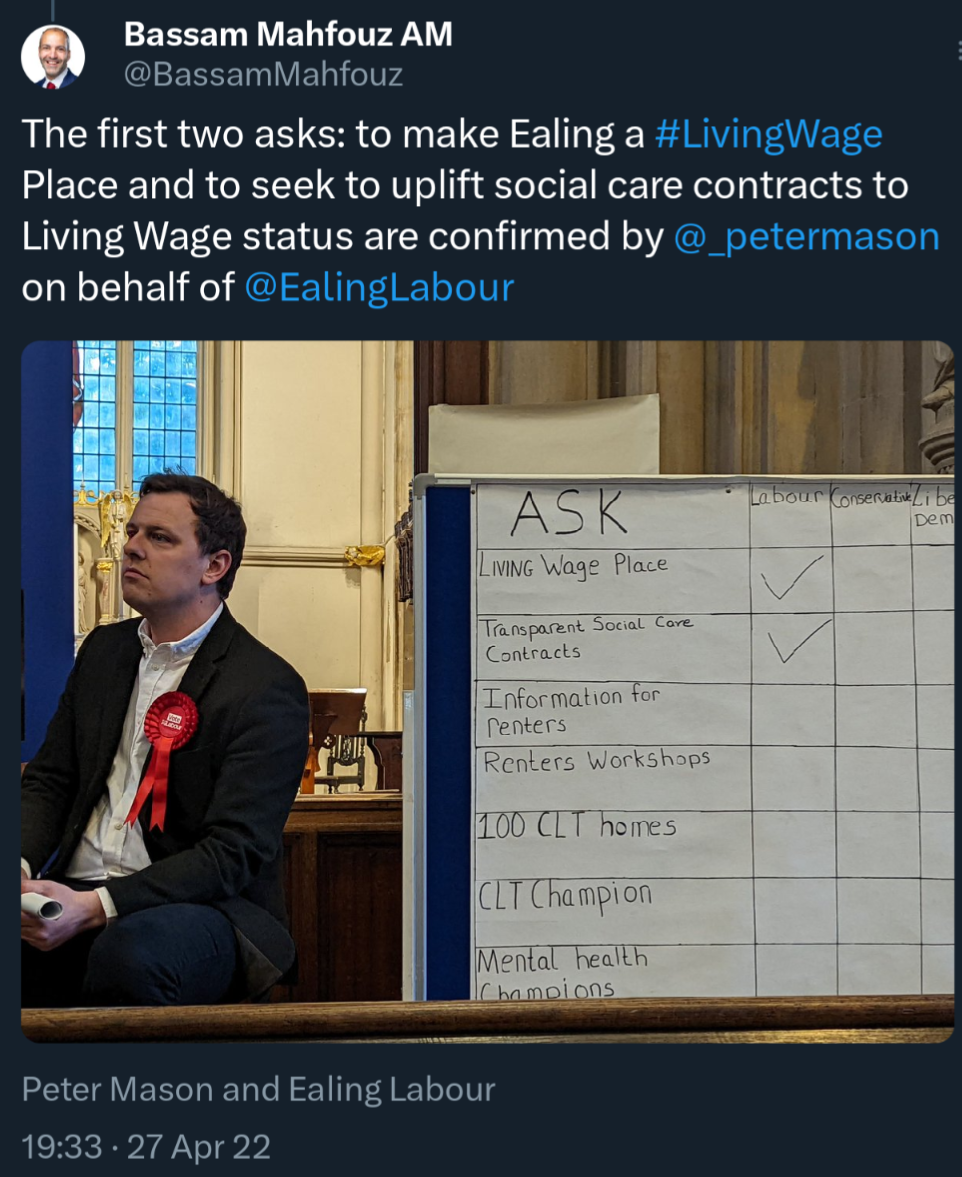
Citizens UK’s own account of the 27 April 2022 assembly records that Mason made the following commitments on behalf of Ealing Labour:
- making Ealing a Living Wage Place and more than doubling the number of Living Wage accredited employers from the 41 then accredited;
- 10 new renters rights workshops;
- 50 new community land trust homes;
- council funding for mental health and SEN parent champions.
The 2026 manifesto asks for 100 CLT homes. Four years ago, Mason committed to 50. Citizens UK’s own records confirm the commitment was made. Last month, on 26 March 2026, West London Citizens accounted for a proposal “which could deliver around 20 genuinely affordable homes.”
Zero homes delivered.
A proposal that might see about 20. Sometime.
On the Living Wage, the record is similarly instructive.
Ealing Council signed a Living Wage Foundation Accreditation Licence in 2014, under then-leader Julian Bell. That licence covered not just direct council employees but workers subcontracted to the council. According to Michael Milne, founder of the Ealing Living Wage Alliance, those obligations went unmet for years. It took a campaign by the Alliance and Ealing UNISON in 2020 to force the belated payment of the Living Wage to school catering workers — six years after the licence was signed.
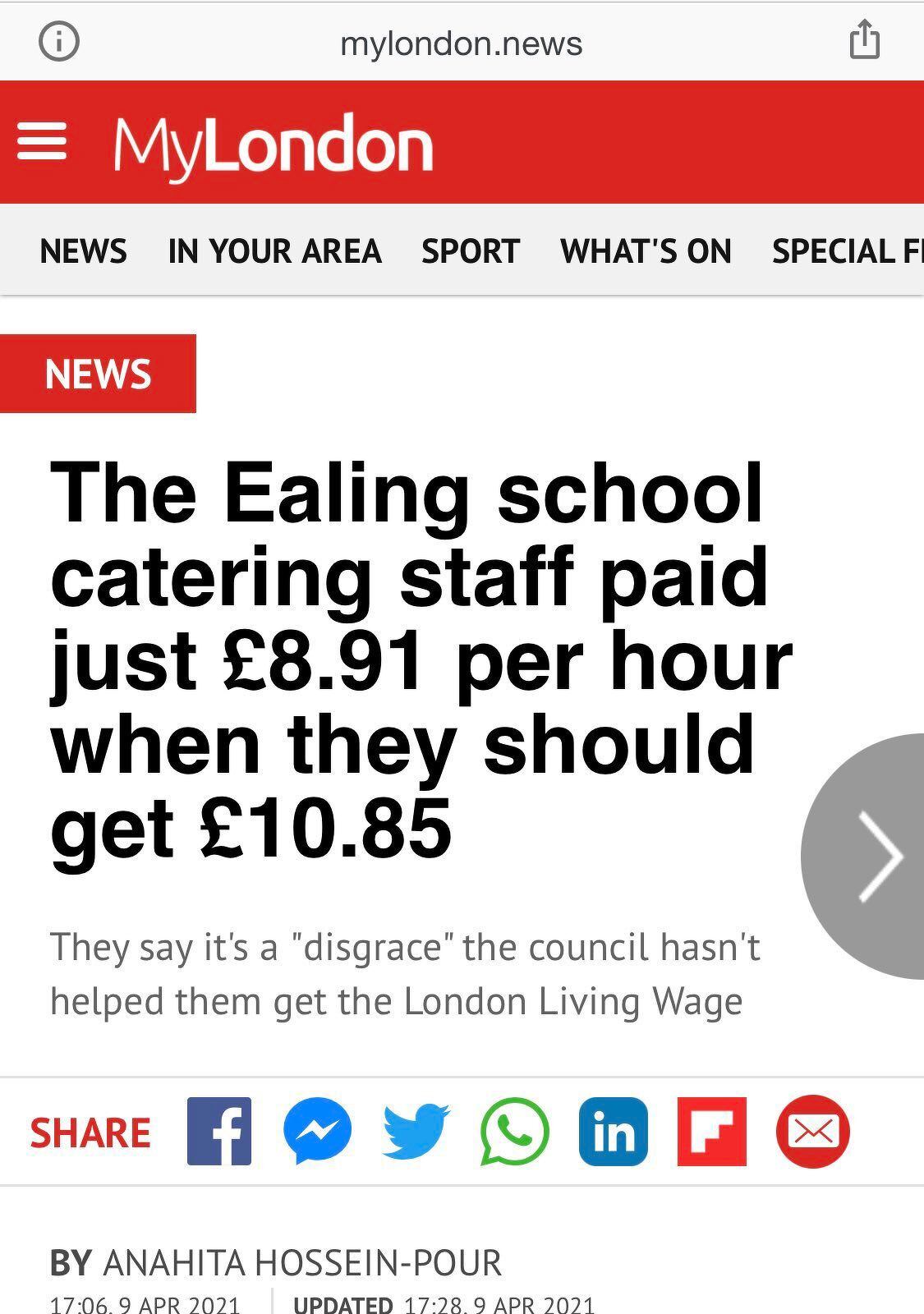
In April 2021 — while Mason was already serving as Ealing’s Living Wage Champion — Ealing school catering staff were being paid £8.91 per hour, against a London Living Wage of £10.85. Workers described it as a “disgrace” that the council had not helped them achieve accreditation.
In May 2022, shortly after making his Citizens UK commitments, Mason awarded himself a 71% pay rise, with other councillors receiving 24%.
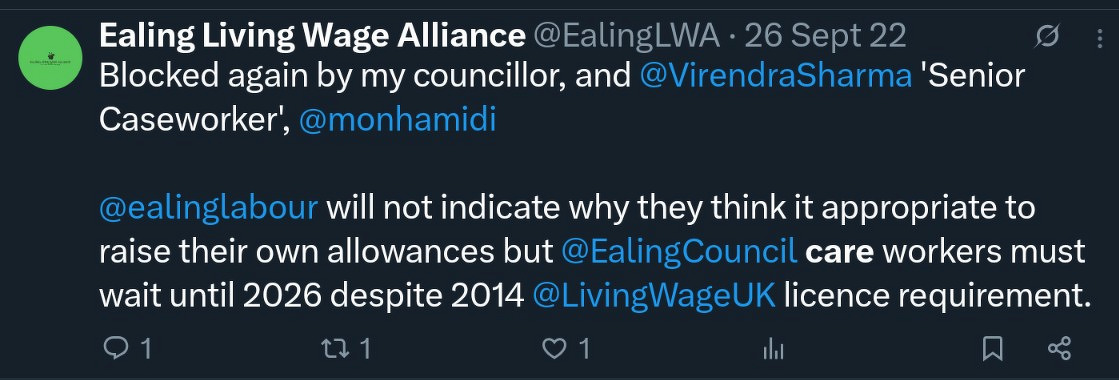
By September 2022, the Ealing Living Wage Alliance was documenting that council care workers would have to wait until 2026 to receive the Living Wage — despite Ealing holding a Living Wage Foundation licence since 2014. Milne wrote that the council appeared to be rebranding its 2014 licence obligation as a new “plan to fix social care”:
“That is a disgrace, and a direct breach of trust.”
When the Alliance raised this publicly, both their local councillor and Virendra Sharma MP’s office blocked them on Twitter.
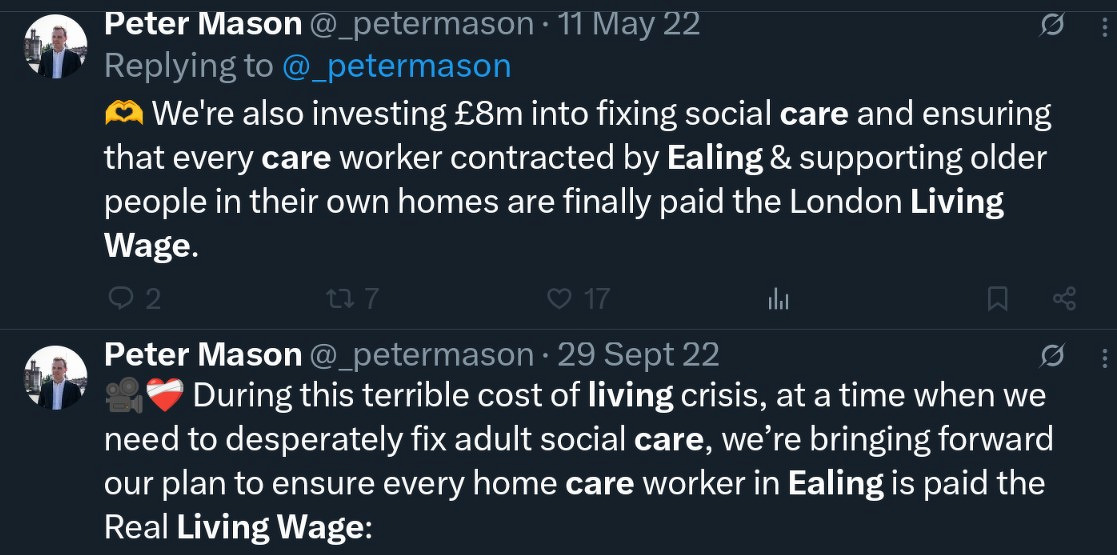
In November 2022, Mason appeared at a West London College Living Wage celebration event in Southall, announcing that homecare workers would receive the Real Living Wage “from this week onwards.”
By June 2023, there were 55 accredited employers and a stated target of 200 by 2026.
That target has not been met.
In November 2023, West London Citizens announced a new Living Wage Action Group.
By October 2025, Ealing reached 100 accredited employers, becoming the first borough in West London to do so — progress Mason cited as evidence his record speaks for itself.
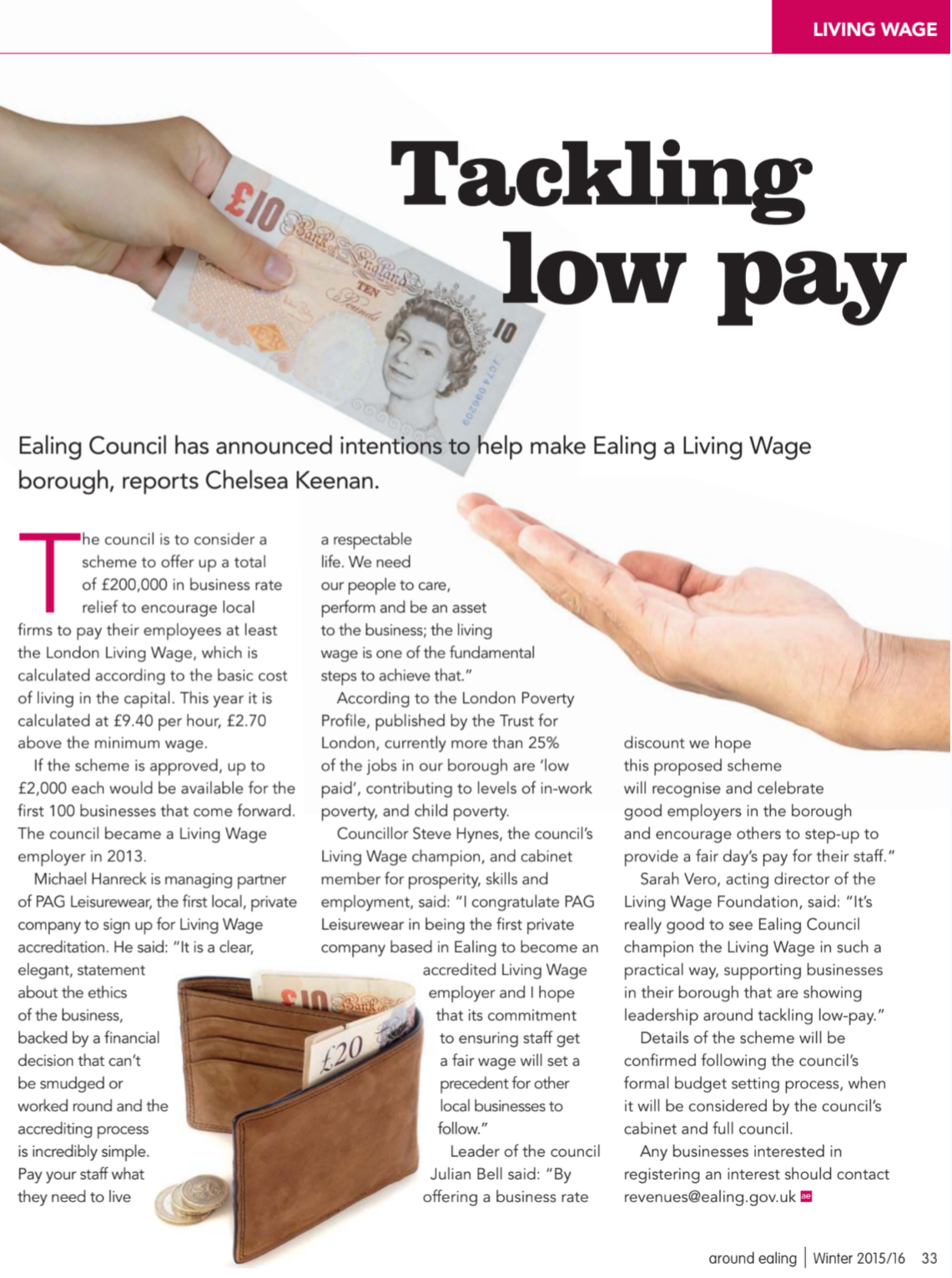
From 14 accredited Living Wage employers in 2016, when Mason became Ealing’s Living Wage Champion, to 55 (or 58) in June 2023 when the Living Wage Action Group took over responsibility, progress has been painfully slow. 50 or so new employers in seven years.
The 100 employer milestone, reached in October 2025, represents 40 or so employers in just over two years.
100 out of Ealing’s 18,000 businesses is just 0.6%.
West London Citizens’ own 2026 manifesto provides the broader verdict on a decade of Mason as Living Wage Champion:
25% of jobs in Ealing still below the Living Wage.
Ealing remains 18th nationally for low-paid work.
These are not figures from Mason’s critics.
They are the figures presented to him on Tuesday evening at St Anselm’s — at the same event where he made his original commitments four years before, organised by the same organiser, Hilal Yazan — at an event from which the candidates most likely to scrutinise his record and hold him accountable had been purposely excluded.
On Tuesday evening, West London Citizens asked Mason to commit to the Living Wage again.
Four years ago, at the same event, he already had.
The five-party reality Mason and West London Citizens didn’t see coming
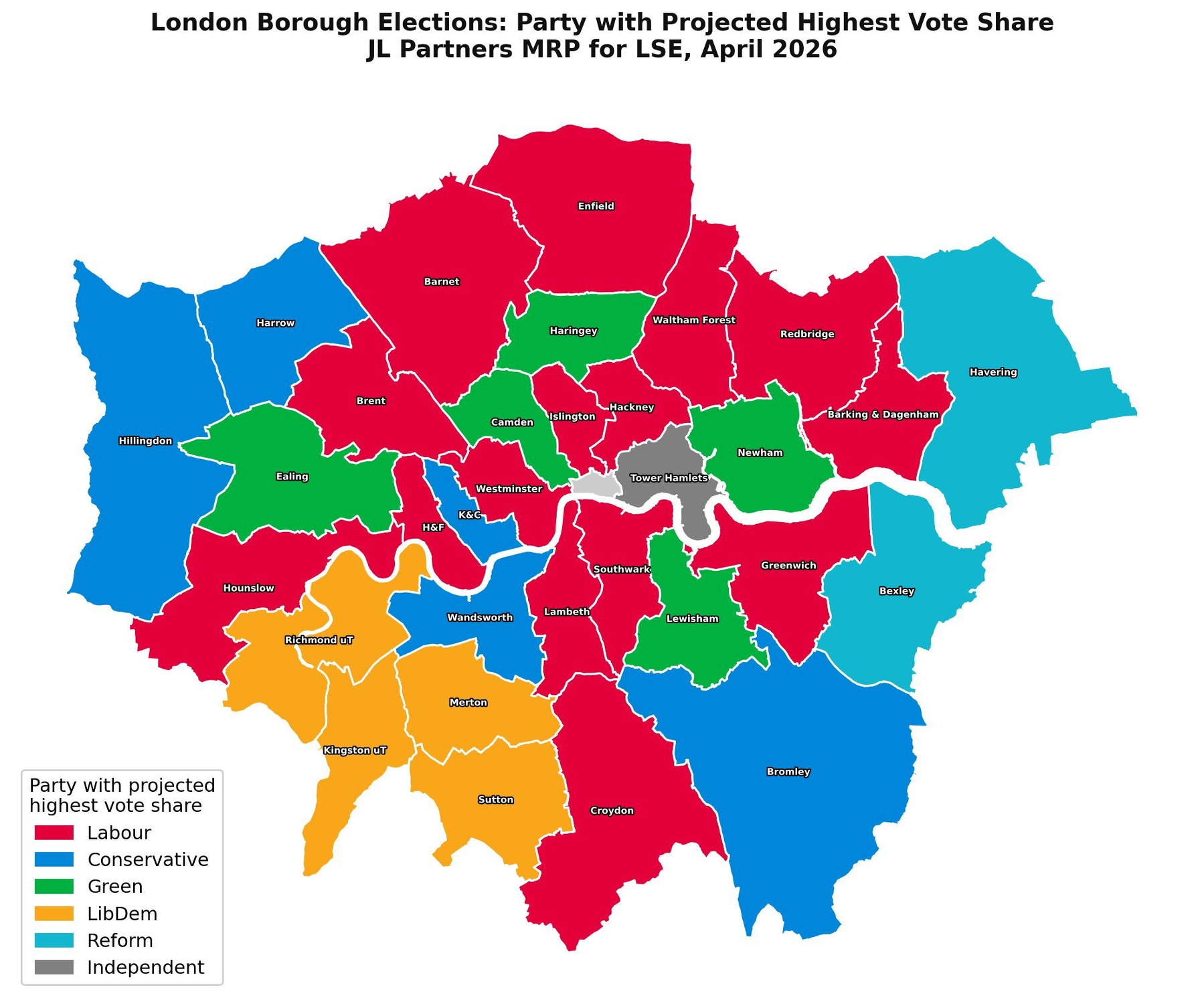
In his Ealing News interview three days earlier on 25 April, Mason said:
“The Greens have never won a single councillor in Ealing and I doubt that they’re going to win a single councillor in the future.”
On 28 April — the same evening as the assembly — independent MRP modelling commissioned by the LSE and conducted by JL Partners projected Ealing as one of the London boroughs where the Green Party is expected to achieve the highest vote share. Mason was not responding to the polling. He didn’t know it was coming.
The LSE’s wider findings are equally striking. Labour is projected to be pushed into second place in seven boroughs it currently controls, with its vote share down 15 points on average across the capital. And 60% of London voters plan to split their ballots across parties. The two-horse-race squeeze — where voters are told it is Labour or nothing — is, according to independent academic modelling, already over.
In Southall, where the Greens are standing only single paper candidates in each ward, the only progressive, local alternative to the other national party branches are the Ealing Community Independents.
The question that remains
West London Citizens says it seeks to “restore trust, integrity and accountability” in local democracy. That is a worthy goal, and the issues in their manifesto — temporary accommodation, renter rights, living wages, community land trusts — are real issues affecting real people in Southall.
Peter Mason in 2021: “You don’t trust me”
But an accountability process that issues written refusals to candidates challenging the incumbent administration — in the wards where that administration’s record is most exposed — is not accountability.
It is gatekeeping.
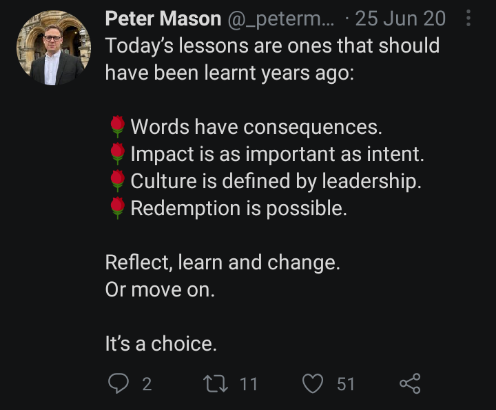
Peter Mason posted this on Twitter on 25 June 2020:
Words have consequences. Impact is as important as intent. Culture is defined by leadership. Redemption is possible.
Reflect, learn and change. Or move on.
It’s a choice.
On 7 May, if you don’t think Peter Mason has done a good job, you get to hold him accountable.
Peter Mason in 2021: “If you don’t think I’ve done a good job, you get to vote me out”
You get to vote him out.
Get Mason Out!
Vote Ealing Community Independents on 7 May.
Southall Deserves Better.