The campaign to save ten of Ealing’s children’s centres was lost in the High Court in April.
The approved judgment in R (JO) v London Borough of Ealing is on the record. The claim was dismissed. Ealing Council won.
But the judgment is worth reading carefully — because what Mr Justice Kimblin did not find is as instructive as what he did.
A reader picked me up on Facebook for writing in The Smell of Success that:
“Mason’s council took a toddler to the high court.”
Strictly, the toddler — JO, through her father CJ as her litigation friend, as the law requires when a claimant is a child — issued the proceedings. The council were the defendant.
But defending a case is also a choice.
The council chose to instruct Rory Dunlop KC and Eleanor Leydon. They chose not to settle. They chose to take a 19-month-old child’s judicial review through a two-day hearing in the Administrative Court — at public expense — to defend a decision that the council’s own cabinet report says will save £751,000 by 2026/27.
What the judgment actually records
Reading the judgment, three things stand out — none of which the Council will be putting on any future election leaflet.
Southall is hit hardest.
At paragraph 19, the court reproduces the Claimant’s submission as the factual position:
Southall, “the area within Ealing which has the greatest level of need,” is “the worst hit of the seven towns in which centres are proposed to close.”
Half of its six children’s centres go, including the main hub at Grove House, “in the most deprived part of the borough.”
The judge did not contest this. It is now in a High Court judgment.
The Council’s comparator data was wrong.
At paragraph 24, Mr Justice Kimblin records that:
“the data for some of the comparator London Boroughs are agreed to be in error.”
The Council has, in the course of these proceedings, conceded that the graphs it relied on to justify the closures contained errors.
The Claimant did not press the point in argument, so it had no legal consequence. But the concession is on the record.
The £751k saving was always part of the picture.
At paragraph 28, the judgment quotes the cabinet report directly:
closures “will allow for a more efficient service model, through a combination of reduction in costs and increase in rental income.”
Children’s Services has “a robust savings target of £11.819m for 2025/26.”
The closures contribute £751k.
The council told consultees that money was “not the main reason for this review.”
The cabinet report read otherwise.
The court found the consultation lawful — within the wide discretion the statute affords councils, and within the case law on financial pressures driving service redesign. That is what the law required of Mr Justice Kimblin.
It is not a verdict on whether the closures are right.
Twenty-five in public, seven in court
There is a fact which has had remarkably little public airing.
Throughout the consultation and ever since, the council has spoken of having 25 children’s centres in the borough. The consultation framed the closures as a reduction “from 25 to 12.” The leadership has repeated that figure on the record.
Yet in February’s judicial review, as the Chiswick Calendar reported, Rory Dunlop KC — defending the council — argued that “not all the Council’s 25 children’s centres met the legal definition of a children’s centre. According to the legal definition only seven are classed as children’s centres.”
It is hard to overstate how striking this is.
The statutory duty to provide “sufficient” children’s centres under the Childcare Act 2006 attaches to centres that meet the legal definition. The council has, in public, used a figure of 25 to demonstrate generosity of provision. In court, it deployed a figure of seven to defeat the legal challenge. Both figures cannot be doing the same work.
Voters told that “we have 25 centres” and “we are reducing to 12” were not told that, on the council’s own legal case, only seven count for the purposes of statutory sufficiency.
Predetermination, in writing, in November
Then there is the matter of what the council was doing while the judicial review was live.
On 14 November 2025, while proceedings were on foot, the council’s own Early Help Strategy report was prepared for the Children’s Scrutiny Panel meeting of 25 November 2025. The document records that the council had received Department for Education funding to deliver the new “Best Start in Life” programme — funding contingent on a DfE readiness check in January 2026 and a programme launch in April 2026.
The same document states that the council would “refrain from further decisions until the legal claim has been resolved.”
That is a difficult sentence to reconcile with what came either side of it.
The council had accepted a grant whose conditions required implementation by April 2026 — irrespective of how the High Court ruled. Officers were mapping current provision and conducting “needs analysis and SWOT” five months after cabinet had decided to close the centres. Workforce development plans for the new model were not yet in place, even as redundancy processes for the existing one rolled forward.
This is not the conduct of a body waiting for a court. It is the conduct of a body that has decided, and is funding, the next thing — and is treating the legal challenge as a delay to be managed rather than a question to be answered.
This material was not before Mr Justice Kimblin as a discrete ground of challenge. It is, however, on the council’s own website, in the council’s own scrutiny papers, with the council’s own date stamp.
The Smell of Allowance
It is worth pausing on that £751,000 figure, because the council leadership has been pulling in the opposite direction.
Mason became leader of Ealing Council in May 2021.
According to Ealing News, his special responsibility allowance in his first year, 2021/22, was £32,100.
After Labour’s landslide win in May 2022, it jumped to £54,860 — a 71% rise in a single year.
By 2026/27 it stands at £62,814.52, a 96% increase across his five years as leader.
With basic allowance, his total annual payment is now £76,570.52.
The deputy leader, cabinet members, and majority group chief whip each take £59,395.56.
The basic allowance paid to all 70 councillors has risen more than 40% since 2021/22 — from £9,708 to £13,756.
In May 2022, when the largest of those increases was first proposed, Liberal Democrat leader Cllr Gary Malcolm called it:
“very wrong given the current cost of living crisis,” accusing Labour of “sticking their noses into the gravy boat.”
The cost-of-living crisis has not lifted. The council’s housing accounts have been disclaimed for four consecutive years. Nearly 3,000 households are in temporary accommodation. The Regulator of Social Housing notice remains in place.
And the closure of ten children’s centres — including three in Southall, the borough’s most deprived town — will save the council a sum that is, broadly speaking, the size of the increase in senior councillor allowances since Mason took the leadership.
Mason’s leader allowance increase alone — £30,714.52 a year — is enough, on its own, to keep one or two children’s centres open.
That is not what Mr Justice Kimblin was asked to rule on. It is what voters can rule on.
Where the council won, and where it didn’t
Mr Justice Kimblin found that the Medium Term Financial Strategy of February 2025 was “a compilation of budgetary proposals” rather than a fetter on the consultation, and that the reinstatement of three centres — Jubilee, Petts Hill, and Dormers Wells — after consultation responses was “strong evidence that the consultation was conducted on a genuine basis.”
That is a finding that depends entirely on the consultation responses doing the work the consultation document failed to do: forcing the council to look again. Without 2,300 responses, organised opposition, and a parent prepared to take the case all the way to the High Court, those three centres would have closed.
The campaign did not win the legal argument. It won three children’s centres back.
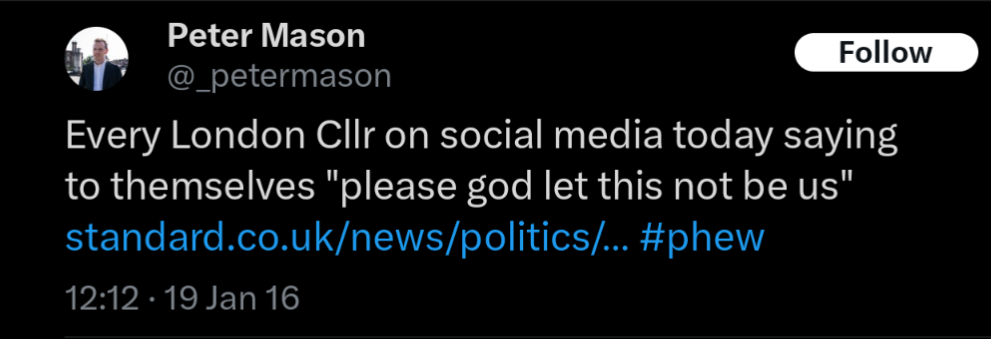
“Please god let this not be us”
In January 2016, Peter Mason tweeted about a London council that had spent £90,000 on a Rolls-Royce while cutting childcare.
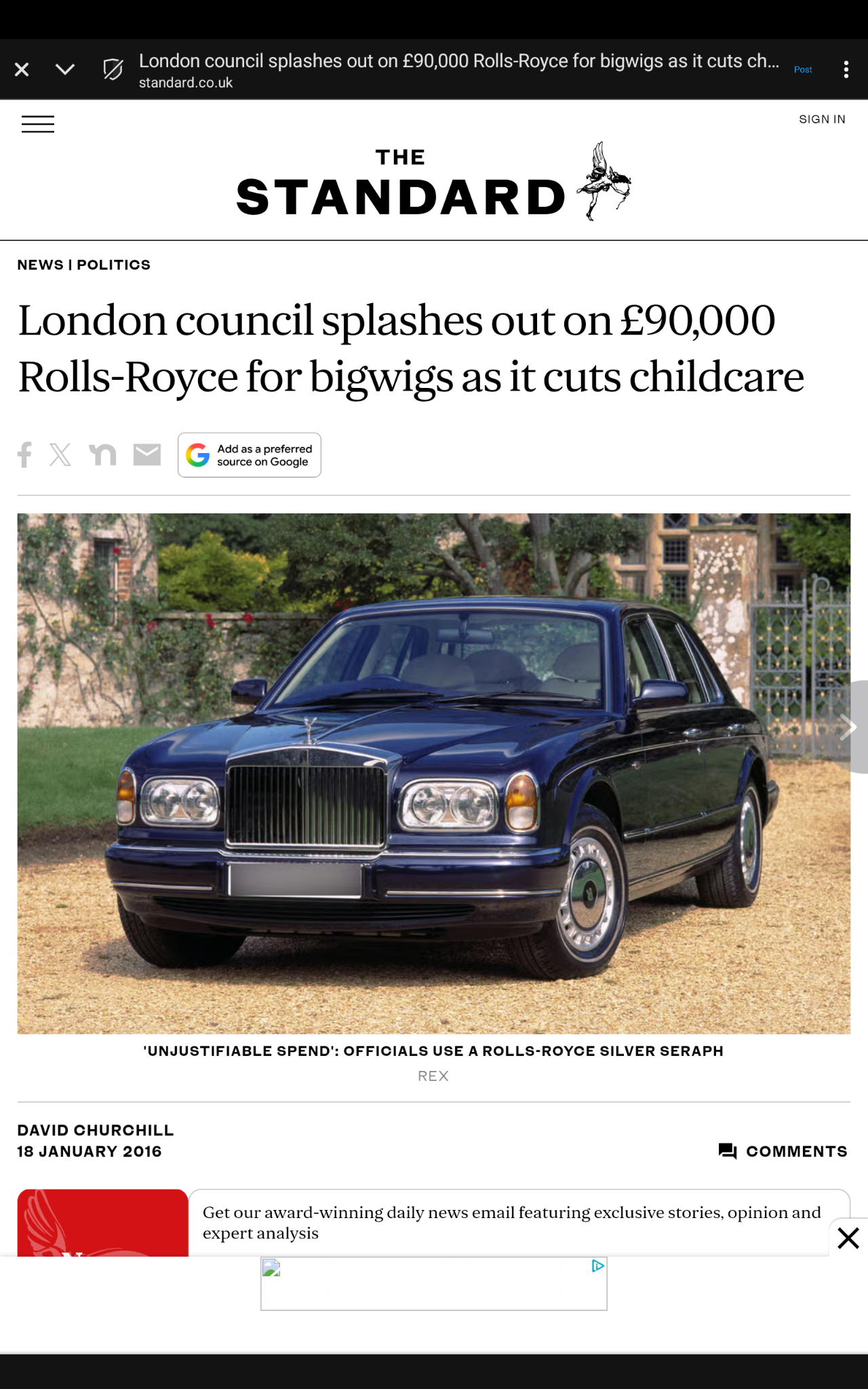
“Every London Cllr on social media today saying to themselves ‘please god let this not be us’. #phew."
Ten years on, the leader of Ealing Council has just won a High Court case defending the closure of ten children’s centres. Half of Southall’s centres go.
The council’s own data was wrong. The savings target is £751,000. The leader’s allowance has nearly doubled.
Mrs Patel understood perfectly, as did all the grown-ups.
Polls open at 7am on Thursday 7 May.