This is the story about how Ealing’s incredibly valuable and (very likely) hugely under-resourced drug and alcohol treatment service has been moved about, along with its vulnerable service users, for what appears to be — at least partly — political gain by Ealing Labour.
The scale of the borough’s substance misuse crisis is real.
According to the council’s own 2025 Substance Misuse Service report, Ealing has an estimated 2,103 opiate and crack users and 3,658 alcohol dependent drinkers.
The borough now has the highest rate of alcohol-related hospital admissions in London. (Substance Misuse Service report; Ealing JSNA 2023)
We see people struggling with addiction every day — thin, exhausted, unwell, surviving from one fix to the next — across our high streets, side streets and public spaces. Their lives can appear to have narrowed to survival, money and the next fix. They need help and support to recover and live normal lives.
And we — the ordinary residents who live here — need help to feel safe and welcome in our own towns.This is how we got here.
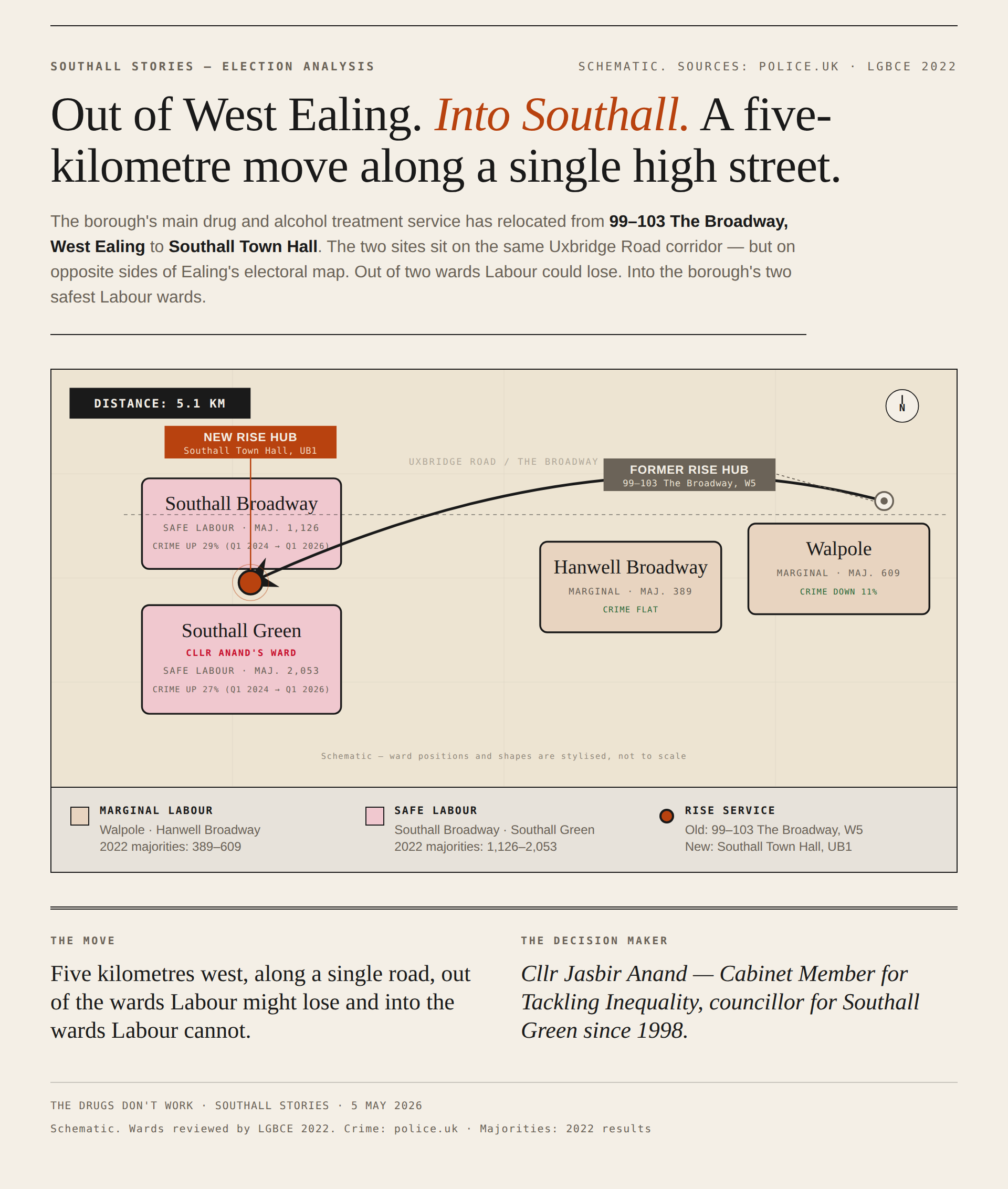
In Walpole ward — the West Ealing ward where residents have spent two years complaining about open drug use, shoplifting and feeling unsafe — Labour’s third-placed winning candidate took the seat by a margin of 609 votes in 2022. In neighbouring Hanwell Broadway, the equivalent margin was just 389 votes — with the Greens in second place, less than 400 votes off taking a seat.
These are the wards covering the streets where the Liberal Democrats have built their entire campaign around resident anger at visible disorder.
In Southall Broadway, Labour’s majority was 1,126 — nearly three times the Hanwell Broadway gap. In Southall Green, Labour’s lead over the nearest opponent was 2,053. Cllr Jasbir Anand topped the poll there with 3,105 votes — a margin of 2,302 over the highest non-Labour candidate.
Now look at where the borough’s main drug and alcohol treatment service has gone.
Out of West Ealing. Into Southall. Specifically: into Southall Town Hall — the same building Southall residents went to court to save when the council tried to dispose of it.
The cabinet member who signed off the decision is Cllr Jasbir Anand. Then Cabinet Member for Tackling Inequality. Now cabinet lead for crime and anti-social behaviour. Councillor for Southall Green since 1998.
The decision
In January 2024, Cllr Anand approved an Individual Cabinet Member Decision authorising a 10-year lease on premises at 68 The Broadway, Southall, public money to refurbish it to clinical standards, and a sub-lease to Change Grow Live (CGL), the borough’s RISE provider.
(For wider context on Anand’s 28-year record in office, see Canvassing with Minni Dogra: A Councillor in All But Name.)
The report is explicit:
“This will be a new main treatment hub situated in Southall.”
The 10-year lease, it argues, means:
“Public Health will not be faced with trying to source suitable premises… for at least 10 years.”
The justification rests on the 2019 Drugs and Alcohol JSNA, which records higher dependency in deprived neighbourhoods, naming Southall, Greenford and Northolt.
That is true. Southall does have higher need. None of what follows disputes that.
The question is not whether Southall needs services. The question is how and where the borough sites them, and who decides — and whether that decision-making is shaped by need, by political convenience, or by both.
A decision that drifted — and ended up at the Town Hall
The 2024 decision named 68 The Broadway as the site. Eighteen months on, the picture had changed.
A later Substance Misuse Service report describes the position in present tense:
“RISE’s main service site is currently in West Ealing… RISE will need to vacate the West Ealing site by summer, as the building site is being re-developed. CGL and the Council have been exploring various opportunities over the last couple of years, and is currently in the process of securing Southall Town Hall as one of the bases in Ealing at the time of writing this report. CGL and the Council continue to explore opportunities for an additional site…”
The Town Hall is described as “one of the bases” — not the main hub — with an unspecified “additional site” still being sought.
CGL’s own announcement confirms what’s actually happened on the ground:
“RISE has now relocated from 99–103 The Broadway, West Ealing. All services are now operating as usual from our new location at Southall Town Hall, 1 High Street, Southall UB1 3HA.”
As far as I know, the public has not been told whether this is a stop-gap while 68 The Broadway is refurbished, or whether the Town Hall has quietly become the permanent home. What they can see is the outcome: West Ealing’s residents got the relocation they asked for. Southall got the building it fought to save partly repurposed as the borough’s main drug treatment hub.
The electoral map
Set the timeline against the political map.
The push from West Ealing. Lease at 99–103 The Broadway expiring. Site being redeveloped. Two years of organised, vocal resident pressure on visible drug use and anti-social behaviour. Two ward majorities — Walpole and Hanwell Broadway — small enough that a determined opposition campaign on local issues could flip them.
The pull to Southall. A council-controlled civic building sitting available. Cheaper space, longer lease. Higher measured deprivation, providing a clean policy justification rooted in the JSNA. Two of the safest Labour wards in the borough, including Anand’s own.
That is not a description of how a service should be sited. It is a description of how a political problem is solved.
The decision is individually defensible. Southall does have higher need. The JSNA does support the case. The West Ealing site did have to close. Each link in the chain has its own logic.
But step back, and the chain runs in only one direction. Out of marginal Labour wards. Into safe Labour wards. Out of streets where resident complaints are political costs. Into the poorest, most deprived town in the borough, least able to cope with the transfer of this service and its associated pressures on the local community and already stretched services.
A Southall Green councillor signing off the relocation of the borough’s main drug and alcohol hub — out of the wards Labour might lose, into the wards Labour cannot — is not a decision without political consequences.
The service follows the users
There is a further point that the JSNA argument quietly skips over.
The borough’s main drug and alcohol hub does not only treat residents who already live near it. It draws users to it. The West Ealing site served users from across the borough, including from Walpole and Hanwell Broadway, where residents’ complaints about visible drug use and anti-social behaviour were about people attending the service, wherever they were from, in their high street.
Move the service to Southall, and you move the visible behaviour with it. The users who were causing concern outside 99–103 The Broadway, West Ealing, are now attending appointments at Southall Town Hall. The same waiting outside, the same coming and going, the same intermittent disorder that two years of West Ealing campaigning was about — relocated, with the building, into the centre of Southall’s high street.
The data is already moving.
Across the wider Southall postcode area (UB1, UB2 and surrounds), drug crime rose 63.6% in the year to April 2026 — against a national rise of 13.3% — making Southall the 10th highest postcode area in England and Wales for drug crime rate.
The two postcode sectors closest to the Town Hall, UB1 1 and UB1 2, are running at 299% and 314% of the national crime rate respectively.
At ward level, the picture is just as telling.
According to Metropolitan Police data for Southall Broadway, anti-social behaviour alone accounts for 37.8% of all reported crime over the last three years — 2,775 reports — with violence and sexual offences a further 21.8% (1,598 reports). Together those two categories make up almost 60% of crime in the ward. Drugs offences themselves are only 3.4%.
The dominant story, in other words, is exactly what surrounds a busy treatment service: not drug-dealing in isolation, but the street-level disorder, public order incidents, and visible distress that follow concentrated dependency.
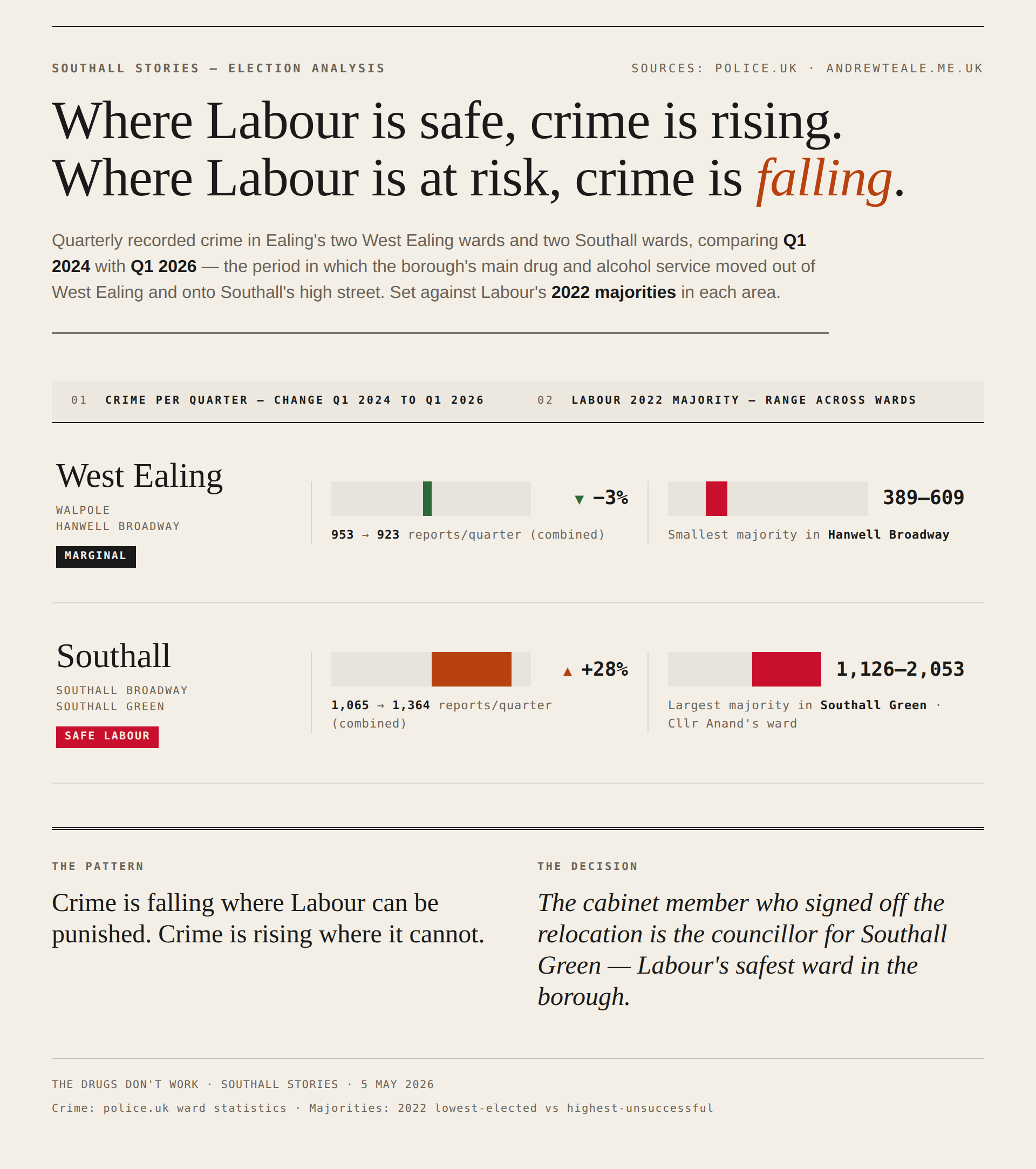
The trend is rising. Quarterly crime in Southall Broadway has moved from 511 in Q1 2024 to 658 in Q1 2026 — up roughly 29% over two years. The most recent quarter is the second-highest in the three-year series, beaten only by Q2 2025 at 698.
Look at Southall Green — Cllr Anand’s own ward — and the picture is sharper still.
For the first six quarters in the three-year series, Southall Green ran at between roughly 550 and 700 reports per quarter. From Q1 2025, the line breaks: 797 in Q1 2025, 768 in Q2, 884 in Q3 (the highest single quarter on record), 782 in Q4, and 706 in Q1 2026.
The ward has averaged 787 reports per quarter for the last five quarters, against 604 for the eight quarters before. A step-change of roughly 30%. It coincides with the period in which, per the council’s own Substance Misuse Service report, CGL and the council were “in the process of securing Southall Town Hall.”
In the West Ealing wards where residents have spent two years organising against visible disorder, the trend has gone hard the other way.
In Hanwell Broadway, quarterly crime peaked at 749 in Q3 2024, fell to 688 by Q3 2025, and dropped to 531 in Q1 2026 — down 29% from the peak in 18 months.
In Walpole, the fall is sharper still: from a peak of 651 in Q3 2025 to 443 in Q4 2025 and 392 in Q1 2026 — a 40% collapse in two quarters, and the lowest quarter the ward has recorded since late 2023.
The composition is also distinctive.
Walpole’s three-year profile is dominated by theft offences typical of busy retail high streets: 13.1% vehicle crime, 8.4% shoplifting, 6.4% other theft.
That mix is much less prominent in Southall Broadway, where shoplifting is 4.6%. But in Southall Green, shoplifting runs at 8.7% of all crime — higher even than Walpole — alongside the borough-wide-leading ASB and violence figures.
The crime profile that drove West Ealing’s complaints — and the headlines about London’s “wild west” — is increasingly the crime profile of Anand’s own ward.
That divergence is correlation, not proof of causation, and the timing does not map cleanly onto a single moving date. But the direction is unmistakable.
The most recent Met Police quarter shows crime in Walpole at its lowest level in nearly three years; crime in Hanwell Broadway down 29% from peak; crime in Southall Broadway near its three-year high; and crime in Southall Green sustaining a 30% step-change above its pre-2025 baseline.
In the same period the borough’s main drug and alcohol service has confirmed it has moved out of West Ealing and is now operating from Southall Town Hall — sited within the Southall Broadway ward, on the boundary with Southall Green.
The “need” justification cuts both ways. It is exactly because Southall is the most deprived part of the borough — and is now experiencing both a steep rise in postcode-level drug crime and rising ward-level crime trends across both Southall wards — that it is the least equipped to absorb concentrated additional pressure on its high street, its public realm, and its already-stretched local infrastructure.
It is also the least equipped to complain.
There is no Southall equivalent of the Police Oracle feature on West Ealing.
There is no Southall equivalent of the organised Lib Dem campaign that turned residents’ frustration into a political threat to Labour.
The complaints exist. They just don’t carry the same weight, in the same papers, with the same effect on majorities.
That asymmetry — between what is heard in Walpole and what is heard in Southall Green — is precisely what makes Southall the politically convenient place to put the problem. Not despite the deprivation. Because of it.
The pattern
This is one decision among many.
Southall already carries a disproportionate share of the borough’s harder-to-place burdens — industrial activity, air quality exposure, waste, lower-income housing pressure, civic underinvestment.
The fuller account of that pattern — and the council’s record under Peter Mason’s leadership — is set out in Community Powered Reporting’s investigation into Ealing Council. Mason — also a Southall Green councillor — has spoken publicly about Southall’s deep-rooted poverty, low pay and structural racism. The diagnosis is correct.
The question is what follows from that diagnosis. Because the same diagnosis can produce two very different policy responses:
- Concentrate resources in Southall to address the inequality directly.
- Concentrate the difficult, visible, politically costly functions in Southall because that is where they meet the least resistance.
The borough’s record on Southall increasingly looks like the second wearing the language of the first.
The drug and alcohol hub relocation is the latest in a sequence in which Southall absorbs what other parts of the borough push back against, and the wards that would punish the administration at the ballot box are protected from the consequences.
That isn’t tackling inequality. That’s redistributing visibility.
That isn’t tackling crime or anti-social behaviour. It’s moving it from West Ealing to Southall.
The irony is that the borough’s own 2023 JSNA increasingly points toward earlier intervention and lower-stigma community treatment embedded in primary care settings. The direction of travel nationally and locally is toward dispersed support through GP surgeries, hospitals and neighbourhood services — not the concentration of visible dependency into a single town-centre hub.
Vote tomorrow
Southall needs investment. Southall needs services. Southall needs properly resourced drug and alcohol treatment, accessible to the residents most affected by dependency.
None of that is in question.
What is in question is why the cabinet member who signed off the relocation is the councillor for the town receiving the relocated service, why the original site decision has drifted into a temporary occupation of the very building Southall fought to save, and why the relocation has landed in a way that solves a political problem in West Ealing by transferring it — physically, materially, and in plain sight — to Southall.
That looks less like need-led siting and more like political convenience-led siting that happens to align with need.
The drugs don’t work. Not like this. Not when the answer to inequality is to relocate it.
On the doorstep, voters across these four wards keep saying the same thing: voting Labour is a habit.
Time to kick the habit.