Update, 10 August 2026: Ealing Council’s press office contacted me today to ask for a minor amendment to this article. Their email arrived without difficulty.
The April email from the Head of Environmental Health confirmed the council was working to ensure my emails were “not unnecessarily blocked.”
Presumably, the blocking was, at some prior point, considered necessary.
How many times have you asked yourself — or heard others ask the same question?
Why does the council never reply to my emails?!
When residents raised concerns about toxic odours from the Southall Gasworks site, they were told to keep reporting. Every call, every email, every logged complaint was encouraged.
“It’s good you’re making so many complaints,” they were told at a meeting with Peter Mason in March 2019.
Volume of reporting, the implication was, would produce results.
It didn’t.
And now, after eighteen months of correspondence with Ealing Council about environmental enforcement failures in Southall, I understand why.
There isn’t one filter between a complaint and accountability in Ealing. There are at least three. And the council has, at various points, been aware of all of them.
Filter one: the complaint that never arrives
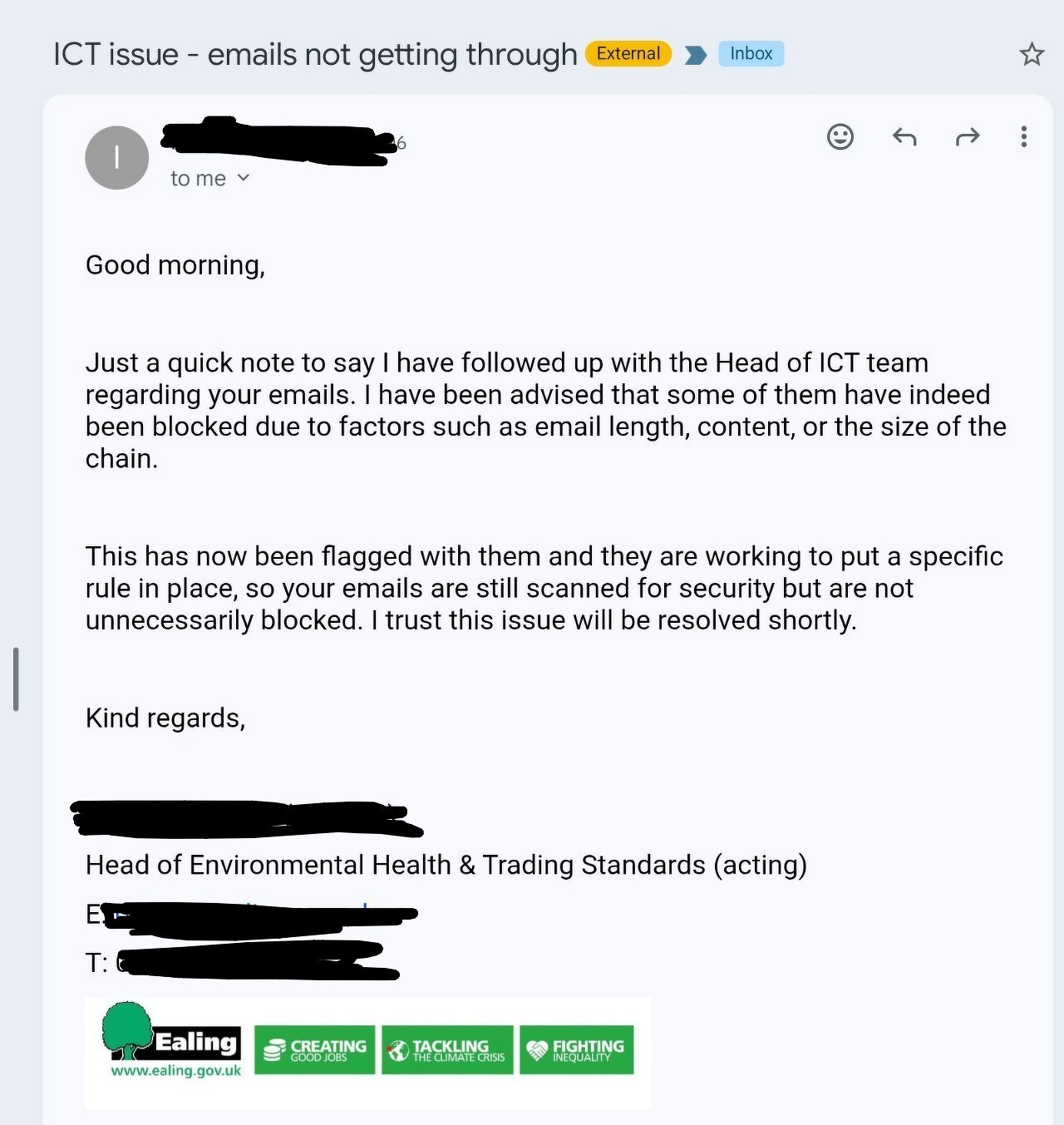
The Head of Environmental Health & Trading Standards wrote to me in April to confirm that some of my emails had been blocked before they were received. She had followed up with the Head of ICT, she explained, and been advised that emails:
“have indeed been blocked due to factors such as email length, content, or the size of the chain.”
This is the first filter.
Note the word content.
Not size. Not formatting. Content.
Who decides which content triggers a block? On what basis?
The council’s response offered no answer — but the question matters, because detailed, evidenced correspondence is precisely the kind most likely to require action, and precisely the kind most likely to be silently discarded before it enters the system.
No notification to the sender. No record on the council’s side.
No complaint, no failure to respond.
No problem. No action required.
What makes this harder to dismiss as a technical glitch is that the evidence was already in the council’s own file when my Stage 1 complaint was closed. The response itself quoted a Pollution Control email from June 2025 stating:
“Our IT systems must have blocked it due to links included within the email.”
The council knew. It closed the complaint anyway.
The Stage 2 response, from Assistant Director Joe Blanchard, upheld Stage 1 in full. Instances of filtering were described as “extremely rare.”
No governance review. No apology. No procedural changes.
That response closed the council’s internal process.
My complaint is now with the Local Government and Social Care Ombudsman (Case 26000430), submitted on 21 April 2026.
Filter two: the complaint that isn’t counted
Of the complaints that do arrive, many are never counted.
The reporting system itself is documented to exhaust complainants into silence: fragmented across multiple hotlines, dependent on telephone menus, requiring each incident to be logged in isolation.
Odour complaints about the Gasworks site had to be reported separately to Ealing Council, the Environment Agency, and Berkeley Group’s own PR company. Each body counted only its own tally. None shared a running total.
The official figure given by council leader Julian Bell at the July 2020 public meeting was 250 complaints over three years — 79 in 2017, 51 in 2018, 82 in 2019, and 38 in the first part of 2020. Those 250 were the ones that got through and were logged.
But at the March 2019 meeting with Peter Mason — the same meeting at which residents were told their volume of reporting was welcome — one resident alone had already called the Environment Agency over a hundred times. The official response to that volume of contact was that Berkeley Group was “going above and beyond what is expected.”
Residents at last month’s ECI meeting in Southall described being told they were “the only one complaining” — a response familiar to anyone who has tried to hold this council to account on anything.
Low complaint counts, in this system, are never evidence of low harm. They are evidence of effective filtration.
Filter three: the complaint that isn’t verified
Of the complaints that arrive and are counted, the council’s own investigation records show a striking pattern: investigating officers verify almost nothing.
As I documented following the January 2026 Johnson Street fire, Ealing Council conducted a year-long daily investigation of the Sam’s Recycling site on Johnson Street.
Its conclusion: no evidence of statutory nuisance. No enforcement action warranted.
In three visits made in response to strong burning plastic odours entering my home, I had documented open incineration, burning of treated wood and plastic waste, smoke affecting residential areas, and explicit fire risk.
The site burned down thirty months after my formal written warnings, causing over half a million pounds of damage.
The Ombudsman submission sets out the problem precisely: the council relied on monitoring methods unsuited to detecting intermittent emissions, did not properly consider information already held by the Environment Agency, and carried out no internal review after the fire of its monitoring approach, its complaint handling, or its escalation processes.
The verification methodology requires officers to witness a statutory nuisance threshold at the precise moment of a visit. Residents’ photographic evidence, video documentation, and patterns of complaint do not meet this threshold.
The result is that investigation techniques function as designed — not to verify harm, but to avoid the enforcement obligation that verified harm would create.
This is the same pattern documented across Southall’s pollution cases.
At the Gasworks site between 2017 and 2020, residents reported respiratory symptoms, hospitalisations, and toxic odours. Public Health England’s assessments relied on site-wide averages that masked localised readings consistently above legal limits.
Residents were encouraged to keep reporting.
The data was there. The verification never came.
The system in full
Set out together, the three filters describe something more troubling than administrative failure.
Complaints are encouraged — volume is welcomed, residents are told it is “good” to keep reporting, Berkeley is praised for going “above and beyond” — because volume without verification is harmless to the institutions being complained about.
The IT system silently discards the most detailed correspondence.
The fragmented reporting architecture ensures counts remain low.
The verification methodology ensures that what is counted rarely produces enforcement.
At each stage, the absence of a finding becomes evidence that there is nothing to find.
The 250 complaints Ealing Council recorded from the Gasworks site were the ones that passed through all three filters.
The questions the council has not been asked — and has not asked itself — are how many were blocked before arrival, how many arrived but were never properly counted, and of the 250 that were counted, how many were ever verified by an investigating officer visiting the site while the problem was actually occurring?
The Ombudsman is now being asked to determine whether a complaints system with documented filters at every stage — one that then uses the absence of complaints as justification for inaction — constitutes maladministration.
The desired outcomes I have set out include an independent review of the council’s monitoring methodology, its correspondence handling, and its coordination with the Environment Agency.
Whether the Ombudsman agrees those are reasonable expectations will be a test of whether the system has a fourth filter — or whether there is, finally, somewhere the complaint actually lands.