The first of three pieces on Southall’s two hyperscale data centres. This one is about health. Part 2 is about consultation, part 3 about how the schemes escaped assessment.
 Demolition at Trident Way, 17 November 2026. Photo: David Marsden.
A woman born in Southall Park can expect to live to 86. That is within a few years of the longest-lived women in Ealing. But she can expect to be in good health only until 62.9. That leaves 23.1 years lived in poor health.
In Pitshanger, on the other side of the borough, the figure is 11.6 years.
These are the Office for National Statistics’ first estimates of healthy life expectancy for small areas, published in July. They cover 2019 to 2023. Ranked by years lived in poor health, the five highest areas for women in Ealing are all in Southall and Norwood Green: Southall Park (23.1), Southall Green West (22.2), Southall West (21.7), Norwood Green North and Windmill Park (21.2) and Southall Green East (20.9).
Southall women live as long as almost anyone in the borough. They spend far longer unwell.
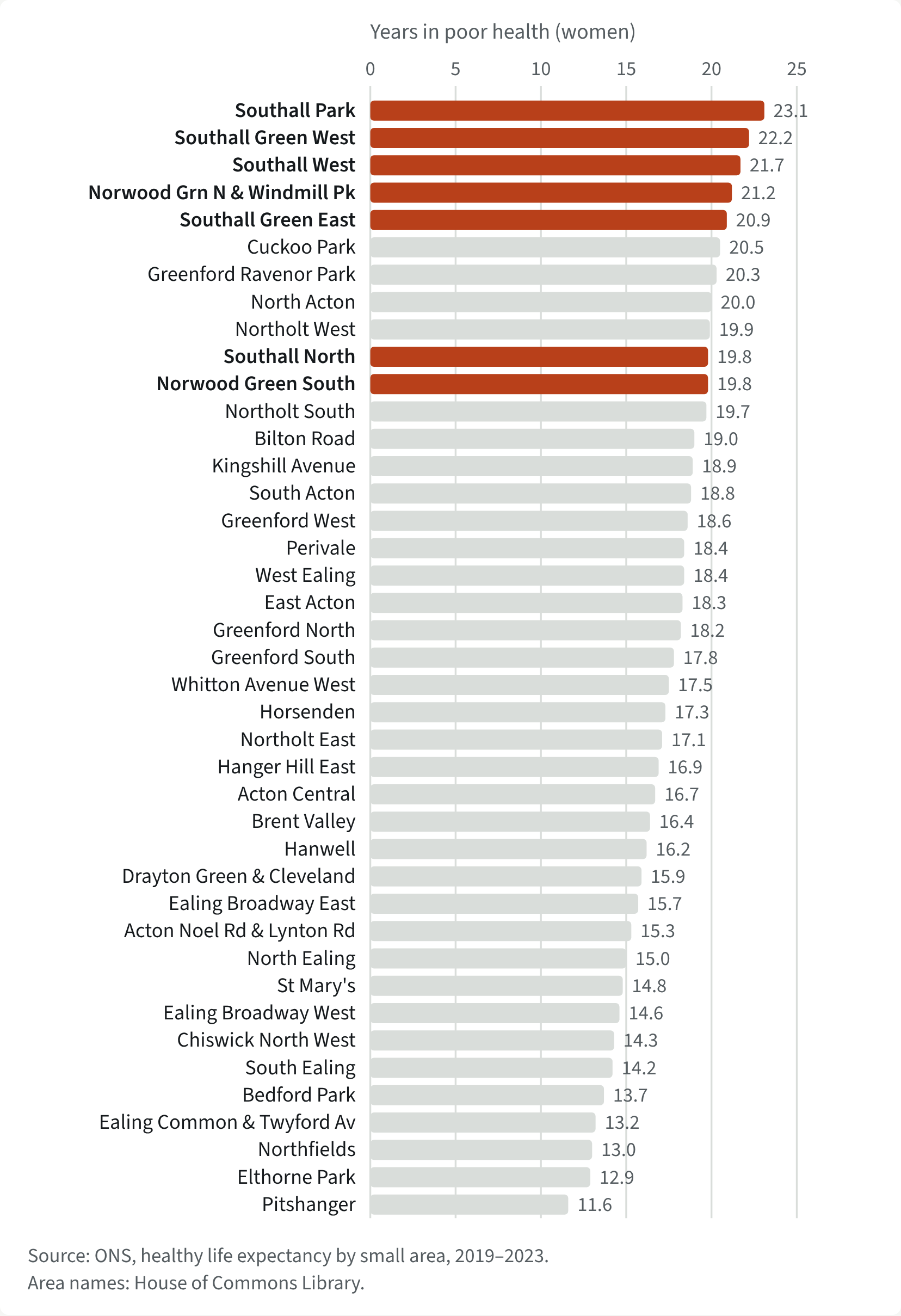 Years women can expect to live in poor health, Ealing’s 41 areas, 2019 to 2023. Southall and Norwood Green in red. Source: ONS.
Why
The figures do not say why, but the evidence points the same way.
Deprivation shortens lives, and it shortens healthy lives far more. In England’s most deprived areas, women can expect 50.5 years in good health, against 70.2 years in the least deprived, and the gap is wider for women than for men. Southall Green is Ealing’s most deprived ward.
South Asian people in the UK tend to develop type 2 diabetes about a decade earlier than white Europeans. Southall helped show it: in 1985 the Southall Diabetes Survey found known diabetes at least 3.8 times as common among Asian residents as among Europeans, and at least five times as common among those aged 40 to 64.
And 2019 to 2023 includes the pandemic. Ealing’s own public health report found infection rates highest in the west of the borough, particularly Southall and Greenford, with Covid death rates following a similar pattern and matching the areas of greatest deprivation. More than a third of Ealing residents who died with Covid in hospital had diabetes. Nationally, people of Bangladeshi, Pakistani and Indian heritage were hit harder than most.
These are not England’s worst figures, and the differences between the lowest few areas are within the margin of error. The story is the gap inside one borough.
Two data centres
Into that gap, Ealing has now given the go-ahead to two hyperscale data centres.
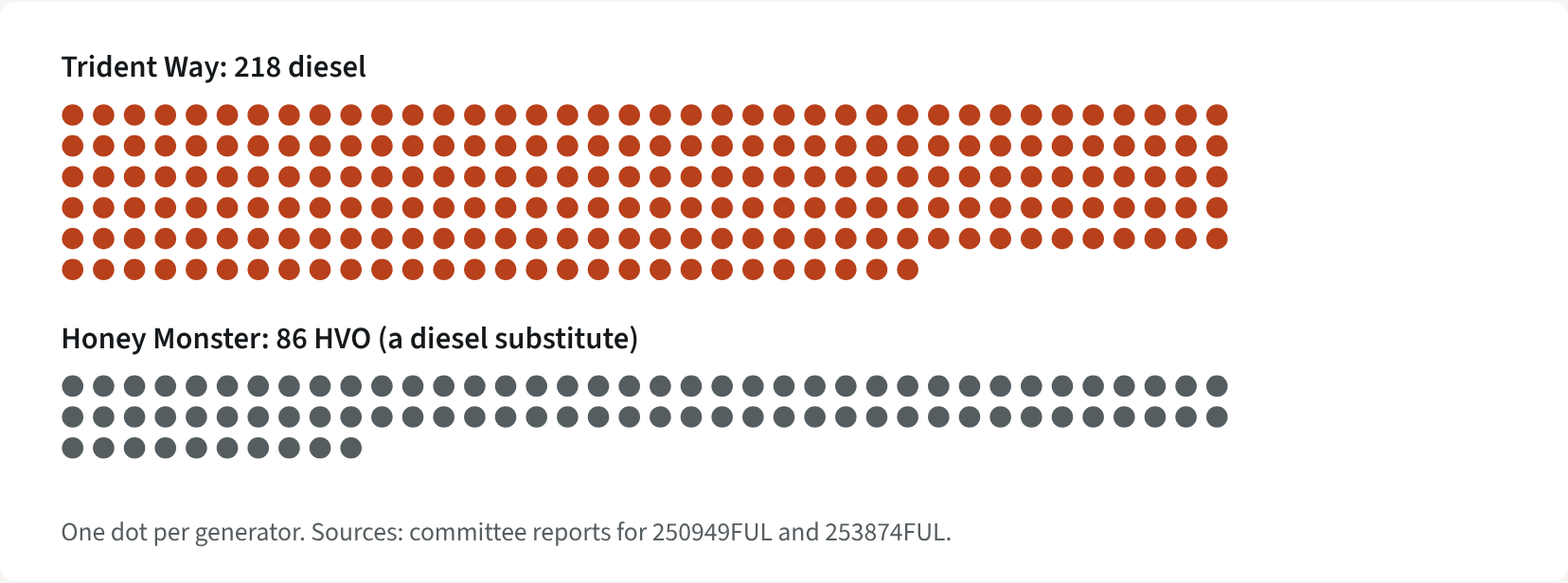
The first, at the International Trading Estate on Trident Way, in Southall Green ward, was approved by the planning committee in October 2025 and granted permission in December. It has four data centre units in three buildings and 218 diesel backup generators. Demolition is under way.
The second, at the former Honey Monster factory on Bridge Road, in Norwood Green ward, was voted through by the planning committee in July, which resolved to grant permission. No decision has been issued yet. It has one data centre and 86 backup generators. It still awaits the Mayor of London’s final decision, and the Secretary of State is now considering a resident’s request to rule that it needs a full environmental impact assessment.
Neither application came with a health impact assessment.
What the developer wrote down
Before applying, CyrusOne asked Ealing whether the Honey Monster scheme needed a full environmental impact assessment. Its consultants, Ramboll, sent a screening report in April 2025. Under “Human Health”, it says:
“The life expectancy rate for men is lower than the England average, at 76.7 years for Norwood Green and 79.5 years for England. … The life expectancy rate for women is lower than the England average, at 81 years for Norwood Green and 83.2 years for England. … The mortality rate for those under 75 years of age from all causes, circulatory disease and from causes considered preventable are notably worse than the England average.”
Elsewhere it records that the local population is 42.5% Asian and 21.8% Black, “significantly higher than borough averages … and national averages”.
Then it explains that health effects would be “largely determined by the way the proposed development’s buildings and spaces are used, as well as lifestyle factors which cannot be accurately quantified or controlled at the planning stage”. It concludes that the development “would not give rise to significant environmental effects in relation to human health”.
The developer wrote the health gap down. It did not carry it into its judgement.
What the council wrote
On 13 June 2025 Ealing decided that no environmental impact assessment was needed. Its officer report, filed on the planning portal under a separate screening reference rather than with the application, lists the schools, homes and houseboats near the site. Its assessment of human health is one sentence:
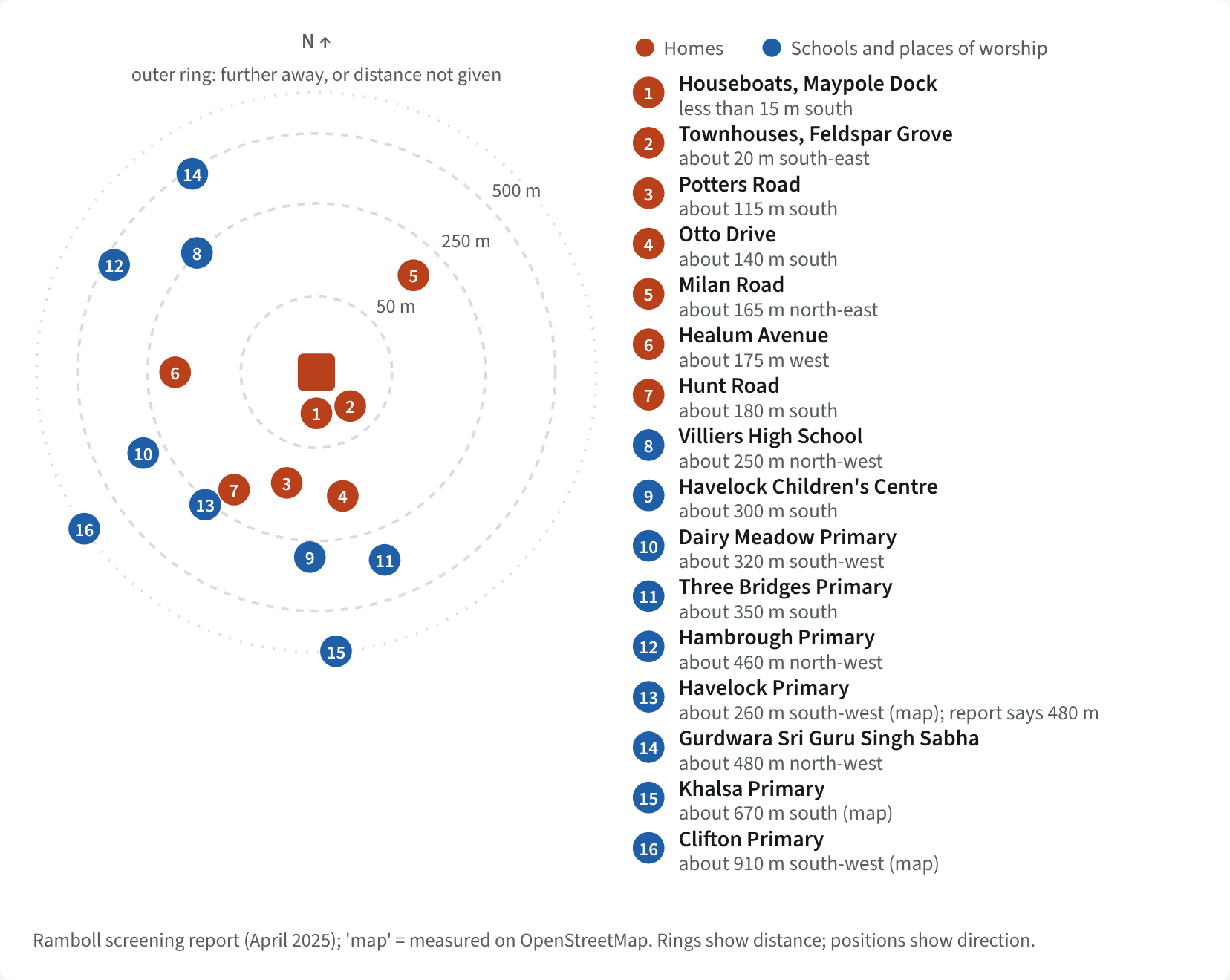 Who lives and learns near the former Honey Monster site. Distances from the developer’s screening report and OpenStreetMap.
“Implementation of a CEMP and compliance with conditions would ensure significant environmental effects in relation to human health would not be likely.”
A CEMP is a construction environmental management plan. The report does not mention life expectancy, illness or who lives nearby. On the public sector equality duty, it says the recommendation “would not have a disproportionately adverse impact on a protected characteristic”.
The same land, asked differently
Ealing has asked these questions on this site before.
In 2018 a developer proposed about 2,000 homes and film studios on the Honey Monster site. The council’s scoping opinion, written by its consultants, said “a precautionary approach must be adopted”, and on health:
“A standalone Health Impact Assessment should be provided to ensure all potential effects are identified … This is consistent with the approach being adopted for the former Margarine Works application.”
In 2023 a smaller industrial scheme for the site, with no generators at all, went through a full environmental impact assessment, independently reviewed for the council.
In 2025, the biggest and most polluting proposal yet, with up to 90 diesel-engined generators, was screened out, with one sentence on health.
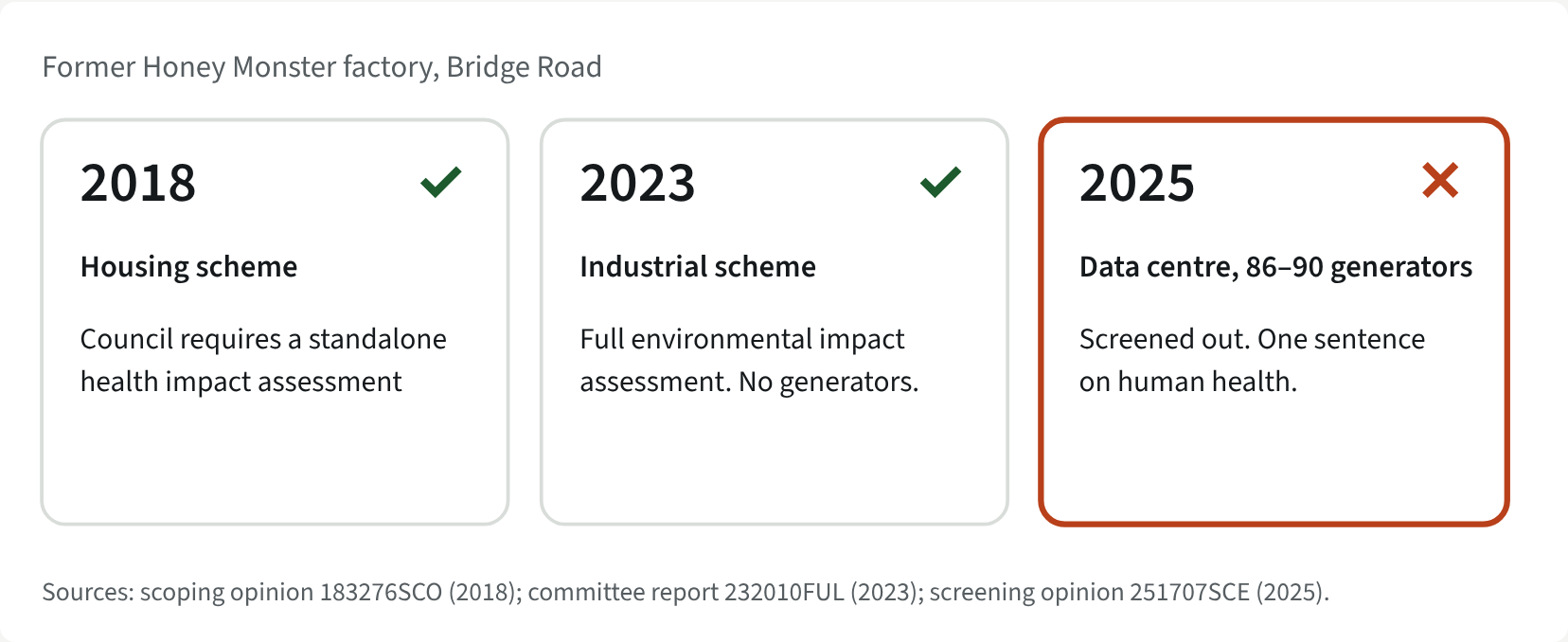
There is a fair caveat. In 2018 and 2023 the developers chose to go through environmental impact assessment, so the council never had to decide whether they needed one. But once an assessment was under way, the council asked for health to be assessed properly. When there was none, health got a sentence.
The cluster that counted one way
The Trident Way scheme did have a full Environmental Statement. Human health was not among the topics it assessed.
The council’s own air quality consultant found that the scheme “would not achieve Air Quality Neutral status due to emissions from the operation and periodic maintenance testing of 218 diesel backup generators”. The answer was a £3 million contribution, not a change to the scheme.
The committee report also argued that the site suited a data centre “due to its proximity to an emerging data centre cluster”, and that the scheme “benefits from agglomeration and clustering effects”. It concluded that “the proposed development would not result in unacceptable cumulative impacts”. It did not mention the Honey Monster scheme, on which Ealing had issued its screening opinion four months earlier.
The cluster was counted as a benefit. It was not counted as a risk to the people who live in it.
The generators that changed
The Honey Monster scheme’s air quality was assessed in September 2025 by CyrusOne’s consultants, Ramboll, on one model of generator. In February 2026, five months before the committee met, Ramboll told the council that the generators CyrusOne now had in mind were different. Its memo says their emissions of nitrogen oxides “are approximately 3.8 times higher than those considered within the Air Quality Assessment submitted with the Planning Application.”
Ramboll said the effect on annual average pollution would still be negligible. But it accepted that “hourly NO2 concentrations would increase”. Short bursts of nitrogen dioxide are what trigger asthma attacks. Emissions from routine testing were not modelled at all.
Ramboll did not redo the assessment. It said a new one “would be required to accompany the future Environmental Permit Application”, after planning permission. The council’s draft permission sets its emissions limits from the figures for the new, more polluting engines.
The Mayor of London’s planning officers, who reviewed the scheme in December 2025, relied on the original assessment, which said the scheme would be “air quality neutral” and need no mitigation once built.
Who was considered?
I have asked this question before.
When the former gasworks a mile north was cleaned up, a full health impact assessment involving local people had been recommended before planning permission was granted. The one produced in 2008 assessed dust and traffic, not vapours from the soil. In 2019 Public Health England said people with G6PD deficiency, an inherited condition far more common in families of South Asian, African and Middle Eastern heritage, were more vulnerable to naphthalene. I have found no assessment that asked how many people downwind might be at greater risk. The monitoring is set out in full here.
It is the same authority, the same corner of Southall, and the same pattern: the health of the people living here is written down, then not weighed.
What this does not show
None of this shows that the data centres will harm anyone’s health. Neither is running yet, and the health figures come from before either decision. What it shows is that the decisions were made without asking.
What they said
I asked Ealing Council and CyrusOne about the points in this article on 15 November, and about the generator memo on 17 November, with a deadline of 5pm on 20 November. Neither had replied by the deadline.
Next
Part 2 looks at the consultation: how few people were told, how few took part, and what happened to what they said. It draws on emails the council released this week about how the consultation area for the Honey Monster scheme was set.
The figures, documents and sources behind this piece are on the data page: Southall Data Centres 2025–26. Corrections are welcome.
Disclosure: I live near the Trident Way site. I answered the developer’s survey on that scheme, and I made the only objection to the Honey Monster application.
This series builds on research by Southall residents, published as the Southall Data Centre Cluster briefing paper.