On 10 July 2019, around 200 residents packed the Dominion Centre in Southall to confront their councillors, their MP, Public Health England, the Environment Agency, and the developer of the former Gasworks site about the toxic fumes — benzene and naphthalene — that had been making their families ill for years.
The meeting was filmed. It runs to ninety minutes.
It is, in retrospect, the most important hour and a half in recent Southall political history.
Cllr Peter Mason, then Cabinet Member for Housing, Planning and Transformation, chaired the meeting. He lost control of the proceedings within thirty seconds and never recovered it.
The panel — councillors, the Environment Agency, Public Health England, Berkeley Group — was asked, repeatedly, by parents, by a doctor in the audience, by a local lawyer, the question that mattered:
Whose side are you on, the community? Or Berkeley Homes?
The panel stayed silent.
The MP, Virendra Sharma, slipped in late, said nothing, and left before the end.
Sharma had survived a Constituency Labour Party trigger ballot challenge only months earlier, in part by promising members closer engagement with the constituency he was failing.
Ealing’s Director of Safer Communities and Housing was asked what he would do if he were in residents’ shoes. His response was instant and emphatic:
“MOVE!.”
Another resident in the room described what she saw that night with brutal clarity:
a meeting that “laid bare” a class divide, “the avarice of big businesses rampant and unashamed,” and “an all round disgrace from our elected representatives who are supposed to be Labour.”
The meeting ended in uproar at 9pm when the chair tried to close it. Many residents wanted to continue, even without the panel. They were told they could not.
This was the meeting that scared the living daylights out of the Labour council.
The response
It was not silence. It was systematic.
Within months, the ward forum system across Ealing was wound down. The last meeting of the Southall Broadway ward forum on the council’s own record took place on 12 February 2020. Then nothing.
When the council was eventually pressed on why, its stated justification was that ward forums had become spaces where:
“the same voices were heard over and over again” and were “unrepresentative of the communities they were supposed to serve.”
That phrase — “the same voices” — has done a great deal of work since.
The voices Mason wanted gone were not unrepresentative. They were the voices of the parents, the doctor, the lawyer, the residents whose children were having nosebleeds, the voices that had stood up at the Dominion Centre and demanded answers his administration could not give.
In place of ward forums came a promise: town forums.
By April 2024, more than £70,000 had been spent on consultant fees with no functioning replacement delivered.
Ealing’s Liberal Democrat group leader put it plainly at the time:
Labour councillors seemed “totally afraid of being in front of the public to face criticism.”
The eventual product, Your Voice, Your Town, arrived in Southall in 2025.
It has a 25-member Town Team, a £120,000 community fund, and an officially determined headline priority: making Southall “a clean and pleasant area.” Its meetings, the council’s own page notes, are “invite only.”
Look at the Town Team membership and the council’s justification for scrapping ward forums collapses entirely. Southall Community Alliance. Let’s Go Southall. APNA Youth. Southall Residents’ Alliance. Hope for Southall Street Homeless. Asian Community Concern.
The same organisations, many of the same people who attended ward forums for years. Three elected Labour councillors sit alongside them. Mason himself confirmed, at the launch event in May 2024, that this was the replacement for the old ward forums.
The same voices, in other words. Just curated. Channelled. Sat next to the very councillors they once questioned.
What’s been removed is not the voices. It’s the room. It’s the ability to walk in unannounced, with your neighbours, and ask your councillor whose side they are on.
The hustings tradition that died
Until 2019, Southall had a functioning hustings culture. The record is on the public web.
In June 2017, the Southall Faiths Forum and Featherstone High School hosted a parliamentary hustings. All six candidates attended. The Revd Mark Poulson chaired. Questions came from the floor on litter, public toilets, Ealing Hospital, the proposed disposal of Southall Town Hall, anti-social behaviour, affordable housing.
The same voices. The same concerns. Speaking to power.
In April 2018, Southall Community Alliance and Ealing Community Network organised a full council election hustings at the Dominion Centre. Conservative, Green, Labour and Liberal Democrat candidates all attended. A 10-point Voluntary Sector Manifesto was put to all parties.
In December 2019, six months after the Gasworks meeting, the Southall Faiths Forum hosted another General Election hustings. Five of seven parliamentary candidates attended.
In March 2022, SCA hosted a Zoom hustings for the council elections. Cllr Peter Mason attended for Labour. I attended for the independents. There were three pre-set questions. Everyone got six minutes. It was, by 2026 standards, an act of accountability bordering on the radical.
In June 2024, Sri Guru Singh Sabha hosted a parliamentary hustings at Norwood Hall. Over 100 electors attended. Six of twelve candidates appeared. Labour’s Deirdre Costigan — parachuted into the constituency to replace Sharma — did not attend. Neither did the Conservative. It was, by some margin, the largest local political event in Southall in years — held without the candidate of the party that has held the seat continuously since 1983.
This is the trajectory:
- 2017–2019: All major parties attend Southall hustings. Rooms are full. Faith leaders chair.
- 2022: Mason attends, because the elections are imminent and the format is controlled.
- 2024: Labour’s parliamentary candidate declines to attend.
- 2026: Labour does not attend the council elections debate. Ten people are in the room.
- 2026: “Ealing Citizens” host an “accountability forum” where local and poll leading parties were actively excluded from the panel, and no questions at all were allowed from the audience.
I have written separately about whether this latter meeting was a hustings at all — and what actual accountability might have looked like had local people been invited to speak and “allowed” to ask questions.
The meeting last Sunday
On 26 April 2026, eleven days before polling, the Peoples Empowerment Alliance organised a council election debate at Gurdwara Ramgharia Sabha. Five pre-set questions. Two hours. An invitation to all candidates standing in the Southall wards.
Five independent candidates attended: Minni Dogra, Angela Fonso, Sukhi Floria, Swaran Padda, and Dan Cortese. Around ten members of the public were present.
I chaired the meeting at short notice after the planned chair, Salvinder Dhillon — a long-standing community organiser who stood as Respect’s parliamentary candidate in the 2007 Ealing Southall by-election, and previously as an independent — was taken ill.
The candidates answered seriously.
Minni Dogra was forensic on grant spending and S106 funds that should have been spent in Southall and were not.
Dan Cortese was direct on housing pressure — 800 HMO licences approved each month, family homes converted to dormitory flats.
Angela Fonso spoke to the visible deterioration of the Broadway.
Sukhi Floria covered tower blocks, congestion, and unanswered complaints.
Swaran Padda — the only person on the platform who has actually sat in the room where Southall’s decisions are made, who lost the Labour whip for challenging the leadership, and who is now standing against Mason in Southall Green — spoke about how Southall systematically loses out to other towns in the borough because residents elsewhere are more organised and aware. Padda is part of a longer pattern of Labour dissenters being silenced or pushed out under Mason’s leadership.
The most pointed contribution from the floor came from Jaginder Singh, founder of One Nation and a candidate at the 2024 Ealing Southall parliamentary hustings. His call was for mass political education: residents cannot hold councillors accountable if they do not understand how the council works, what decisions it takes, or what their own rights are. I only recognised him afterwards when he gave me his card.
He is right. And he is describing the long-term consequence of the process this article is about. When the institutions of resident scrutiny are dismantled, the population that grew up using them disperses. The next generation does not learn how to do it. Political knowledge is not innate. It is transmitted, in part, through participation in working democratic structures. Take the structures away, and you do not just lose the meetings. You lose the muscle.
That is what has happened in Southall, deliberately, over the seven years since the Dominion Centre.
What community politics looks like when it still works
The night before the PEA debate, the Ealing Community Independents held their own engagement evening at Parkside Yards. Around ten residents — comparable in number to the PEA meeting — but the difference was instructive.
Residents at Parkside Yards described, in granular detail, what living in Southall in 2026 actually feels like: rats under the floorboards, fly-tipping that doubled after waste collection was halved in 2016, footpaths so damaged that disabled residents walk in the road, asking the council for a CCTV camera to deal with fly-tipping and being offered a sign instead, forty years of complaints to get a road resurfaced.
One resident put it more bluntly:
“This place has turned into a bloody slum.”
Another:
“There’s no unity left in Southall. We beat the National Front, but it’s all gone. Where is everyone?”
That is the question this article has been trying to answer. The unity is not gone because Southall has changed. It is gone because the institutions that produced and sustained it have been dismantled.
Where is everyone?
They are still here. They still have things to say.
They are simply no longer permitted to say them in rooms where their councillors are obliged to listen.
Why this matters on 7 May
There is a respectable line of argument that says local democracy was always thinly attended; that ward forums attracted activists, not “ordinary residents”; that Your Voice Your Town is genuinely more representative; that Labour’s non-attendance at hustings is a national phenomenon, not a Southall one; that ten people on a Sunday afternoon in April is a verdict on the independent campaign, not on the governing party.
Watch the Gasworks video. The room is not full of activists. It is full of parents, of grandparents, of people in headscarves and turbans who have come because their children cannot breathe.
They are not “the same voices.”
They are the voices of a community that was, for ninety minutes, ungovernable — and that the ruling group of Ealing Council has spent the seven years since making sure cannot reassemble.
On 7 May, voters in Southall Green will decide whether Peter Mason returns to the council.
He chaired the meeting that produced this trajectory. He has presided over the abolition of the forums, the £70,000 of consultant fees, the invite-only Town Team, and a Labour council that no longer feels obliged to attend community-led election hustings.
His personal vote in Southall Green declined by 20.7% between 2018 and 2022 — and he finished last of the three Labour candidates in his ward at both elections."
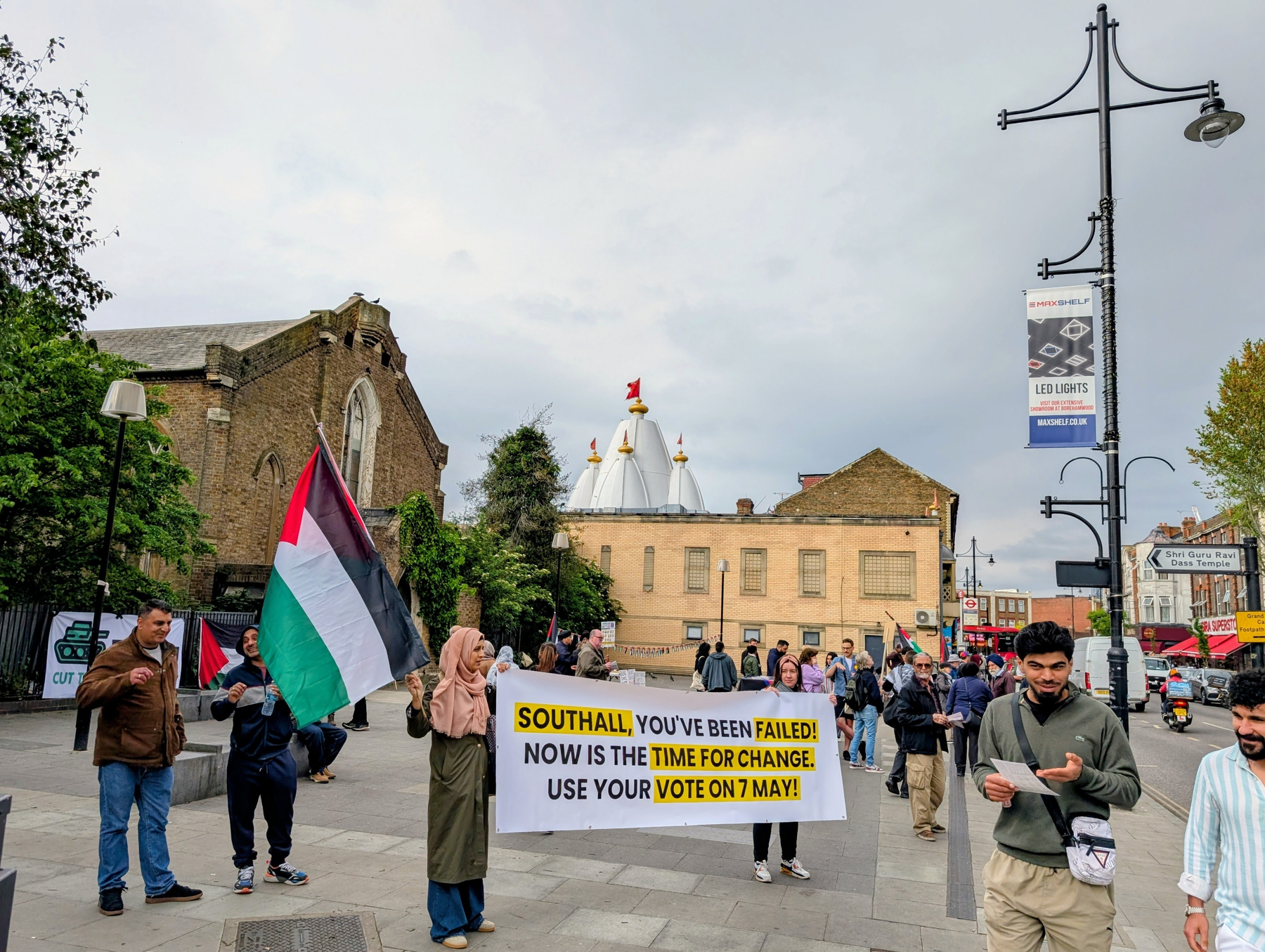
Campaigners, activists and Ealing Community Independents candidates gathered on Bank Holiday Monday to protest the failings of Ealing Labour in Southall and across the borough. The mood is positive and determined to bring about real change.
The vote on 7 May will be one of the few remaining mechanisms through which the residents of Southall Green can ask, directly and on the record, the question the panel never answered in July 2019.
Whose side are you on?