In July 2022 Ealing Council’s Cabinet pressed the “reset” button on Southall.
The Southall Reset report was meant to tackle “deep-rooted challenges specific to Southall”. It set priorities for four years, cancelled the South Road bridge widening the gasworks developer had been obliged to fund since 2010, and moved £9.29 million of GLA money to other projects.
Its evidence base opens with a simple fact:
“Southall is home to 70,176 people.”
It wasn’t.
Ten thousand people
The 2021 Census counted 80,588 people in Southall’s six wards, the same six wards the Southall Reset report names. That is the figure Ealing’s own Local Plan now uses: “approximately 81,000 people, which comprises 22% of the borough’s population”.
So where did 70,176 come from?
I asked. The council’s Strategic Planning Team replied that when the briefing was prepared, full Census 2021 figures weren’t yet available for small areas, so “mid-year estimates were used”. It gave the sources as “Census 2011, ONS Mid-Year Population Estimates, Annual Population Survey”, for Southall on its new 2022 ward boundaries.
That checks out, as far as it goes. The Office for National Statistics’ small-area estimates available in 2022 put the population of those same streets at about 72,000, and had it at about 72,000 every year from 2011 to 2020.
According to the official figures, Southall hadn’t grown at all in a decade.
The town that stood still
Except it had. After the 2021 Census, the ONS went back and revised its estimates. The revised series shows the same 40 neighbourhoods growing from 71,665 people in 2011 to 80,321 in 2020, an increase of more than 8,600 that the original estimates simply didn’t see.
So the council’s figure wasn’t invented, and it wasn’t a Census count from 2011. It was close to the official estimate. That estimate was about 8,000 people short of the Census, the council’s figure about 10,000 short, and both were wrong in the direction anyone who lives here could have told you.
Deliberate or incompetent?
Neither label quite fits. The council used the number the national statistics gave it. But “it was the official figure” only goes so far.
Southall has had a decade of tower blocks. The gasworks scheme alone had been building homes since 2016, and more soon followed around the station and down Merrick Road. The council approves the planning applications. It collects council tax from every one of those new households. An estimate showing no growth at all, in the part of the borough taking the most new homes, should have rung alarm bells.
And the same report was busy deciding what infrastructure Southall would and wouldn’t get. It was the report that recommended abandoning the bridge widening, because the cost had risen to £29.6 million. If you are deciding whether a town needs a wider bridge, more GP capacity or more school places, how many people live there seems like a fairly important number to sense-check.
The council says the Southall Reset figures were superseded by its Southall Regeneration Framework in February 2024, part of the Local Plan evidence. The bridge widening stays cancelled.
We told them
None of this was hidden. A year before the reset, on 19 July 2021, I posted a thread built around this map by Stop the Towers:
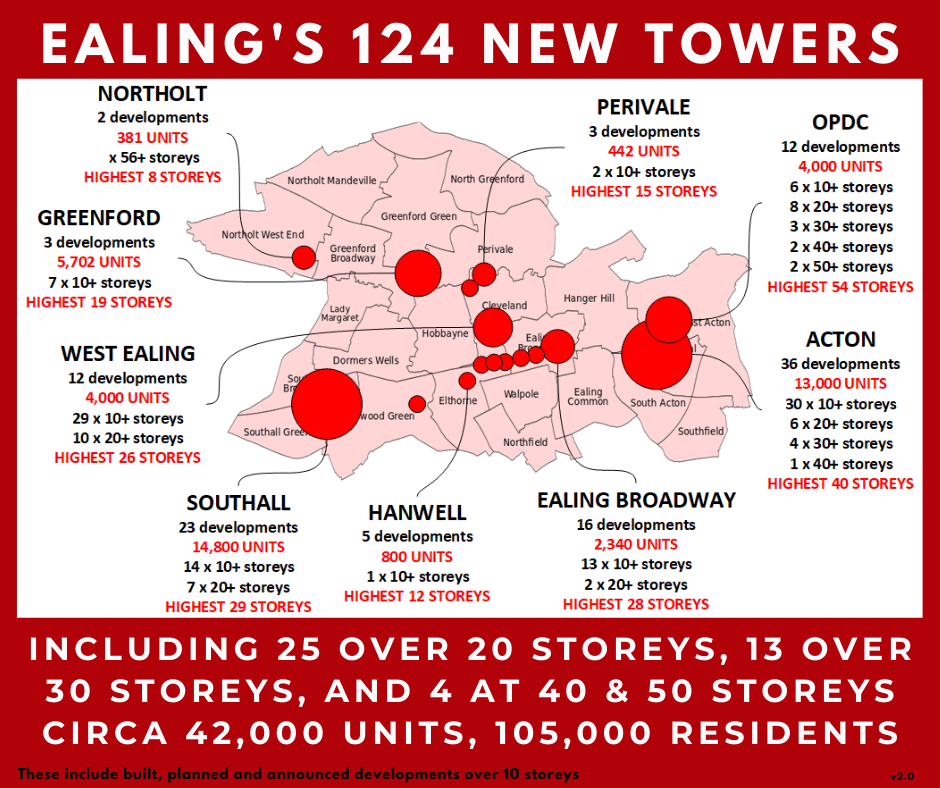
Map: Stop the Towers, v2.0, 2021. Built, planned and announced developments over 10 storeys.
There will be 14,800 new homes in 23 new developments in #Southall over the next few years. 14 units over 10 stories high, and 7 over 20 stories high. Up to 40,000 new residents (and their cars)!
One third of the total new developments in the whole of #Ealing borough (only #Acton is getting it worse).
None of these homes will be genuinely affordable to most people currently living in overcrowded homes in #Southall or #Ealing…
Where will 40,000 new residents’ children go to school, how will they get an appointment to see a GP, which hospital will they go to when they need emergency treatment, and how will they get there on the roads already regularly gridlocked by too much traffic?
Five years on, the council’s own Local Plan adds capacity for 12,455 more homes in Southall and 42% of the homes on the borough’s allocated sites. My estimate of what that means is 29,000 to 37,000 more people. The 2021 Census confirmed the overcrowding. And the Plan’s answer to the school, GP and hospital questions is, for most of its listed schemes, “TBC”.
So campaigners and residents could see up to 40,000 new arrivals coming in 2021. A year later the council reset Southall on official estimates that said its population hadn’t grown in ten years.
Packed in
The Census also answers a question the council’s own papers never ask.
Neither the Southall Reset report nor its Town Briefing mentions overcrowding. Nor does the Southall section of the new Local Plan. So here it is:
- 23.3% of Southall households have fewer bedrooms than they need. In England it’s 4.4%.
- 7.2% are severely overcrowded, two or more bedrooms short. That’s ten times the England rate.
- Southall Green (30.6%), Southall West (27.4%) and Southall Broadway (27.3%) are the three most overcrowded wards of Ealing’s 24.
Ten thousand more people than the council’s starting figure, living in homes five times as likely to be overcrowded as the England average.
One correction while we’re at it. In October 2022 Peter Mason told a Southall Community Alliance forum that 80% of homes in his ward, Southall Green, are privately rented. The Census says 45.3%. That’s high, the third highest of Ealing’s 24 wards and more than double England’s 20.5%. But it isn’t 80%.
The people nobody counts
And 80,588 is only the people the Census found.
The Census tries to count everyone, whatever their immigration status, and the ONS adjusts its figures for people it estimates it missed. Nationally 97% of people responded, and at least 88% in every local authority. But the people hardest to count tend to live in exactly the kind of housing Southall has plenty of: shared, sublet, overcrowded and privately rented.
Research on shared and multiple-occupancy housing found that its households “are more easily missed in population surveys such as the Census”, partly “because both landlords and tenants may benefit from informality and thus want to avoid detection by authorities” (Cauvain and Bouzarovski, 2016). The same paper cites Ealing’s own council leader, quoted in the press estimating that 60,000 residents of the borough could be living in “beds in sheds”.
Then there are people with no immigration status, people who have overstayed a visa, and others simply too frightened of officialdom to fill in a government form. Research for the Mayor of London estimated that 397,000 undocumented migrants and their UK-born children were living in London in 2017, somewhere between 350,000 and 478,000, and that they were unevenly spread across the capital (University of Wolverhampton for the GLA, 2020). There is no breakdown by borough, let alone by ward.
So nobody knows Southall’s real population. But it is almost certainly higher than the official count, and the people missing from it are the ones most likely to be living in overcrowded, unsafe homes. Every school place, GP appointment and bus seat is planned on the number that was counted.
What Happened to Southall?
All of this, and a lot more, is now on a new data page: What Happened to Southall?.
It takes the numbers from Community Powered Reporting’s 83-page What Happened to Southall? report and sets them out chapter by chapter, with page references, next to what the council’s own papers say:
- fly-tipping up 245% since fortnightly collections;
- 180 affordable homes completed out of 1,138 funded by about £100m of GLA money;
- £13.1m in developer contributions raised in Southall in five years, and £4.9m spent here;
- diabetes at 15.2% in North Southall, more than double England’s rate;
- a petition threshold of 3,671 signatures to force a council debate, where Brent asks for five.
It opens with what I’ve called the Bingo Test.
When someone applied for a bingo hall on South Road this summer, Ealing’s Head of Community Safety objected, as I wrote in September. The objection described Southall’s “disproportionate levels of harm associated with financial hardship, social isolation, poor mental health, addiction, and exploitation”, and asked the council to consider the cumulative impact of one more pressure on a town already under strain.
That is exactly the right test.
So the data page applies it to everything else: deep-rooted poverty, rising crime, toxic emissions from development with nobody properly regulating them, a population increase mandated without the infrastructure to match, developer money that leaves Southall, and planning conditions that get quietly dropped.
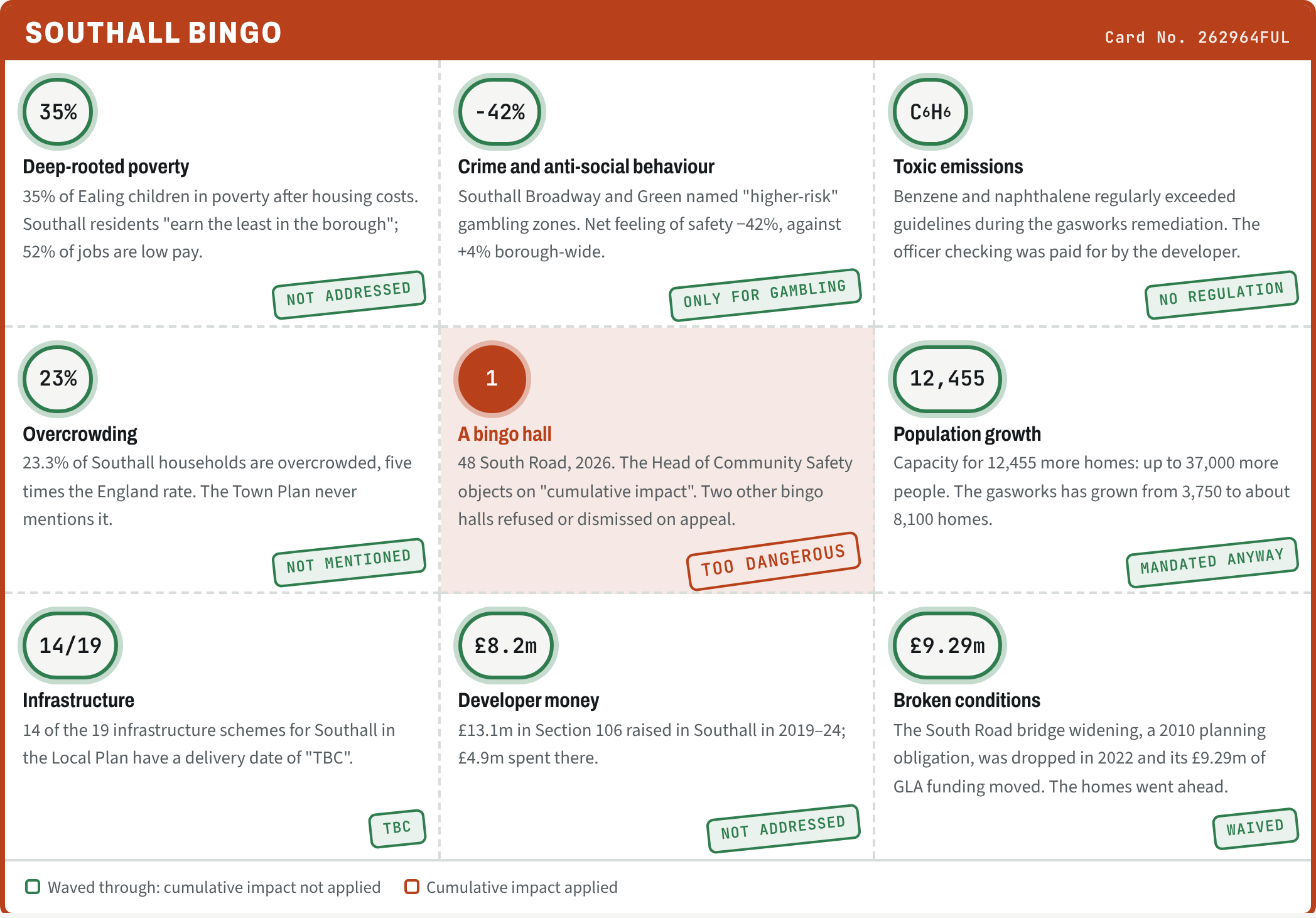
The Bingo Test, from the What Happened to Southall? data page.
On every one of them, Ealing found a way to say yes.
A bingo hall? No. Too dangerous.
What next
The council is consulting until 5pm on 21 December on changes to its Local Plan that add capacity for another 12,455 homes in Southall, which could mean 29,000 to 37,000 more people. Fourteen of the nineteen infrastructure schemes listed for Southall have a delivery date of “TBC”.
I’ve put together a separate guide to responding, with draft wording: Ealing Local Plan Modifications.
If the official starting point for Southall was ten thousand people short, it’s worth asking what else is.
Ealing Council and Berkeley Group were sent the points in this article and asked to respond by 5pm on Friday 20 November 2026. Neither had responded by the deadline. Ealing Council’s Strategic Planning Team did answer an earlier question about the source of the Southall Reset population figure, and that answer is reflected above. Any later response will be added.