Ealing Council told Southall residents that it had consulted partners, considered local impacts and updated its equality assessment when it chose Southall Town Hall for its drug and alcohol treatment service, RISE. It also told them there was “no evidence” that the move was behind the problems they were reporting.
In Freedom of Information responses, the council has now confirmed that it holds:
- no recorded update to that equality assessment
- no record showing how the earlier assessment was applied to Southall Town Hall
- no records of most of its consultation discussions
- no recorded advice from the Metropolitan Police
- no site-specific community-safety risk assessment
- no report, dataset or analysis behind its “no evidence” statement.
It has also disclosed a warning from its own Safer Communities team, sent months before the move, about the safety of a proposed side entrance. In that email, the community safety officer said they did not know whether the location had even been “surveyed with options considered”. The council now says the side entrance was dropped as a result. That email is still the only record of Community Safety advice it holds.
And on 23 October, asked to comment, the council no longer said there was “no evidence”. It said instead that “it is important not to assume” the problems are caused by RISE. On 18 November, it removed the claim that it had “updated” its equality assessment.
The question is no longer simply whether RISE caused the problems residents have been reporting. It is what Ealing actually examined before assuring the public that it had considered the risks.
A shorter report on the first two FOI responses was published on 16 October. The data behind this article, with interactive charts, is at data.southallstories.uk/rise-southall-town-hall.
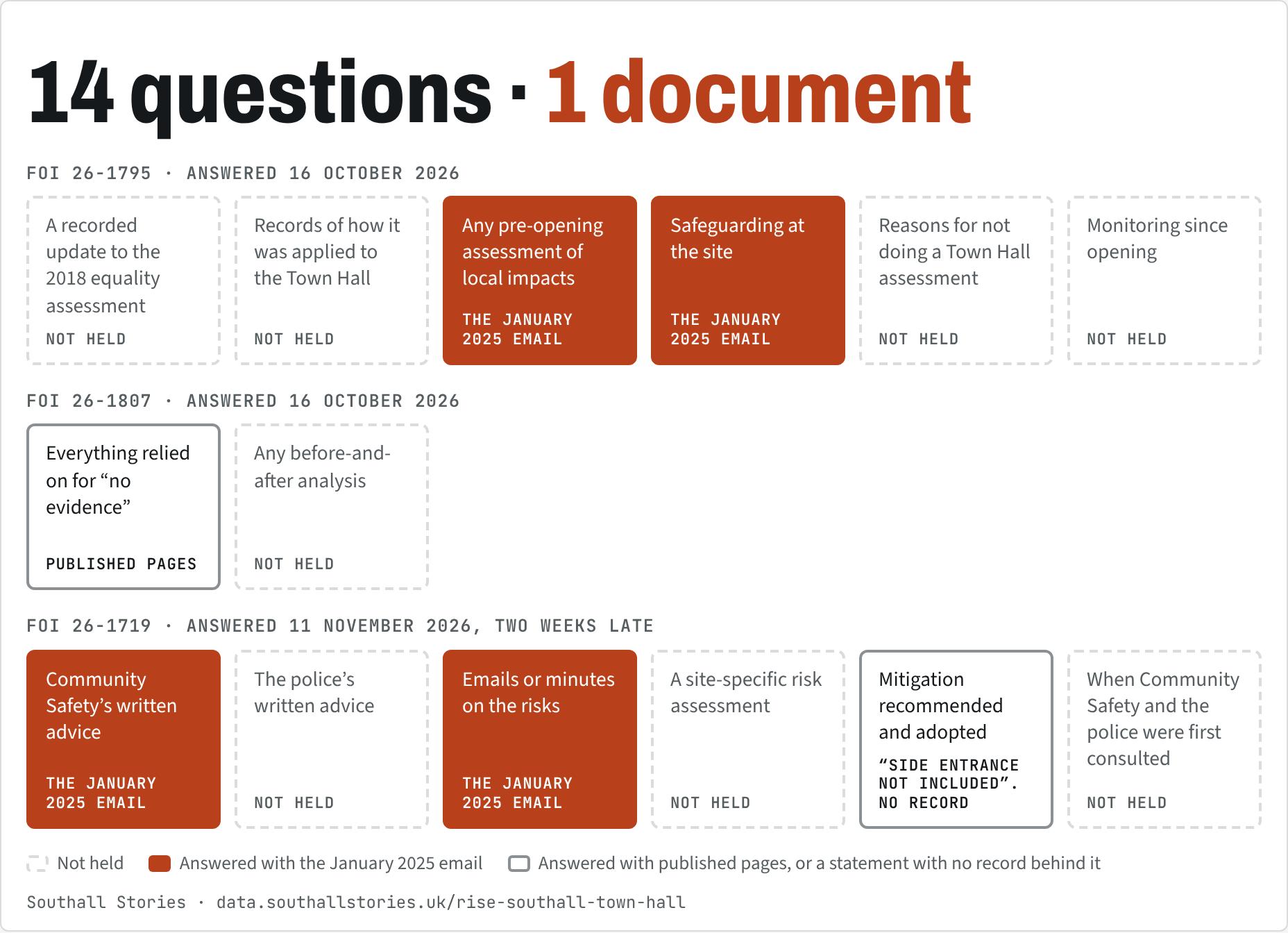
Three requests, fourteen questions, one document.
When RISE arrived
Campaigners and local press reports have said RISE moved from West Ealing to Southall in February 2024. It did not. RISE’s provider, Change Grow Live, records that it “moved out of the Central Hub (99–103 The Broadway) on Friday 31st October 2025”, with services continuing from Southall Town Hall and its existing site on Northcote Avenue. In May 2025, its website still listed West Ealing as the main hub.
The Town Hall stands at the corner of the High Street and Lady Margaret Road, on the boundary between two wards: Southall Broadway, which its entrance faces, and Dormers Wells, where its postcode is registered.
Both details matter for what follows. The date tells us which months count as “after” the move. The location tells us why ward-level crime figures, quoted by both the council and its critics, are a blunt tool.
The assessment that wasn’t updated
Until 18 November, Ealing’s RISE information pages said the council “used and updated the findings of the borough-wide Equality Impact Assessment completed in 2018 when deciding to locate services there”. The same page says the council reviewed who uses the service locally, how people with protected characteristics would access the site, and whether any measures were needed to address potential barriers.
The assessment linked in the council’s supporting evidence dates back to the earlier procurement process: headed “Updated February 2017”, it was signed in June 2018. The council’s list of supporting documents says they explain “the equality considerations and mitigations informing the Southall Town Hall decisions”. One of them is the April 2025 officer decision on the Town Hall lease, which records:
“Equality implications: Not applicable”.
That earlier document is not irrelevant. It discusses vulnerable service users and recognises that the environment of treatment hubs matters. It refers to young adults needing the option of being seen away from two main “chaotic hubs”, and to women who had concerns about their safety when former abusive partners used the same services.
But it was not an assessment of Southall Town Hall.
In FOI response 26-1795, the council now says:
“The Council does not hold recorded information constituting an update to the earlier Equality Analysis Assessment. No separate or discrete updated assessment was created for Southall Town Hall.”
It goes further. It has searched for, and does not hold, recorded information showing how the earlier assessment was applied specifically to Southall Town Hall. It holds no recorded decision or reasons for not carrying out a separate Town Hall-specific equality assessment. And it holds no records of site-specific equality, safeguarding or community-impact monitoring after opening: “The Council does not undertake location-specific monitoring or evaluation of this nature.”
The council explains that “used and updated” was intended to mean the earlier assessment informed “subsequent operational consideration; it did not refer to a recorded update”. It said on 16 October that it was reviewing the wording. A month later, on 15 November, the page still said “used and updated”. That day, I told the council this article would report that. On 18 November, the page was changed. It now says the council “drew on the findings of the borough-wide Equality Impact Assessment completed in 2018, together with more recent evidence and insights, when deciding to locate services there.”
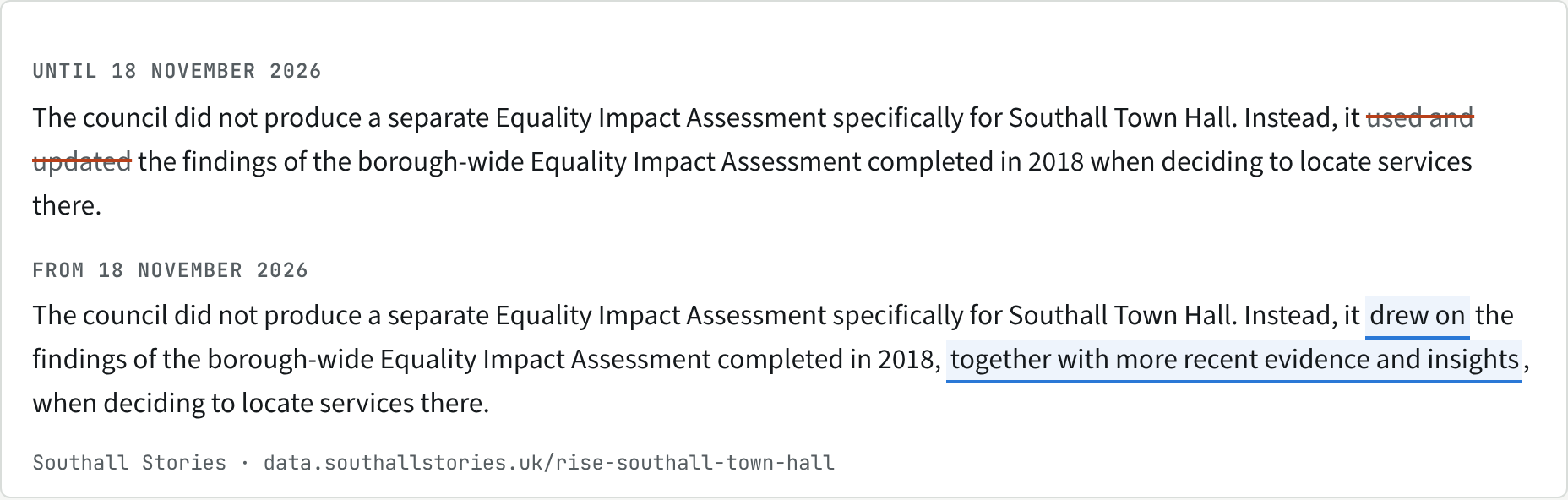
The council’s equality assessment page, before and after 18 November.
That is not a minor semantic distinction. “Updated” implied something was revisited, examined and recorded, and the council has now withdrawn it. But the new wording makes a claim the old one did not: “more recent evidence and insights”. The council has not said what they were. And the page still says the council “reviewed” who uses the service locally, how people with protected characteristics would access the site, and whether measures were needed. The FOI response identified no record of that review.
Councils are not legally required to produce a document called an Equality Impact Assessment. But under the public sector equality duty they must have “due regard” to equality when they make decisions, and being able to show that they did is the usual way of demonstrating it. That is why the absence of records matters.
A warning from inside the council
The only pre-opening assessment the council says it holds is an email dated 8 January 2025.
A Safer Communities team leader wrote to the council’s Substance Misuse Programme Manager, copying their Head of Service, Community Safety, about a proposal to create a side entrance to the former Town Hall for RISE clients.
It was not a response to a consultation. The officer apologised for the delay in getting in touch and wrote: “I just wanted to email you to express some concern.”
The officer noted that RISE and Change Grow Live had been presented with concerns by Southall Community Alliance — “currently occupying the former Town Hall” — and by the neighbouring Hindu Mandir, which owns the rear car park. They suggested those concerns might rest partly on “a notion that the RISE client group are high risk”. They also recorded existing rough sleeping around the building, and “a little bit of confusion” suggesting that people sleeping rough there were RISE clients.
The officer supported the service itself. RISE’s existing Southall sites at Northcote Avenue and “WWZ” were “invaluable”, they wrote, “particularly given the degree of acute need in the area”.
The concern was about the physical design.
“I am alarmed that a newly built alleyway may be created to the side of the former Town Hall,” the officer wrote. With existing antisocial behaviour concerns around the building, it “would likely create a further unregulated space that cannot be policed”, providing “the perfect opportunity for nefarious activity to occur”. It would also “leave female access user incredibly vulnerable due to the location and limited visibility”.
Citing the council’s work on male violence against women and girls, they concluded:
“I strongly believe this is not appropriate.”
Then came the sentence that matters most:
“I am not sure whether a planning application has been submitted, or whether the location has been surveyed with options considered.”
Ealing’s website now says the proposal “was informed by operational discussions with a range of partners, including the council’s community safety team”. In January 2025, the council’s own community safety officer did not know whether the location had been surveyed or options considered.
Ealing says the email “was part of the assessments that informed the final design of the building”. In a later response, it says the side entrance “was therefore not included” (see below). A search of the council’s planning register found no application for a side entrance at the building, which fits. Nor does the email establish that the harms it predicted would have occurred.
The timing does matter. Three months after that warning, in April 2025, the officer decision authorising the Town Hall lease recorded:
“Equality implications: Not applicable”
“Background Papers Used in Preparing This Report: None”.
It is also worth putting the warning beside the older document. The borough-wide equality assessment of 2017–18 recorded women’s concerns about feeling unsafe in treatment hubs. In 2025, a community safety officer warned that the Town Hall’s proposed access would leave women using the service “incredibly vulnerable”. In 2026, the council says it does no site-specific safeguarding monitoring.
Consultation without a paper trail
The council’s website says operational discussions with “the council’s community safety team, the Police and NHS organisations” considered potential local impacts and mitigation, and helped shape delivery from the Town Hall.
That paragraph was not always there. An earlier indexed version of the page did not contain it. The council’s site records the page as updated on 29 September 2026, two days after the second Southall protest and the same day I submitted an FOI request for the Community Safety consultation material. I do not know why the page was changed on that date, and the timing alone does not show that one caused the other.
The FOI response gives a different list of the bodies consulted: Community Safety, the Metropolitan Police, Southall Community Alliance and representatives of the neighbouring Mandir. NHS organisations are not named. And the council “does not hold records of most of those discussions”.
That does not establish that consultation never took place. It does make it difficult for residents to check what was said, what warnings were raised, what options were examined and what was actually changed.
Against the sparse formal record of the April 2025 lease decision, the later website language invited the public to believe a more extensive evidence-based process had taken place.
Perhaps there was one. If so, the records of it matter.
What Community Safety and the police advised
A third request asked for the advice itself: any written response from Community Safety or the Metropolitan Police, any emails or minutes discussing the risks of the location, any site-specific risk assessment, any mitigation recommended, and the dates each was first consulted. It was made on 29 September and due on 27 October. The council answered on 11 November, two weeks late.
From Community Safety, the council holds one document: the January 2025 email, sent again. It holds no other recorded assessment made before opening. And it repeats what it said in October: “Although officers and RISE spoke with relevant organisations,” naming Community Safety, the police, Southall Community Alliance and the Mandir, “the Council does not hold records of most of those discussions.”
From the Metropolitan Police, it holds nothing:
“The Council does not hold any recorded information relating to consultation responses, advice, assessments, or recommendations provided by the Metropolitan Police concerning the proposed location.”
It holds no site-specific risk assessment:
“The Council does not hold any recorded assessment of community-safety consequences relating to RISE moving into Southall Town Hall.”
And it cannot say when either body was first told about, or consulted on, the Town Hall. It “can confirm that there was ongoing engagement with both parties during the identification and operationalisation of the service in Southall”, but holds no record giving a date. So nothing in the records shows whether the police or Community Safety were consulted before the lease was authorised in April 2025.
The response does answer one question. “The advice received was taken into account in the final design of the floor plan,” the council says, “and the proposed side entrance was therefore not included.” The officer’s warning had an effect. But the council has disclosed no record of that decision either: no revised plan, no reply to the email, no note of who decided or when.
The email also raised more than the entrance. It described existing antisocial behaviour and rough sleeping around the building, and tension with the building’s other occupants and the Mandir. The council has disclosed nothing to show how those were assessed.
For further information on how the location was chosen, the response refers readers to the council’s “About the RISE service” webpage. That is the page whose account of consultation these requests set out to test.
The council’s website says discussions with Community Safety and the police “considered potential impacts on the local area and how service can mitigate these”, and covered “local needs, crime prevention and how the service would work in the area”. On the council’s own records, the only impact written down is the one a Safer Communities officer raised unprompted, and the only mitigation is the side entrance that was dropped.
“No evidence” — of what?
When residents announced their first protest, a council spokesperson told EALING.NEWS on 7 August: “There is no evidence that the current issues are being caused by the relocation of RISE. What we are seeing reflects a more complex picture, including displacement from enforcement activity elsewhere and existing pressures in the area.” Ahead of the second protest, the council gave the North West Londoner the same words on 23 September.
That statement sounds definitive. It also offers an alternative explanation: displacement from enforcement elsewhere. FOI response 26-1807 reveals a more limited evidential basis for both.
The council says the statement “was based on operational intelligence shared between the Council and the Metropolitan Police during the increased police and Council activity in Southall in summer 2026”. That operation ran from 13 July to 9 August. The council first made the statement on 7 August, two days before the operation ended and two weeks before its results were announced.
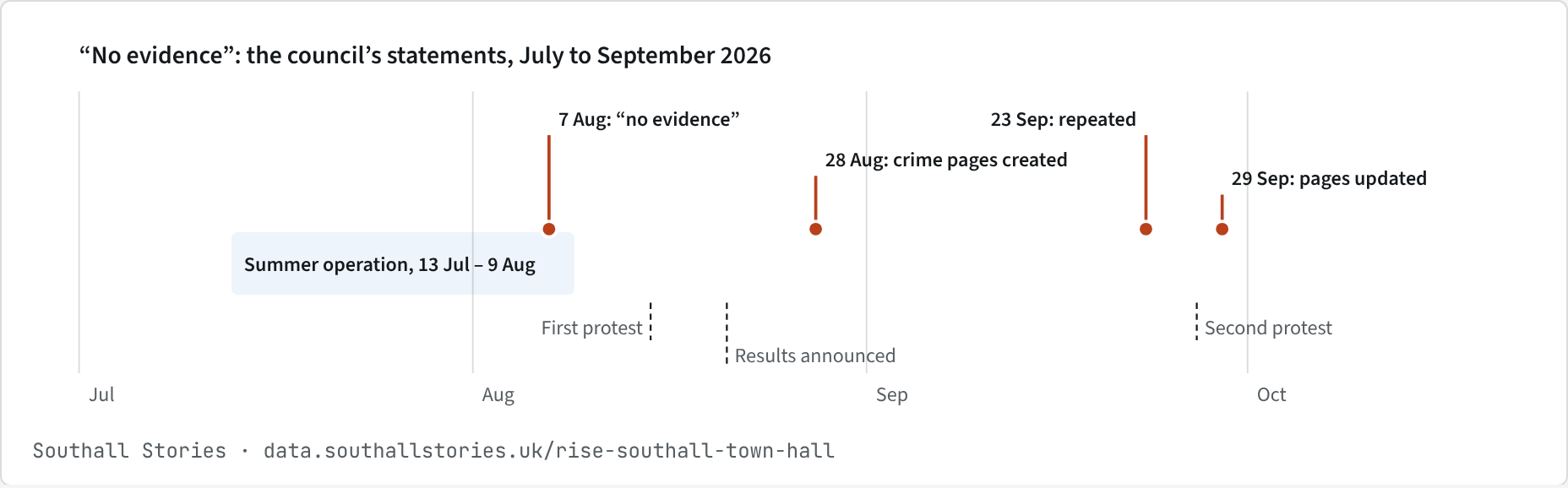
“No evidence”, before the evidence was in.
According to Ealing, that intelligence “indicated that the majority of individuals identified as involved in criminal or anti-social behaviour had no identified link to services delivered by RISE”.
That is relevant evidence. It also means, on the council’s own account, that some of those identified did have such a link. And it is not the same as an assessment of whether relocating a service affected the frequency, visibility or geographical distribution of incidents around the Town Hall.
The council has “not identified a discrete report, dataset or formal causal analysis created for the purpose of making that statement”. Instead it points to published material: its own RISE webpages, ward-level police figures and the Safer Ealing Partnership’s annual report. The council’s website records those RISE pages as created on 28 August, three weeks after the statement was first made.
Nothing in the response supports the second half of the statement. I asked for all recorded information relied upon. The council described intelligence about whether individuals were linked to RISE. It identified nothing recorded about “displacement from enforcement activity elsewhere”: no analysis of where people had moved from, and no before-and-after mapping. On the council’s own account, the displacement explanation is no better documented than the one it rejects.
The area’s MP describes displacement differently. In a video posted on 13 August, two days before the first protest, Deirdre Costigan said the police needed more power to crack down on anti-social behaviour “so they don’t just move people from one end of the town to the other”.
The council’s statement points to people displaced into Southall from enforcement elsewhere.
The MP describes people being moved around within Southall itself.
Neither account is supported by any recorded analysis the council could produce. Ms Costigan was invited to comment on this passage before publication and did not respond by the deadline.
Deirdre Costigan MP on policing in Southall, from a video posted on X on 13 August 2026. Clip trimmed to the passage on moving people around the town.
Asked for analysis of whether incidents changed after the relocation, the council replied that it “does not undertake site-specific monitoring or evaluation of this nature” and had identified no recorded analysis. It also acknowledged that the ward-level police figures and partnership reporting it cited “are not a site-specific before-and-after assessment of the Southall Town Hall location”.
What the police data shows
This kind of check is not impossible. Police.uk publishes the approximate location of every recorded crime and anti-social behaviour report. Using four years of that data, I compared the area within 500 metres of the Town Hall with the ring between 500 metres and a kilometre away.
In the ten months after the move (November 2025 to August 2026), recorded crime and anti-social behaviour within 500 metres of the Town Hall was 18% higher than in the same months a year earlier. In the surrounding ring it rose 7%; across Ealing, 1%; across London it fell 2%. Anti-social behaviour reports within 500 metres rose 44%, against 3% in the ring and 3% across Ealing.
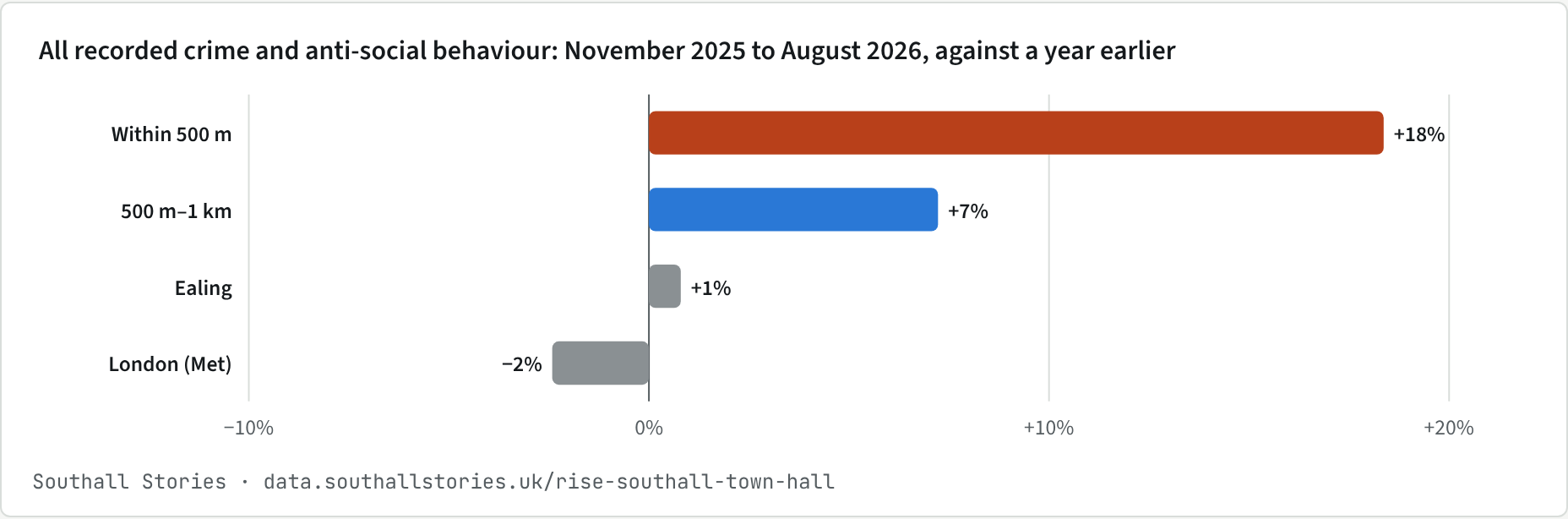
The change was not immediate. From November to February, the area near the Town Hall was up 6%. From March to August, it was up 26%, and anti-social behaviour reports were up 66%. Drugs offences rose in the surrounding ring as well as near the Town Hall, while falling across Ealing as a whole.
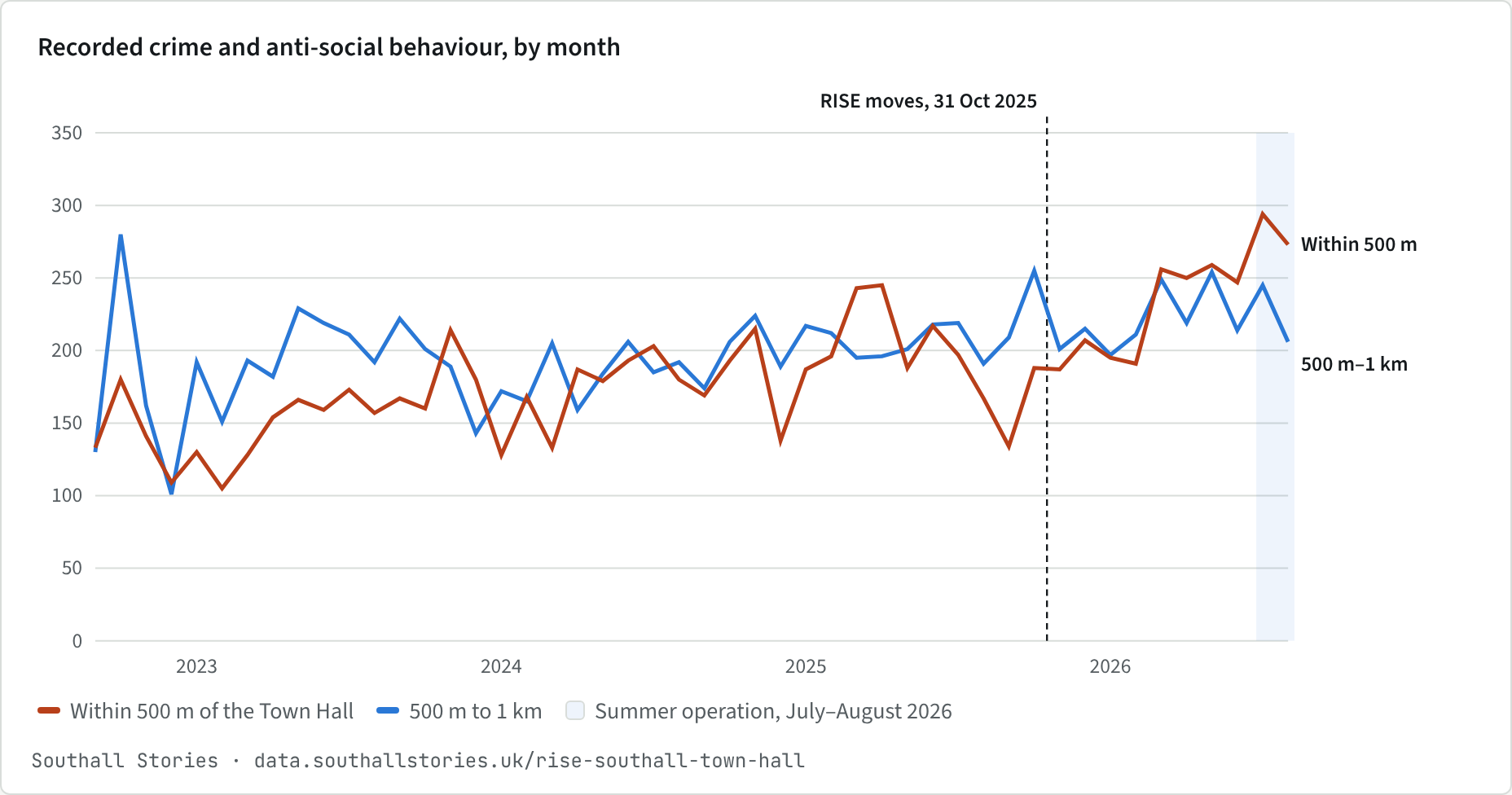
Police.uk street-level data. The dashed line marks RISE’s move on 31 October 2025. The interactive version, with figures for anti-social behaviour and drugs, is on the data page.
The area around the Town Hall was also rising faster than its surroundings well before RISE arrived: comparing the same November-to-August months, up 40% between 2022–23 and 2024–25, against 13% in the ring. And police data cannot separate a real increase from more reporting by worried residents, or from more crime found by more police. The jump in reports began in March 2026, around the time residents started campaigning about RISE ahead of May’s local elections. It cannot prove cause. It is, though, exactly the kind of question the council says it has never asked.
To be clear: none of this proves that RISE caused an increase in crime or antisocial behaviour. Residents’ photographs, reports and experiences cannot by themselves establish that causal relationship either. Southall had serious problems before the relocation, as the council’s own January 2025 email records. People needing drug treatment must not be blamed collectively for crimes committed by others.
But Ealing’s public “no evidence” assurance should not be mistaken for the conclusion of a documented local before-and-after study. On the council’s own account, no such study exists.
There is a difference between examining whether something happened and finding that it did not, and not having undertaken the examination.
What the council says now
Southall Stories asked the council to comment on its FOI responses, and put five questions to it: what the 7 August statement was based on and who approved it; what evidence supports the displacement explanation; what happened to the side entrance; when the “used and updated” wording will be revised; and whether it will begin monitoring the area around the Town Hall.
The council’s statement of 23 October answered none of them. But it said something different from before.
“Criminal and anti-social behaviour is unacceptable,” a spokesperson said, “but it is important not to assume that people accessing treatment are responsible for crime in the area, or that the issues being reported are being caused by RISE. The causes of crime and anti-social behaviour are complex, which is why the [process] of gathering evidence is so important, and we will continue to act on residents’ concerns and the information available.”
The words “no evidence” have gone. So has “displacement from enforcement activity elsewhere”. Saying there is no evidence is a claim about what has been examined. Saying it is important not to assume is a caution. It is the more defensible position, and the one the council’s own records support.
The rest of the statement repeated earlier commitments: increased CCTV monitoring and patrols, further targeted police activity, more outreach to people sleeping rough, and an approach that “combines appropriate enforcement action with compassionate outreach”.
Before publication, Southall Stories sent the council the main points of this article and nine questions, including the five above. They covered the police’s advice, whether Community Safety and the police were consulted before the lease, who decided to drop the side entrance, and how many people in the summer operation had a link to RISE. The council replied on 17 November that it would “like to re-iterate” its statement of 23 October, and sent it again word for word. It did not dispute any of the points, and it answered none of the questions. The next day, it changed the “used and updated” wording.
I have asked the council for internal reviews of all three Freedom of Information responses. I have also asked the Metropolitan Police directly for any advice it gave on the Town Hall. This article will be updated with anything they produce.
The question Ealing must answer
Nobody should have to choose between supporting drug and alcohol treatment and expecting a council to scrutinise where and how a treatment service operates. Vulnerable service users, neighbouring organisations, women accessing treatment and local residents all have legitimate interests in safe, properly planned services.
The January 2025 email proves that at least one council officer understood that.
Ealing’s disclosures do not establish that Southall Town Hall was the wrong location. They establish something narrower, and important: the council cannot produce several of the recorded assessments that its public explanations led residents to expect.
If the risks were considered, what were the findings? The side entrance was dropped; what else changed, and where is the record of it? What did the police advise? If the council drew on “more recent evidence and insights”, what were they? And if the council says there is no evidence of a link to worsening local conditions, what location-specific analysis was done to test that proposition?
Ealing has supplied its answers. For too many of those questions, the answer was: no recorded information held.