On 15 July, Ealing’s planning committee voted to grant permission for a hyperscale data centre on the site of the former Honey Monster factory in Southall. It took 27 minutes.
The approved minutes of that meeting record that officers highlighted the scheme’s benefits, including “over £70 million in combined Section 106 and Community Infrastructure Levy contributions”.
That is not what the committee was told.
What members saw
The committee report gives the total as £17,758,956: £9,854,706 in Section 106 contributions and £7,904,250 in Community Infrastructure Levy (Table 1, Financial Contributions).
The slide shown to members while the officer presented, headed “Benefits for Ealing”, says “£17.76m S106 + Ealing CIL contributions”.
What the record says
YouTube automatically generates a transcript of the council’s meeting videos. At 12:45 in the recording of 15 July, it renders the officer’s words as:
“and there would be over 70 million pounds in combined section 106 and community infrastructure levy contributions.”
The approved minutes say:
“over £70 million in combined Section 106 and Community Infrastructure Levy contributions.”
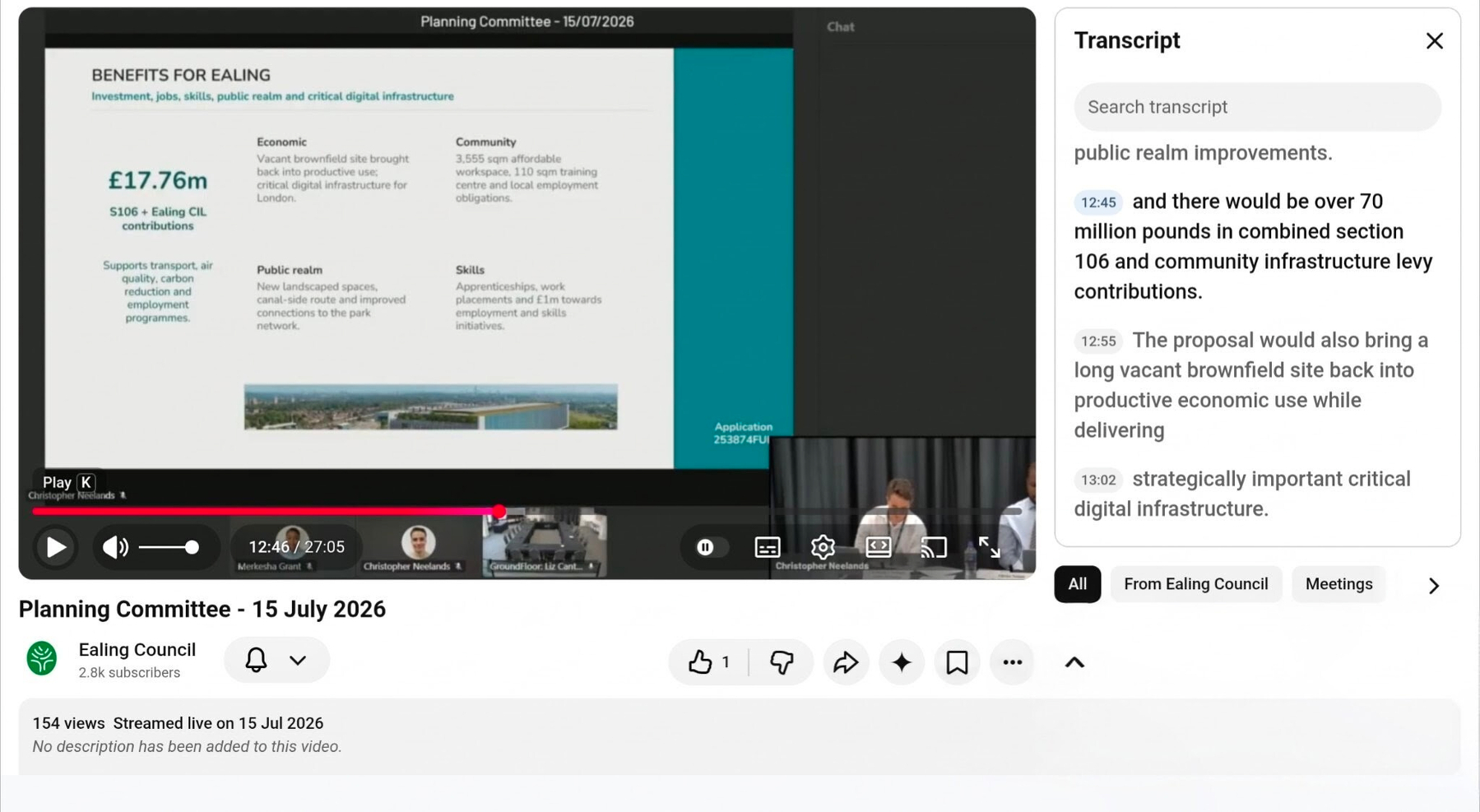
The slide says £17.76m. The automatic transcript, right, says “over 70 million pounds”. Ealing Council, YouTube.
Listen to the recording and the officer says seventeen. “Seventeen” and “seventy” are easy for automatic captions to confuse.
The council says the transcript was not the source. “Minutes are prepared by committee clerks using a range of sources, primarily the notes they take during the meeting,” a spokesperson said. “Clerks may refer back to the YouTube recording to clarify particular points but minutes are not prepared using their automated transcript.”
It did not explain how the minutes came to repeat the transcript’s wording almost word for word.
Either way, I have some sympathy for the clerk. Using an automatic transcript to help write up a long meeting would be a sensible use of the tools available, and “seventeen” and “seventy” are easy to mishear, for a person or a machine. Getting one figure wrong is not the problem.
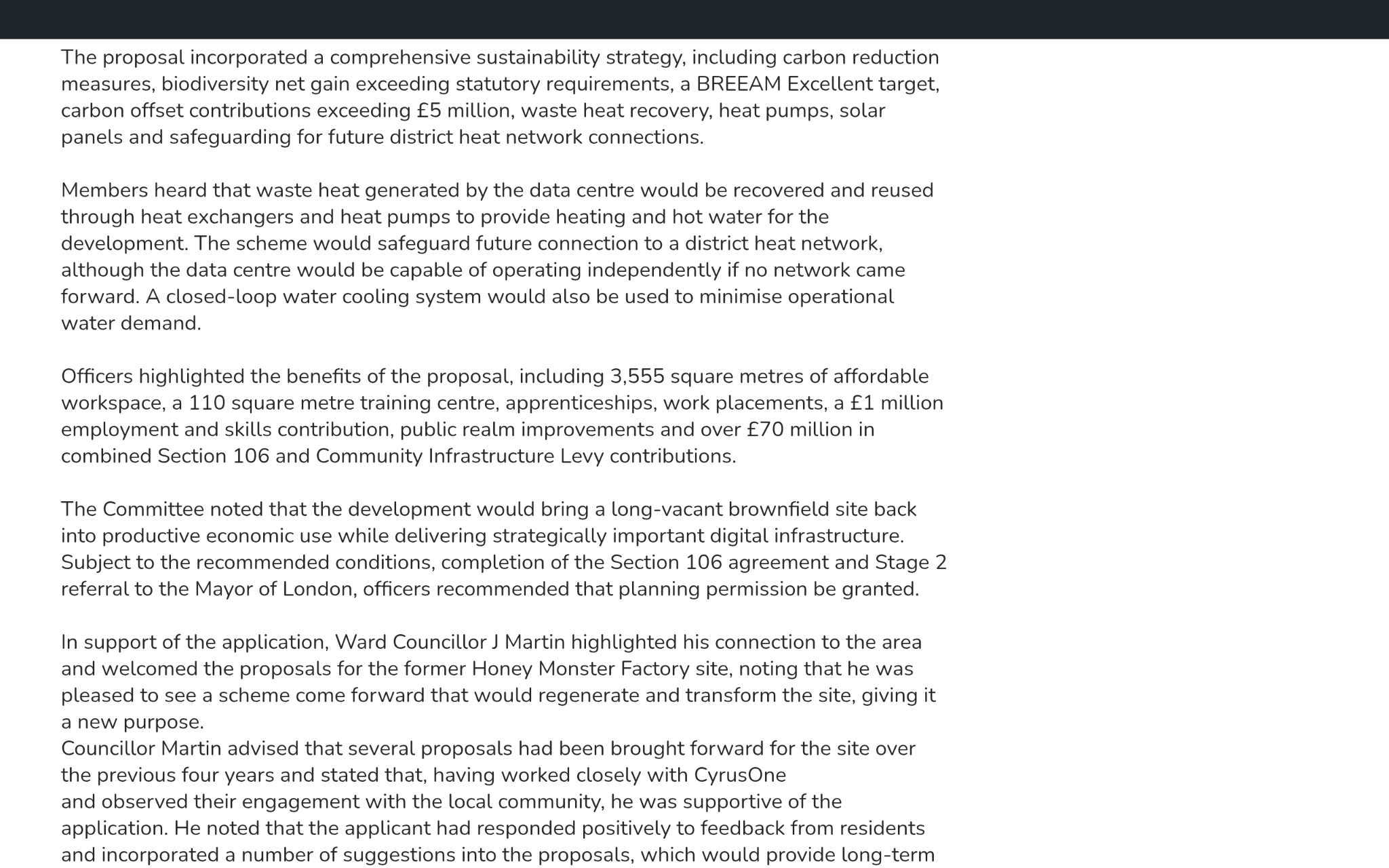
The approved minutes of 15 July 2026.
The minutes were put to the committee and signed as “a true and accurate record of proceedings” on 19 August 2026. The figure was not corrected.
What the council says
On 29 October I asked Ealing Council how the minutes were prepared, whether YouTube’s automatic transcript was used, whether automated transcripts are used for other council minutes, what checks are made on figures before members approve minutes, and whether it would correct this record.
On 17 November, after a reminder, the council replied:
“The reference to ‘over £70 million’ in the minutes is incorrect. This did not affect the decision taken, which included Section 106 and CIL contributions totalling £17,758,956.
“To ensure the council’s official record is accurate, an item will be brought to the next Planning Committee meeting to correct the figure.”
The committee’s November meeting was cancelled. Its next meeting is listed for 16 December. I’ll report whether the correction is made.
Why it matters
Members were shown the right figure, so this did not change the decision, and the council has now agreed to put the record right. But minutes are the council’s permanent legal record of what it decided and why. Anyone checking later, a resident, a journalist, an inspector or a court, would read that a £1.4 billion data centre came with “over £70 million” for the borough. The real figure is about a quarter of that.
The problem is that nobody spotted it. At the meeting on 15 July, the officer’s slide showed £17.76m. Five weeks later, on 19 August, the committee approved minutes saying “over £70 million” as “a true and accurate record”. A figure four times too big passed the clerk, whoever checked the draft, and every member who voted to approve it.
The council did not say what checks are made on figures before minutes are approved. That is the question that matters, whatever tools clerks use.
I have now asked, under the Freedom of Information Act, for the draft minutes, the clerk’s notes, and the council’s guidance on checking figures and on using automated transcription.
The council’s statement in full
An Ealing Council spokesperson said: “Minutes are prepared by committee clerks using a range of sources, primarily the notes they take during the meeting. Clerks may refer back to the YouTube recording to clarify particular points but minutes are not prepared using their automated transcript.
“The reference to “over £70 million” in the minutes is incorrect. This did not affect the decision taken, which included Section 106 and CIL contributions totalling £17,758,956.
“To ensure the council’s official record is accurate, an item will be brought to the next Planning Committee meeting to correct the figure.”
A side story from Scary Monsters, a series on Southall’s data centres. Part 1: They Wrote It Down. Part 2, on consultation, is coming. The figures and documents are on the data page.