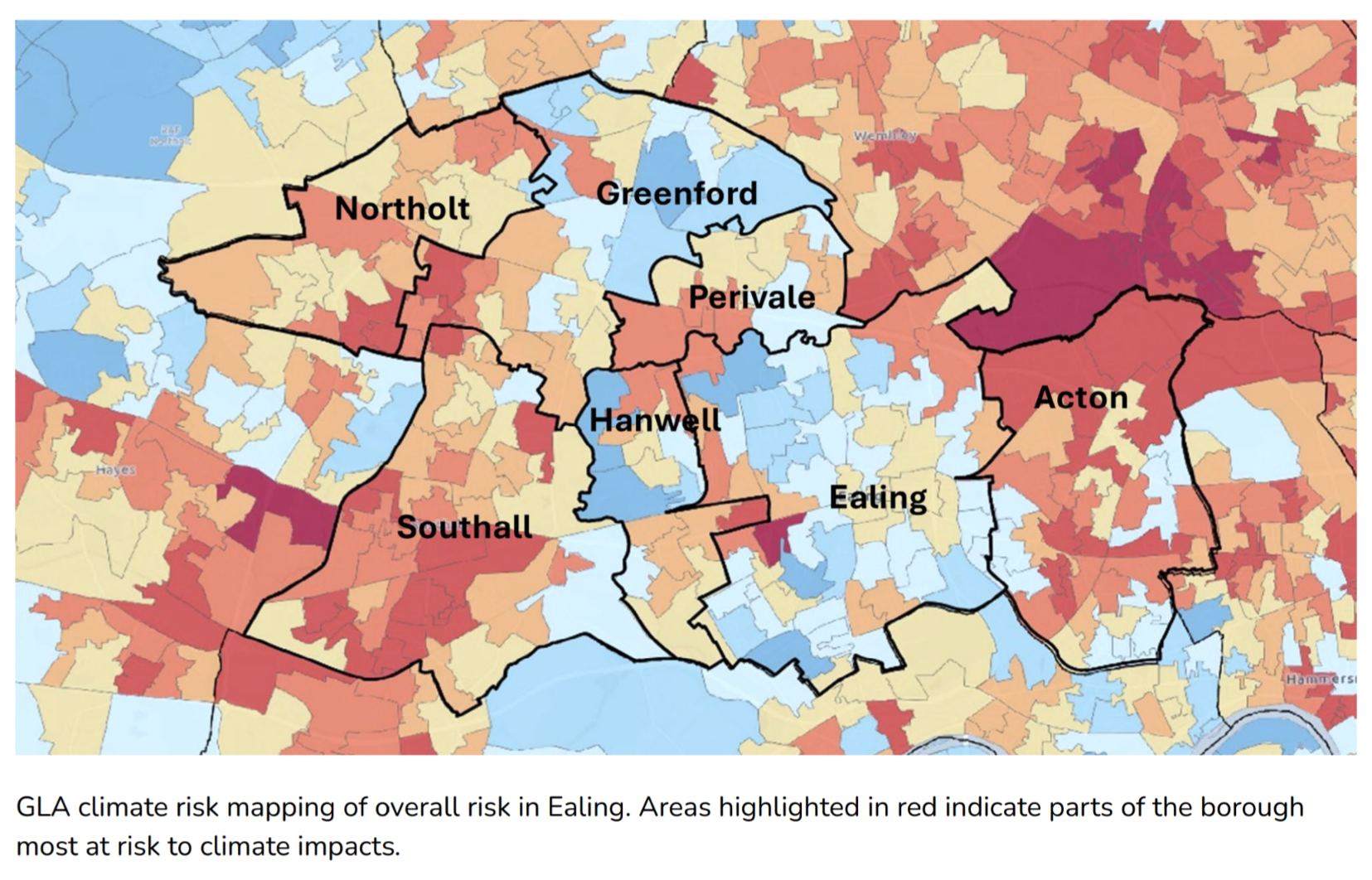
Above: the council’s own climate risk map for Ealing. Reds and dark reds mark the highest-risk neighbourhoods. Source: Ealing CEES 2025 Progress Report, p.13.
On 11 July 2018, I recorded a video for the Clean Air for Southall and Hayes campaign’s petition to stop the toxic and odorous open-air remediation of Southall’s massive old Gasworks site by the mega rich developer Berkeley Group.
In the video, I described how I had to keep my windows closed all night and all morning in the middle of a sweltering three-month heatwave.
Why?
Because of the stink of petrol outside, a result of Berkeley’s “clean-up” operation.
With very little respite, we were enveloped in the sickly-sweet smell for most of that year’s three-month heatwave.
As a result, and as Berkeley refused to stop, the temperature inside my home — 26°C — was around 5°C higher than the temperature outside.
Almost eight years on, we are having a mini-heatwave in the last week of May, with temperatures topping 30°C for the next few days in London.
In 2018, the highest temperature in May was 28.5°C.
In June, it was 29°C. In July, 34°C. In August, 32°C.
The all-time UK record temperature in May, set in 1944, was 32.8°C.
“So what?” you might ask. “It’s nothing to worry about. Most people will be fine. It’s worse in the Global South, and people survive there with less to cope.”
It is true that most people will be fine.
But does that mean we should not worry about those who won’t?
Last year, there were more than 1,000 excess heat-related deaths in the UK.
Just last week, the Climate Change Committee warned that the majority of homes in the UK will overheat by 2050, water shortages will worsen, and the costs to public welfare could reach hundreds of billions of pounds a year.
What has all this got to do with Southall?
Quite a lot, actually.
Readers of this blog will not be surprised to learn that the impact of excess heat is worse in Southall.
But don’t worry! Ealing Council is here!
In April 2019, as the so-called “soil treatment hospital” at the Gasworks was officially decommissioned, Ealing Council declared a Climate Emergency.
And they’ve been “fighting” this climate emergency ever since.
Mostly, some might argue, by closing recycling centres, blocking roads with giant plant pots, and granting planning permission to transform the “Queen of the Suburbs” into a new Manhattan.
But the council has a strategy.
Ealing Council knew
On 11 January 2021, Ealing Council adopted its Climate and Ecological Emergency Strategy.
The strategy committed in writing to climate justice, acknowledging in Section 6 that low-income households contribute least to emissions, are most negatively affected by climate impacts, and are least able to participate in decision-making.
Section 15 commits the council to use its planning powers — described as “one of the most influential tools available to the council to mitigate the effects of climate change” — to “maximise urban greening”, “protect and enhance our network of open spaces”, ensure new developments are “Air Quality Positive”, and “steer development to the areas with the lowest probability of risk from flooding.”
The targets are testable.
-
Tree canopy cover from 16.9% to 23% by 2030 (N1.1).
-
50,000 energy efficiency measures in private homes by 2025 (E1.4).
-
10,000m³ of additional surface water storage by 2025 (N3.4).
-
All major developments built to net zero (E2.2).
Ealing knew, in 2021, exactly which residents would bear the cost.
Veteran Southall Green councillor Jasbir Anand was appointed to lead the fight for residents.
Residents knew
Six weeks after the April 2019 declaration of a Climate Emergency, Ealing Transition Initiative submitted a detailed community response — pages of specifics, costed by category.
Among the asks:
-
retrofit of existing housing stock beginning with local authority homes;
-
shade trees in every street rather than ornamentals;
-
Passivhaus or equivalent standards for all building works and conversions; - and no further building on green spaces.
Seven years on, none of the four has been delivered in the borough’s most heat-vulnerable neighbourhoods.
-
Warren Farm Nature Reserve was saved but is scheduled to have building works right next door as new sports pitches and facilities are erected.
-
Passivhaus applies to new council-built housing only.
-
The trees that have been planted have mostly gone elsewhere — not in Southall.
-
And the retrofit numbers will be addressed below.
Only in Southall
Three years ago, I went through the council’s draft Air Quality Strategy line by line.
The strategy named Southall as an Air Quality Focus Area, identified BAME and low-income populations as disproportionately exposed, and committed to “fighting inequalities.”
But by then, the council had already:
-
approved continued open-air remediation of the contaminated Southall Gasworks site, including through the 2018 heatwave, when residents pleaded with leaders to halt work
-
failed to enforce the Construction Management Plan — and confirmed in an FOI response that it did not hold a complete copy of the original
-
refused to widen South Road bridge by the train station, the one mitigation promised when the Mayor overruled local planning objections
-
proposed destroying most of the rewilded Warren Farm Nature Reserve to build sports pitches the consulted public did not want.
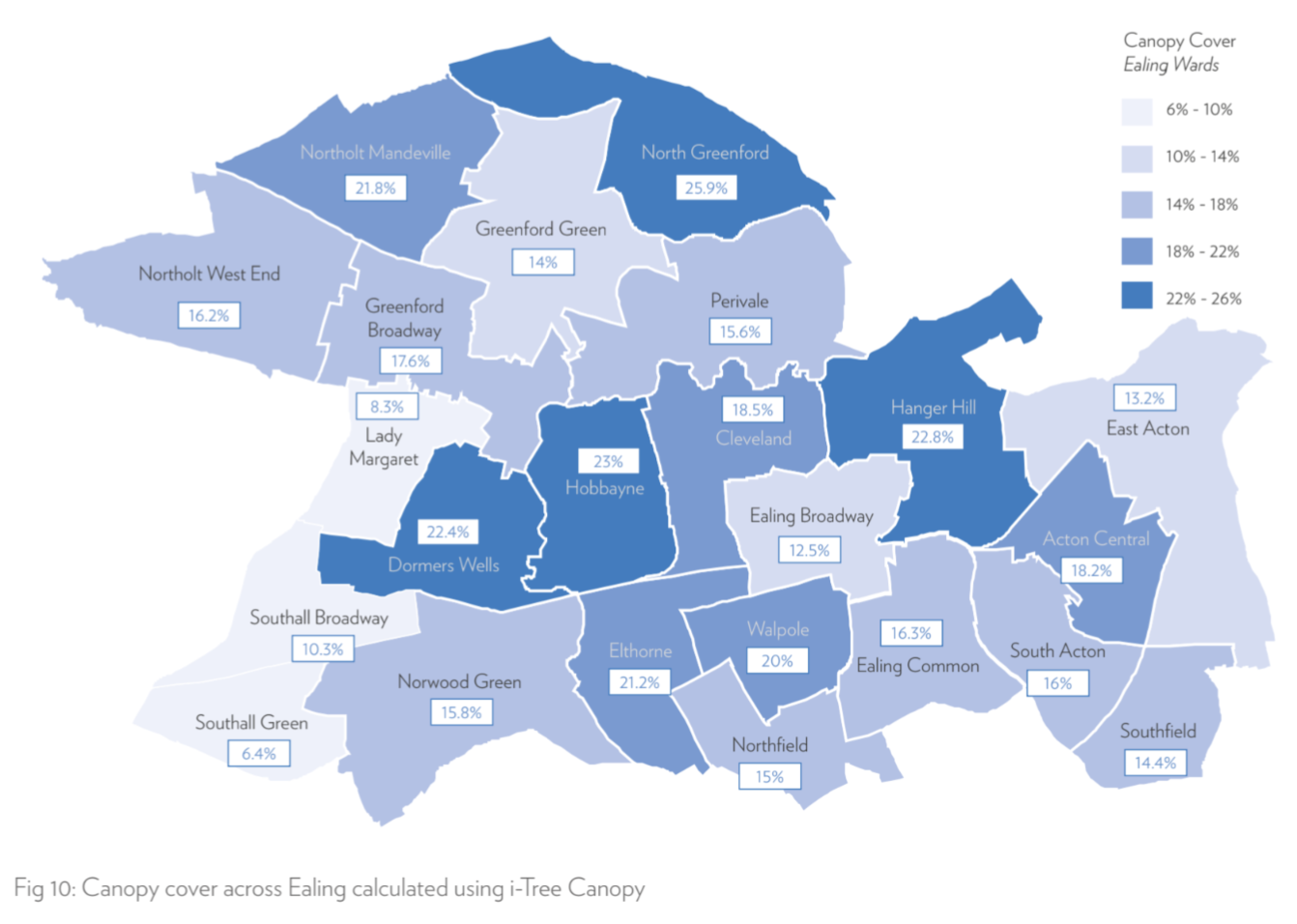
Southall already has the lowest tree canopy cover in Ealing.
What I suggested in 2023
“If Ealing is serious about ‘fighting’ inequalities, action must be targeted to protect vulnerable people in Southall to reduce air pollution and its impact on the health of its large, mostly economically deprived and non-white population.”
“The Strategy and Plan must target children and older people, people with lung conditions, and pregnant women: outside schools and school run hours.”
[I wrote that in January 2023. As it happens, I was diagnosed with chronic lung disease the following year.]
“The Council must question if it is ethical to promote active travel in Southall when it knows that it is a high pollution area and that most of its population is particularly vulnerable to its adverse health impacts.”
I also proposed something specific:
“If the council’s air quality strategy is to have any real meaning and intent to address air pollution and multiple inequalities in the Southall Air Quality Focus Area and beyond, it must surely include a vast tree-planting project, and proper maintenance of our existing parks if no new ones can be created on non-contaminated land.”
The council adopted its draft strategy with some minor adjustments, and apparently ignored my submission.
The 10,000 trees planned in the new adaptation strategy are going to the new regional park, not into the priority neighbourhoods.
The council’s schools climate-change resource page, run by the School Travel Team, still does not mention heat adaptation, and still promotes active travel in a borough now confirmed as ninth worst in England for heat vulnerability.
Ninth worst in England
In July 2022, Friends of the Earth published an analysis of research led by Professor Sarah Lindley at the University of Manchester, ranking every English local authority by the number of neighbourhoods most socially vulnerable to extreme heat.
Ealing came ninth out of the whole of England.
Seventy-nine priority neighbourhoods for adaptation. Worse than Haringey, Brent, Lambeth, Hounslow, Wandsworth, and every other west London borough. Better than only Birmingham, Newham, Tower Hamlets, Hackney, Nottingham, Southwark, Leicester, and Enfield.
The research, drawing on University of Bristol heat-exposure modelling and over forty social vulnerability indicators, identified where heat would land hardest, who lived there, and what they could afford to do about it.
Friends of the Earth then overlaid the rankings with Leeds University carbon-footprint data and found that priority neighbourhoods have lower than average carbon footprints. The communities most exposed to the climate impact are least responsible for the climate cause.
And one finding largely ignored at the time of publication:
People of colour are four times more likely than white people to live in a priority neighbourhood for adaptation.
The council had this analysis nearly four years ago.
As Professor Hannah Cloke, Regius Professor in Meteorology and Climate Science at the University of Reading, put it last week:
“The solutions exist. The challenge now is turning adaptation plans on paper into streets, homes, rivers and infrastructure that are ready for what’s coming.”
The plans on paper, in Ealing’s case, are five years old. The streets, homes and infrastructure have moved in the opposite direction.
The Leader’s own words
It wouldn’t be Southall Stories without a quote from our newly re-elected leader.
In June 2020, in the aftermath of George Floyd’s murder, the man who would become Leader of Ealing Council the following year, Peter Mason, posted to his then-Twitter account:
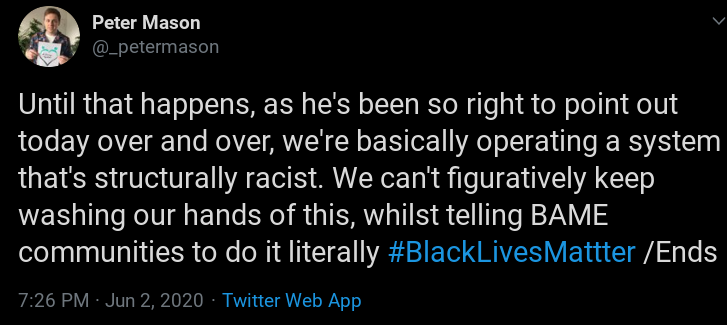
“we’re basically operating a system that’s structurally racist. We can’t figuratively keep washing our hands of this, whilst telling BAME communities to do it literally. #BlackLivesMatter”
Three years later, at the unveiling of replacement memorial plaques for Blair Peach and Gurdip Singh Chaggar — both killed in racist attacks on the streets of Southall — Mason named structural racism as the cause of Southall’s gaps in life expectancy, earnings and housing.
He’s not wrong.
He’s also been Leader of the council during the period in which the Friends of the Earth analysis has sat on the public record. That analysis quantified one component of what the Leader publicly described.
People of colour, four times more likely to live in priority heat-adaptation neighbourhoods.
The council’s measured delivery against its 2021 climate justice commitments, in those neighbourhoods, is what the Leader’s stated diagnosis describes in practice.
Feet to the flames
In January 2022, the Ealing Race Equality Commission — set up by the council and chaired by Lord Simon Woolley — published its final report.
Mason had been in office as Leader for eight months.
Woolley’s framing was direct: previous reports across the country had ended up “gathering dust on shelves – and we do not want that to happen with this report.”
Priority 7 of the recommendations called for an independent body that would keep “feet to the flames” in order to “hold the next Ealing administration to account for progress”, with the Leader required to report on progress annually from 2023.
The council established the Citizens’ Tribunal in response.
Two years on, the Tribunal’s own evaluation report records that 58% of its members reported difficulties in obtaining the necessary data from the council. “This in turn diluted their ability to make informed recommendations.”
The council’s own accountability body has said, in writing, that the council will not give it the evidence it needs to hold the council accountable.
EREC’s housing recommendations — empowered tenant groups, a private-renters rights campaign, ward-level housing advice hubs — sit alongside one statistic from the same report.
Citing North West London Community Voices research, EREC recorded that BAME households in the borough are four times more likely to be overcrowded than the borough average. Private renters six times. Social renters eight times.
That is the demographic of the seventy-nine priority neighbourhoods, set out in the council’s own commissioned report, six months before Friends of the Earth published the heat-vulnerability rankings.
What the Council knew, and when
In January 2021, the council adopted its Climate and Ecological Emergency Strategy, committing in target E1.4 to 50,000 energy efficiency measures in private homes by 2025.
By July 2021 — six months later — the council’s Deputy Leader and Cabinet Member for Climate Action, Cllr Deirdre Costigan (since July 2024, the Labour MP for Ealing Southall), wrote to the then Secretary of State, Kwasi Kwarteng, telling him in writing that “the major levers to reduce costs and make retrofitting affordable for more households do not sit with local government”.
Without national VAT cuts, the costs of retrofitting would “fall beyond the means even of relatively financially comfortable households.”
In November 2021, the London Assembly published a written answer from the Mayor to a question from Onkar Sahota AM.
The question recorded that “Ealing has only enough funding to start work on 68 council homes out of the 5,000 that are ready for refurbishment.”
That is the council’s own social housing backlog, on the record. 68 out of 5,000, ten months into a strategy promising 50,000 private homes by 2025.
By August 2023, Cllr Peter Mason and Cllr Costigan jointly wrote to Grant Shapps, then Secretary of State for Energy Security and Net Zero. Their letter quantified the gap in writing:
“this is estimated to be in the order of £300M for Council-owned properties – and £5B for all domestic properties within the Borough. The gap between existing funding from central government and the task in hand is profound.”
Five billion pounds. The council’s own figure, signed by its Leader, for the cost of decarbonising the borough’s housing stock.
On 21 January 2026, the council’s own Around Ealing magazine confirmed the delivery numbers.
Since May 2022, 1,207 of its own homes have been upgraded.
A further 732 council homes are scheduled for retrofit by 2028 — part-funded by £6.5 million from the Government’s Warm Homes: Social Housing Fund, and £35.5 million from the council over three years.
£35.5 million from the council, against a £5 billion gap the Leader had quantified two and a half years earlier. 0.7% of what the council itself told the government was needed.
The arithmetic looks worse still when set against Southall’s housing tenure.
In October 2022, speaking at a Southall Community Alliance forum, Mason described his own ward with unusual candour.
“If you live in Southall,” he said, “your opportunity and your access to get onto the housing ladder is next to nothing. 80% of the homes in Southall Green are in the private rented sector. The challenges and the quality of accommodation available leads people having to live in terrible situations.”
The council’s current retrofit programme — its own social housing stock — touches at most 20% of homes in the Leader’s own description.
The other 80% depends on the £5 billion private-sector decarbonisation the Leader himself told government, ten months later, was not funded.
Cadent Gas, the regional gas network operator, published its own data in March 2023 confirming that 16% of households in Ealing Southall live in fuel poverty — higher than the average both nationally and in London.
The same housing stock now ranked ninth in England for summer heat vulnerability is also among London’s worst for winter cold. Cadent privately funded a £94,540 community grant to mitigate this.
The public retrofit programme that would have reached most of those households is the same one the Leader told government, in writing, was £5 billion short.
Where did all the trees go?
The council’s own 2023 progress report confirmed the “commitment to plant 50,000 trees by 2026.”
The council’s 2025 Progress Report records over 41,500 trees planted since 2022 — the majority within the West London Regional Park, connecting Pear Tree Park, Warren Farm, Churchfields Recreation Ground and Horsenden Hill. A further 10,000 are planned, the report says, “prioritising areas with the least greenery.”
The areas with the least greenery, on the council’s own iTree data, are in Southall.
The planting to date has mostly gone elsewhere.
The very last “Going forward” item in the Nature section of the 2025 report is more revealing:
“Undertake an updated canopy cover survey to guide our approach to enhancing wildlife and connecting people to nature.”
The council is commissioning a new canopy survey in 2026 — after most of the planting has been completed.
Berkeley Group’s “Poison Park” — the so-called “green” space grafted on to contaminated Gasworks land — will be counted towards Southall’s green infrastructure on paper.
The site’s contamination history is well documented.
In May 2019, The Observer reported that fifty Southall residents (including me) interviewed by Jo Griffin described “breathing difficulties, the onset and worsening of asthma, eye irritation, irregular heartbeats, migraines, skin rashes, chest infections, nausea, dizziness, memory problems, a sensation of ‘internal burning’ and other symptoms.”
The soil was found to contain “hydrocarbons including benzene, a known carcinogen, naphthalene, asbestos and cyanide.”
The same Observer article cites a toxicology report obtained via Freedom of Information request.
The note, from Berkeley’s own consultants Atkins, reads:
“there are no private gardens proposed cannot grow veg on the contaminated soil ever ! [sic]”
That is the developer’s own technical record, on the site of the council’s new “green infrastructure” for Southall.
A pattern of unmet targets
The 2021–22 Council Plan set three “transformational targets” against the climate priority:
-
shifting residents away from car use,
-
hitting a 60% recycling rate by 2022,
-
and improving the energy performance of “social housing stock, council buildings, and resident homes throughout the borough.”
As I documented in detail, the council’s 2016 switch to fortnightly collections — sold to residents on the promise of cost savings and higher recycling rates — produced an immediate 103% spike in fly-tipping, and recycling barely changed: from 45% in 2015 to 49% in 2024.
The car use target has not been measurably reported against in any way the average resident can see.
The 2025 Progress Report introduces a new “Better Living Framework” promising six outcomes, including “Comfortable spaces: more homes, workplaces, public- and private- spaces are thermally comfortable all year round.”
That is the heat-adaptation commitment, restated yet again.
It joins a series: the 2019 declaration, the 2021 strategy, the 2021–22 Council Plan, the 2023 Air Quality Strategy, the 2026 Adaptation and Resilience Strategy.
Each iteration commits to the same outcome in different language.
None of them has been delivered in the priority neighbourhoods such as Southall.
The Local Plan in Examination
Section 15 of the 2021 strategy described the Local Plan as “one of the most influential tools available to the council to mitigate the effects of climate change.”
On 10 December 2025, the draft Local Plan was tested at the statutory Examination in Public.
Ealing Friends of the Earth’s Nic Ferriday presented evidence to the inspectors arguing that the plan’s “overriding policy” was to build “tens of thousands of flats, mostly in huge tower blocks” with “no mention of the fact that building and running high tower blocks emits huge quantities of carbon. Terraces of around five storeys are, in contrast, much more energy efficient but can still provide a similar density of housing.”
Ferriday also noted that the council’s “change team” — the unit responsible for delivering climate action — did not attend the EiP climate session, despite climate action being listed as one of the council’s three core aims. The accountability mechanism the council set up to drive climate delivery did not turn up to the formal planning examination where its strategy was being tested.
The council’s response to public criticism cited “the largest deployment of solar power in west London, planted more than 40,000 trees, installed over 1,000 electric vehicle charging points” and the borough’s score in Climate Emergency UK’s 2025 Council Climate Action Scorecard.
The council mentioned one figure from the assessment: “90% in the planning and land use category.”
The remaining categories are publicly available on the same scorecard.
-
Ealing scored 53% on Buildings & Heating — no change since 2023.
-
54% on Transport — down one point since 2023.
-
62% on Collaboration & Engagement, 57% on Biodiversity, 51% on Governance & Finance.
The borough’s headline 65% total score places it joint tenth out of 186 single-tier councils.
But the gap between its 90% on what it has written and its 53% on housing decarbonisation — the category most relevant to the £5 billion retrofit gap — is the entire argument of this piece in two numbers.
Tenth in policy. Ninth in measured vulnerability.
The council is celebrating the assessment of what it has written, against the measurement of what its residents experience.
The 2026 strategy
The forthcoming Climate Adaptation and Resilience Strategy, previewed by MyLondon, proposes:
-
Passivhaus standards for new council-built housing. The 2021 ETI submission asked for this seven years ago, for all building works and conversions.
-
A 575-hectare regional park with 10,000 more trees and a rewilding project including beavers — alongside the 41,500 already planted in the same regional park.
-
District heating powered by waste heat from data centres, which currently consume 25% of the borough’s energy supply. At least two more are planned for Southall.
The strategy will be put out to consultation. The council has said it wants input from “community leaders.”
Act For Ealing, launched in January 2021 by Ealing Transition Initiative and community partners as “an online hub and network through which existing and emerging community groups can come together,” is described in the council’s 2025 Progress Report as a network of “60 organisations” that the council “wants to build on its role as a convener” of.
Ealing Transition Initiative’s detailed 2019 community proposals remain unanswered.
The ward forums through which residents could directly question councillors on the record have been replaced by the council-convened Your Voice, Your Town programme.
What next?
A serious adaptation strategy for a borough ranked ninth in England would publish, neighbourhood by neighbourhood, what has actually been delivered against the 2021 commitments.
It would acknowledge openly that the most-exposed neighbourhoods are the same ones bearing the air pollution, the gas works contamination, the canopy deficit, overdevelopment and the demolition of half-built new council homes. It would commit replanting and retrofit funding to those neighbourhoods in proportion to risk.
It would give the Citizens’ Tribunal the data its own members say they cannot obtain.
It would answer the question I asked them three years ago:
Is it ethical to promote active travel in Southall when the council knows the population is particularly vulnerable to the adverse health impacts of the air it is being told to breathe more deeply?
It would ensure that the climate team responsible for delivering the strategy turned up to the statutory Examination in Public testing it.
And it would stop treating “consultation” as a stage in a process whose outcome is already decided.
The council declared a climate emergency in 2019, and had the Ealing Transition plan in response.
Ealing had its own strategy in 2021. By July 2021 it was privately telling government the strategy could not be funded. By November 2021 the GLA was publishing that it had funded 68 of 5,000 council homes ready for retrofit.
By January 2022 the Ealing Race Equality Commission was telling it to hold its own feet to the flames. Ealing missed its own 2022 recycling target. It received Friends of the Earth’s climate change analysis.
It received my submission on the Air Quality Strategy in January 2023. Cadent Gas published Southall’s 16% fuel-poverty figure in March 2023. By August 2023 the Leader was telling government the retrofit funding gap was £5 billion.
Peter Mason has repeatedly publicly named the system he operates as structurally racist.
The Climate Change Committee published its national warning this week.
This bank holiday weekend and half-term we are cooking in our homes.
More vulnerable people will die.
Across that period, in the same neighbourhoods named in every successive evidence base, the council has approved more density, less canopy, more contamination, less green space, and fewer of the social rent homes that house the residents who carry the risk.
Ealing did not stumble into ninth place in England. It knew. It was warned. It legislated. It built anyway.
If you can’t stand the heat, don’t declare a climate emergency.
And don’t live in Southall.